What is Electrical Energy?
The complete, advanced guide to the energy carried by electric current — from the joule and E = P×t to the kilowatt-hour, energy storage in capacitors and inductors, conversion and efficiency, and how your electricity bill is worked out.
Complete Learning Path — Electrical Energy
From the joule and E = P×t to the kilowatt-hour, energy storage, conversion, efficiency, metering and applications
What is Electrical Energy?
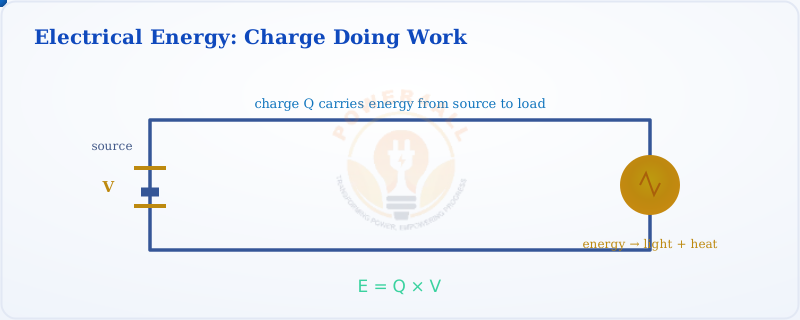
Electrical energy is the energy delivered by moving electric charge. When a source such as a battery pushes charge through a potential difference, it does work on that charge — and that work, transferred to the circuit, is electrical energy.
Energy is given the symbol E (or W for work) and is measured in joules (J). Every joule of electrical energy can become light, heat, sound or motion. The bigger the charge and the bigger the voltage it falls through, the more energy is delivered.
E = P × t
Energy (joules) = Power (watts) × time (seconds)
Energy vs power — the classic mix-up
Power is how fast energy is used (watts); energy is the total used over time (joules or kWh). A 2000 W kettle is powerful, but run for two minutes it uses far less energy than a 15 W bulb left on all day.
Energy, Power & Time
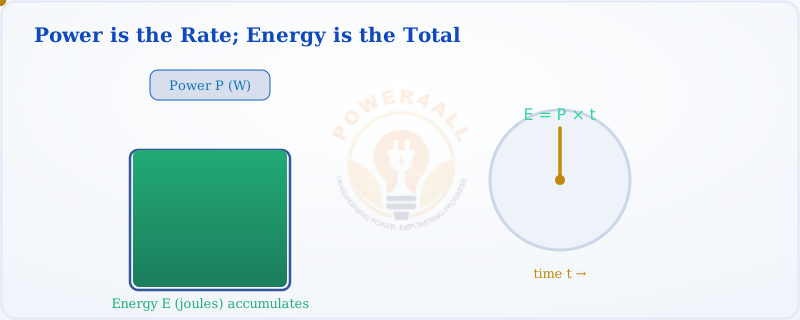
Power and energy are inseparable. Power is the rate of energy transfer — joules per second. Multiply that rate by how long it runs and you get the total energy: E = P × t.
Power (P)
The rate of energy use, in watts. 1 W = 1 joule per second. It tells you how hard a device works right now.
Energy (E)
The total transferred, in joules or kWh. E = P × t. It is what you actually pay for.
Time (t)
How long the power flows. Double the time and you double the energy for the same power.
Worked example 1 — energy from power and time
A 60 W bulb runs for 5 hours. In joules (5 h = 18000 s):
E = P × t = 60 × 18000 = 1,080,000 J = 1.08 MJ
In kilowatt-hours: E = 0.06 kW × 5 h = 0.3 kWh — the same energy, an easier number.
Energy Formulas: E = VIt = I²Rt = V²t/R
Because power itself can be written several ways with Ohm’s law, electrical energy has a whole family of equivalent formulas. Pick whichever matches the quantities you know.
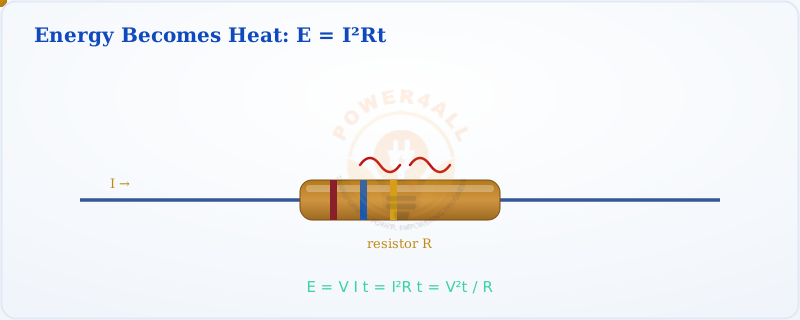
E = V I t = I² R t = V²t / R
All equal to P×t — use the form that matches your known values (V, I, R)
Know V and I
E = V × I × t — voltage times current times time.
Know I and R
E = I² × R × t — the heating (Joule) form.
Know V and R
E = (V² / R) × t — handy for a fixed supply voltage.
Worked example 2 — energy from a heater
A heater draws 5 A from 230 V mains for 2 hours (7200 s):
E = V I t = 230 × 5 × 7200 = 8,280,000 J ≈ 8.28 MJ = 2.3 kWh
Check via power: P = VI = 1150 W = 1.15 kW, so E = 1.15 × 2 = 2.3 kWh. ✓
Joules & the Kilowatt-Hour
The joule is the scientific unit, but it is tiny for everyday electricity — so bills use the far larger kilowatt-hour (kWh), the “unit” of electricity you see on your meter.
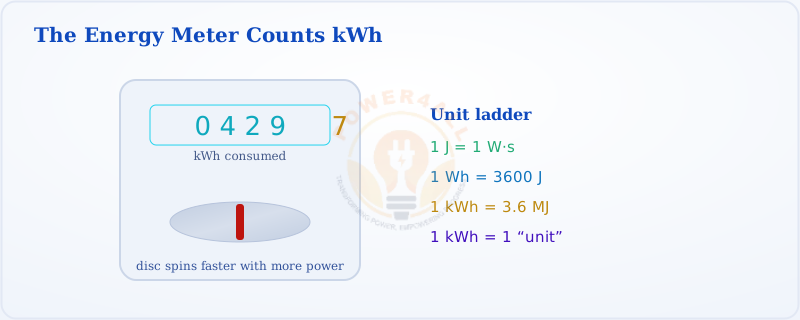
1 kWh = 1000 W × 3600 s = 3.6 × 10⁶ J
One kilowatt-hour = 3.6 megajoules = one “unit” of electricity
| Unit | Equals | Used for |
|---|---|---|
| Joule (J) | 1 watt-second | Physics, small energies |
| Watt-hour (Wh) | 3600 J | Batteries, small devices |
| Kilowatt-hour (kWh) | 3.6 × 10⁶ J | Home & industry bills |
| Calorie (cal) | 4.184 J | Heat energy |
| Electron-volt (eV) | 1.6 × 10⁻¹⁹ J | Atomic / electronics |
Convert between any of these instantly with the Energy Units Converter.
Storing Electrical Energy
Electrical energy can be stashed away and released later. Capacitors store it in an electric field, inductors in a magnetic field, and batteries in chemical bonds.
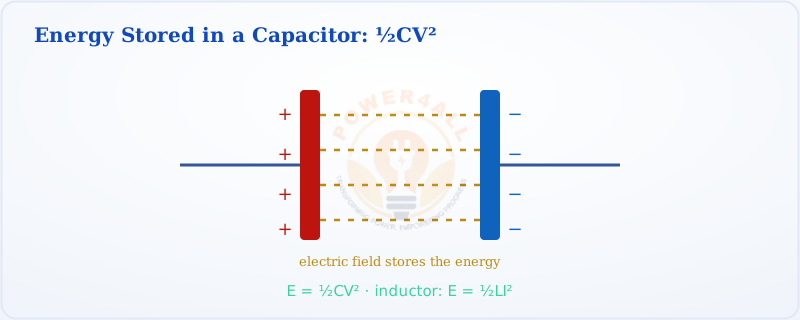
Capacitor
E = ½CV²
Stores energy in an electric field — fast to charge and discharge (camera flash, smoothing).
Inductor
E = ½LI²
Stores energy in a magnetic field — resists sudden current change (converters, chokes).
Battery
Stores energy chemically — huge capacity, measured in Wh or Ah, released slowly and steadily.
Work out stored energy with the Energy Stored Calculator.
Conversion & Efficiency
Energy is never destroyed — only converted. Electrical energy becomes light, heat, sound and motion. Efficiency measures how much becomes the form you actually wanted.
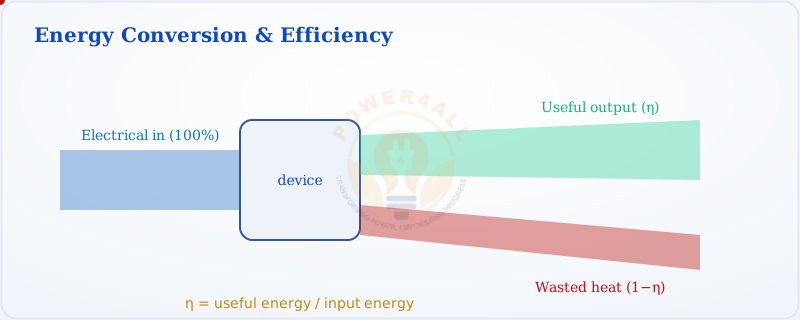
η = (useful energy out / energy in) × 100%
Efficiency η — the fraction of input energy delivered as useful output
To light
LEDs and lamps — LEDs convert most energy to light; incandescents waste it as heat.
To motion
Motors turn electrical energy into mechanical work — fans, pumps, EVs, machines.
To heat
Heaters, geysers, ovens — here heat is the goal, so efficiency is near 100%.
Measure conversion performance with the Energy Cost Calculator and the Solar kWh Generation Calculator.
Metering & Electricity Bills
Your electricity bill is simply electrical energy, priced. The meter counts kilowatt-hours, and the utility charges a tariff — a price per unit.
1. Power × time
Each appliance’s power (kW) times the hours it runs gives its energy in kWh.
2. Add up units
Sum the kWh of everything over the billing period — that is your total units.
3. Multiply by tariff
Total units × price per unit = the energy charge on your bill.
Worked example 3 — a simple bill
A 1.5 kW air-conditioner runs 8 hours/day for 30 days at ₹8 per unit:
Energy = 1.5 × 8 × 30 = 360 kWh
Cost = 360 × 8 = ₹2880 for the month.
Saving energy saves money
Because cost scales directly with kWh, cutting either power (efficient appliances) or time (switching off) cuts the bill in exactly the same proportion. Estimate yours with the Energy Cost Calculator.
Where Electrical Energy Powers Life
From the grid to the gadget, electrical energy is the most flexible, transportable form of energy we have.
Homes & industry
Lighting, heating, cooling, appliances and machines — all metered and billed in kWh.
Transport
Electric vehicles store energy in battery packs (kWh) and turn it into motion at high efficiency.
Renewables
Solar and wind generate electrical energy; storage banks the surplus for later use.
Electronics
Every chip and device runs on tightly-budgeted energy — battery life is an energy calculation.
Explore further with the Power Calculator and the Energy Units Converter.
Key Terms at a Glance
The essential electrical-energy vocabulary students and engineers search for.
Energy (E)
Capacity to do work, in joules (J). E = P×t.
Joule (J)
SI unit of energy; 1 J = 1 W·s.
Power (P)
Rate of energy use, in watts. P = E/t.
Kilowatt-hour (kWh)
Practical energy unit; 1 kWh = 3.6 MJ.
Efficiency (η)
Useful energy out ÷ energy in, as a percentage.
Tariff
Price charged per unit (kWh) of electricity.
Frequently Asked Questions
Quick, expert answers to the questions people ask most about electrical energy.
What exactly is electrical energy?
Electrical energy is the energy carried by moving charge. A source does work pushing charge through a potential difference, transferring energy to the circuit. It is measured in joules and equals power times time, E = P×t.
What is the unit of electrical energy?
The joule (J), where 1 J = 1 watt-second. For bills the larger kilowatt-hour is used: 1 kWh = 3.6 MJ, also called one “unit” of electricity.
What is the formula for electrical energy?
The core formula is E = P×t. With Ohm’s law it expands to E = VIt = I²Rt = V²t/R, and for charge moved through a voltage, E = QV.
What is the difference between energy and power?
Power is the rate of energy use (watts = joules/second); energy is the total transferred over time (joules or kWh). Energy = power × time. A 100 W bulb for 10 hours uses 1 kWh.
What is a kilowatt-hour (kWh)?
The energy a 1000 W appliance uses in one hour. It is what your meter counts and your bill charges for. 1 kWh = 3.6 MJ, often just called a unit of electricity.
How is energy stored in a capacitor or inductor?
A capacitor stores it in an electric field, E = ½CV²; an inductor stores it in a magnetic field, E = ½LI². Both give the energy back to the circuit later.
How do you calculate an electricity bill?
Multiply each appliance’s power (kW) by its running hours to get kWh, add them up, and multiply by the tariff (price per unit). E.g. 2 kW × 3 h = 6 kWh, at ₹8/unit = ₹48.
Is electrical energy conserved?
Yes — energy is only converted, never created or destroyed. Electrical energy becomes light, heat, sound and motion. Efficiency measures how much becomes the useful form; the rest (usually heat) is still energy.
Conclusion & Key Takeaways
Electrical energy is what electricity actually delivers — the work done by moving charge. Master E = P×t and the kWh, and both physics and your electricity bill make sense.
Work by moving charge
Measured in joules (J); E = QV.
E = P × t
Energy is power accumulated over time.
Many equivalent forms
E = VIt = I²Rt = V²t/R.
The kWh
1 kWh = 3.6 MJ = one unit on your bill.
Can be stored
½CV² in capacitors, ½LI² in inductors.
Always conserved
Converted to light, heat and motion; efficiency counts.