Complete Power Electronics Mastery Guide
Master the art of power conversion and control - from basic rectifiers to advanced AC-AC conversion techniques in modern electronic systems. Your comprehensive journey from fundamentals to cutting-edge applications.
Complete Learning Path - All Power Conversion Types
Navigate through comprehensive coverage of power electronics fundamentals to advanced applications
What is Power Electronics?
Power electronics is the technology of efficiently converting electrical power from one form to another using electronic devices. It combines electronics, power engineering, and control systems to process and control the flow of electrical energy in applications ranging from smartphone chargers to industrial motor drives and renewable energy systems.
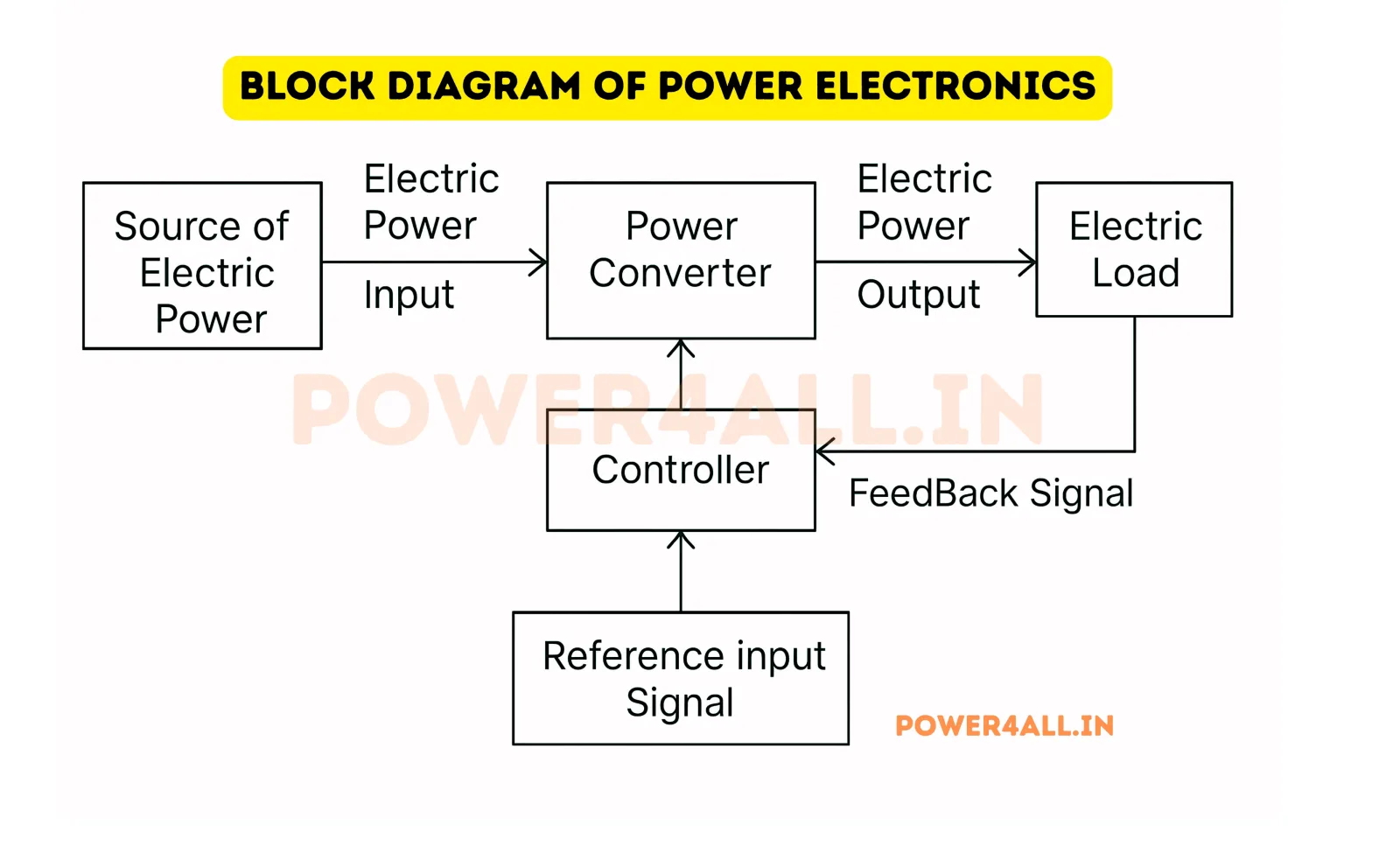
The Power Conversion Process
Power electronics works like electrical power transformation — it changes voltage, current, and frequency, and converts between AC and DC at 95–99% efficiency. You rely on it every day:
Everyday Examples of Power Electronics
- Phone charger: 120V/230V AC → 5V DC (AC–DC)
- Electric vehicle (EV): battery DC → variable-frequency AC for the motor (DC–AC)
- Solar inverter: panel DC → grid-synchronised AC (DC–AC)
- LED lights & laptop adapters: AC → low-voltage DC (AC–DC / DC–DC)
η = (P_out / P_in) × 100%
Efficiency is the key measure of power electronic performance — every 1% improvement saves significant energy and cost.
Power Electronics Fundamentals
Understanding power electronics requires grasping fundamental concepts of power conversion, switching techniques, and the behavior of power semiconductor devices under different operating conditions. These principles form the foundation for all power electronic applications, from simple rectifiers to complex grid-tied systems.
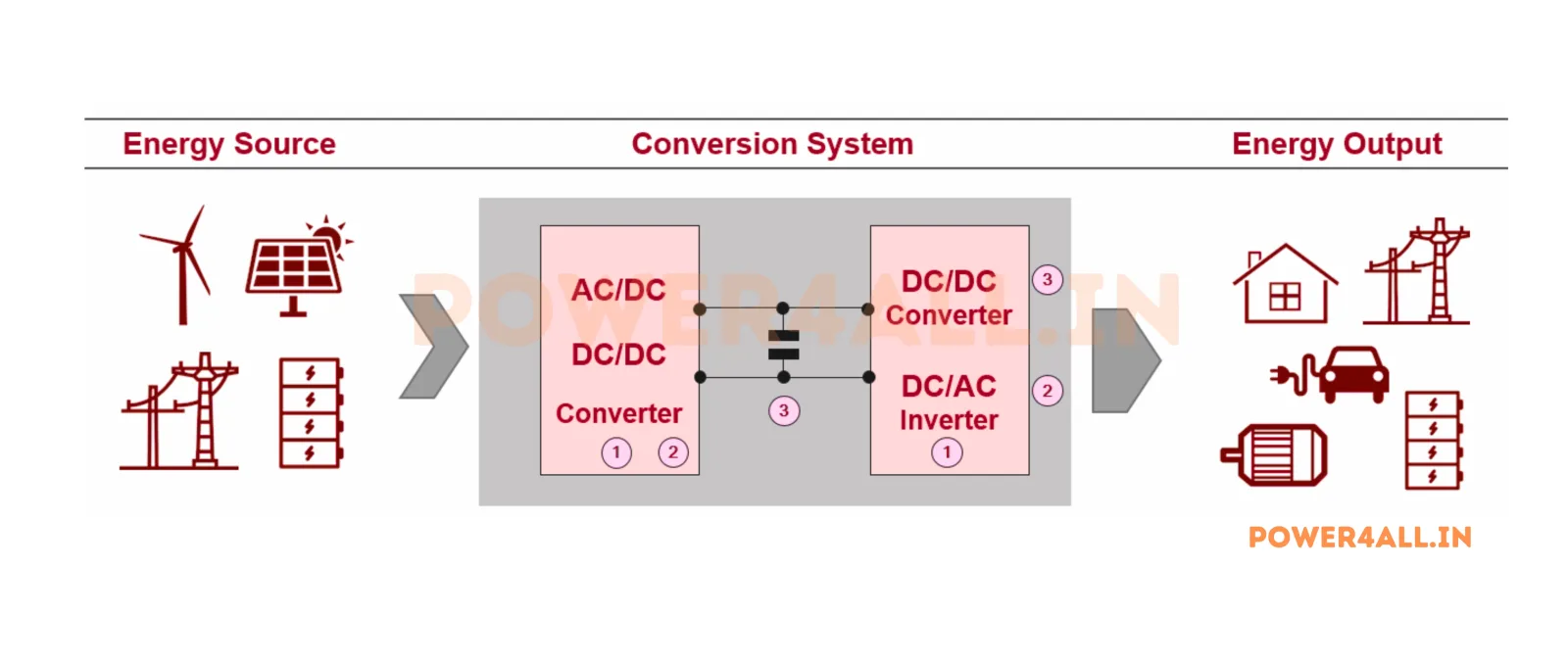
The Core Switching Principle
Power electronics reaches high efficiency by operating switches either fully ON or fully OFF, so very little power is wasted as heat. Linear regulation manages only 50–70% efficiency, while modern switching converters reach 85–98%.
P_loss = V_switch × I_switch
Loss is minimized when either V≈0 (ON) or I≈0 (OFF).
Four Main Power Conversion Types
AC to DC (Rectification)
Converting alternating current to direct current
Rectifier Classifications
- Uncontrolled (Diode): Fixed output voltage, simple, low cost, 80-85% efficiency
- Controlled (SCR/Thyristor): Variable output, phase control, 85-90% efficiency
- Active (MOSFET/IGBT): Power factor correction, low harmonics, 95-98% efficiency
- Synchronous: Active rectification with MOSFETs, highest efficiency
PF = P_real / P_apparent
Power factor is critical for grid compatibility
DC to AC (Inversion)
Converting direct current to alternating current
Inverter Classifications
- Voltage Source (VSI): PWM control, most common, 93-97% efficiency
- Current Source (CSI): Specialized industrial applications, robust
- Multilevel: High power, low harmonics, >99% efficiency
- Grid-tied: Synchronization with utility grid, smart features
THD = √(∑H²₂₋∞) / H₁
Total Harmonic Distortion measures output quality
DC to DC (Chopper)
Converting DC voltage to different DC voltage level
Topology Classifications
- Buck (Step-down): V_out < V_in, 90-98% efficiency
- Boost (Step-up): V_out > V_in, 85-95% efficiency
- Buck-Boost: V_out can be higher or lower, polarity inversion
- Isolated: Galvanic isolation using transformers, safety
V_out = D × V_in
Buck converter voltage relationship (D = duty cycle)
AC to AC (Cycloconverter)
Converting AC to different frequency/voltage AC
Conversion Methods
- Cycloconverters: Direct frequency conversion, 0-1/3 input frequency
- Matrix converters: Any input to any output frequency
- AC voltage controllers: Same frequency, variable voltage
Key Feature: Direct conversion without an intermediate DC stage
Power Semiconductor Devices
Power semiconductor devices are the heart of power electronics, acting as controllable switches that can handle high voltages and currents while switching at high speeds. Understanding their characteristics, limitations, and proper selection is crucial for designing efficient and reliable power electronic systems.
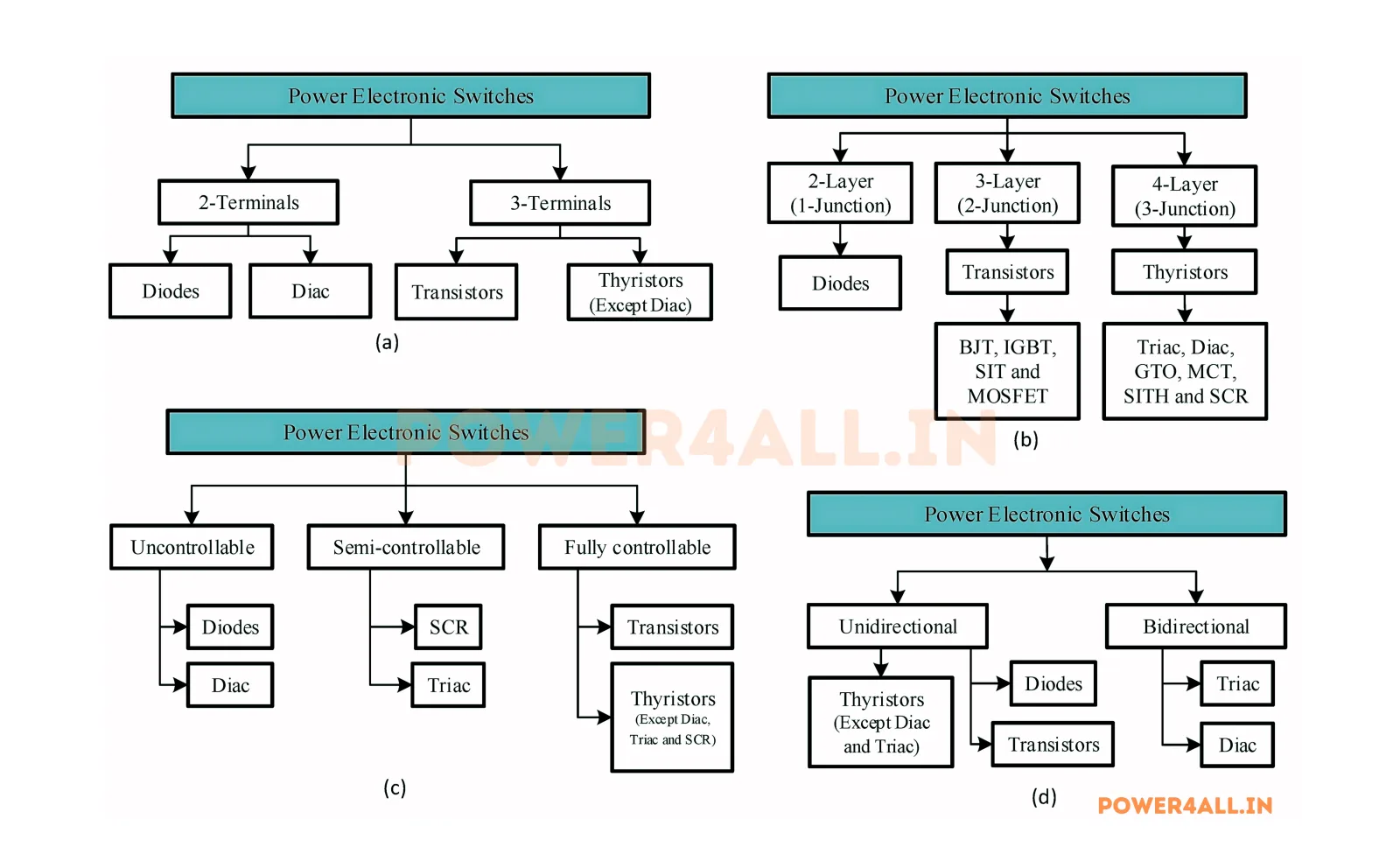
Device Categories by Control Capability
Uncontrolled Devices (Diodes)
Automatic one-way current flow based on voltage polarity
Power Diode Types & Applications
- Standard Recovery (>1μs): Line frequency applications, cost-effective
- Fast Recovery (50-200ns): High-frequency switching, reduced losses
- Schottky Diodes: Low forward drop (0.3V), very fast, low power
- SiC Diodes: High temperature (200°C), ultra-fast, efficient
Semi-Controlled (Thyristors)
Can be turned ON with gate signal, turn OFF naturally at zero current
Thyristor Family Members
- SCR (Silicon Controlled Rectifier): Basic thyristor, unidirectional
- TRIAC: Bidirectional thyristor, AC control applications
- GTO (Gate Turn-Off): Can be turned off with negative gate current
- MCT (MOS Controlled Thyristor): MOSFET gate drive capability
Fully Controlled Devices
Complete ON/OFF control with gate/base signals
Modern Power Switches
- Power MOSFET: Voltage controlled, very fast switching, low/medium power
- IGBT: Combines MOSFET + BJT benefits, medium/high power
- Power BJT: Current controlled, older technology, still used
- Wide Bandgap (SiC/GaN): Next-generation, ultra-efficient
Wide Bandgap Semiconductor Revolution
Silicon Carbide (SiC)
Revolutionary material properties for ultra-efficient power conversion
- EV powertrains — smaller and more efficient
- Solar inverters — 99%+ efficiency
- Data centers & industrial drives
Gallium Nitride (GaN)
Ultra-high frequency operation in compact packages
Unique Advantages
- Ultra-fast switching: MHz operation capability
- Low switching losses: Minimal energy waste during transitions
- Small form factor: Enables extremely compact designs
- High power density: More power in smaller packages
- Low gate charge: Easy to drive, fast switching
Power Converters Overview
Power converters are complete systems that transform electrical energy from one form to another with high efficiency and precise control. They combine power semiconductor devices, passive components, and intelligent control circuits.
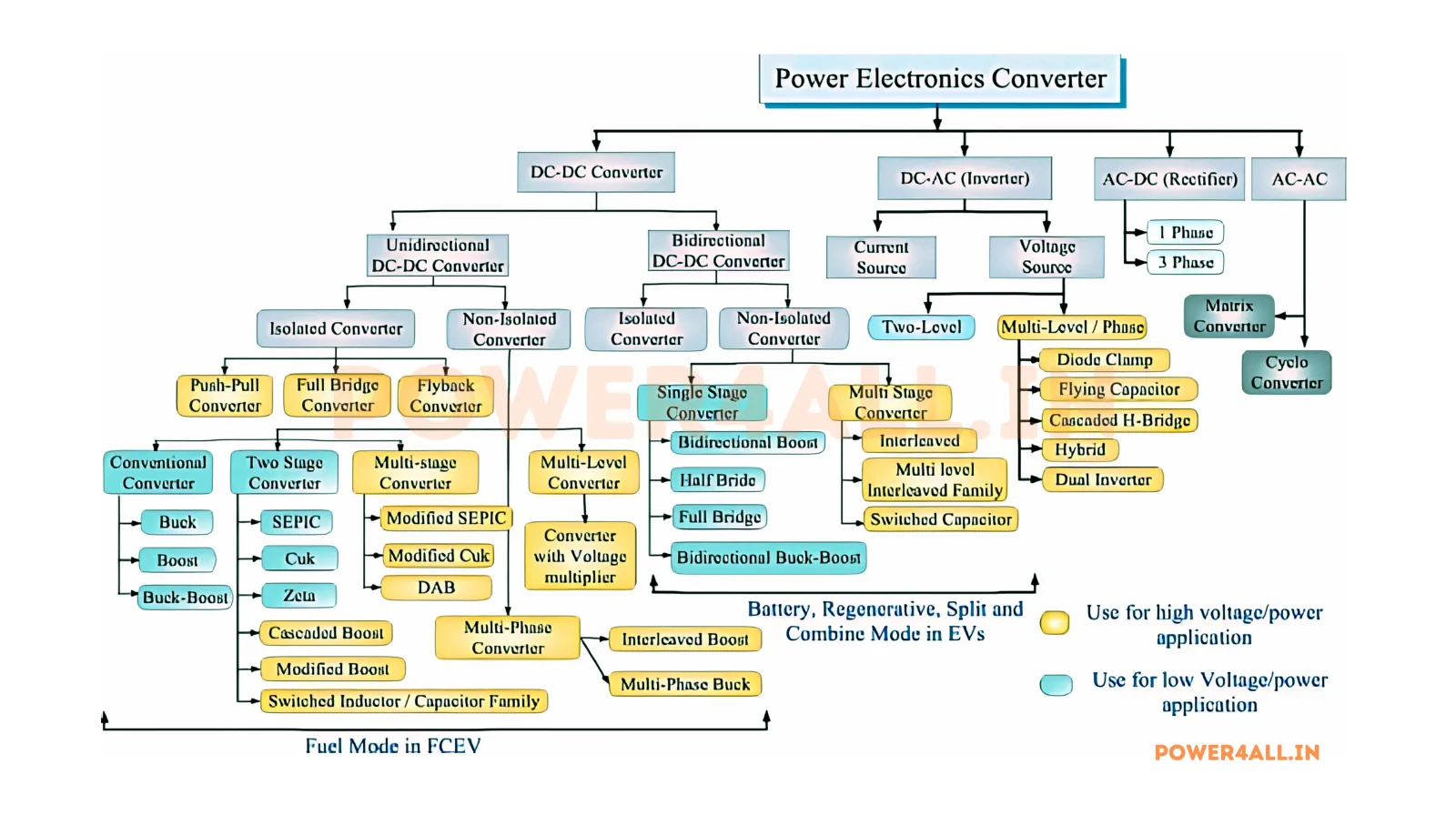
Converter System Architecture
A complete power converter combines four subsystems: a power stage (semiconductors, magnetics, capacitors), a control system (microcontroller/DSP with real-time feedback), protection circuits (over-current, over-voltage, thermal), and a monitoring interface for system integration.
Rectifiers: AC to DC Conversion
Rectifiers convert alternating current (AC) to direct current (DC) and form the foundation of most electronic systems.
Uncontrolled Rectifiers
Half-Wave Rectifier
V_dc = V_m / π ≈ 0.318 V_m
Average output voltage
- Efficiency: 40.6%
- Ripple factor: 1.21
- Use: Educational purposes only
Full-Wave Bridge
V_dc = 2V_m / π ≈ 0.636 V_m
Better utilization
- Efficiency: 81.2%
- Ripple factor: 0.48
- Use: Most common type
Controlled Rectifiers
Phase-Controlled Rectification
By controlling the firing angle (α) of thyristors, we can vary the output voltage.
V_dc = (2V_m / π) × cos(α)
Output voltage control through firing angle — used in DC motor drives, battery chargers and variable DC supplies.
Inverters: DC to AC Conversion
Inverters convert direct current (DC) to alternating current (AC) and are critical components in renewable energy systems, motor drives, and UPS systems.
Inverter Types by Waveform
Square Wave Inverters
V_rms = V_dc
Simple relationship
- THD: 48.3%
- Efficiency: 90-95%
- Cost: Lowest
- Use: Simple applications
Pure Sine Wave (PWM)
V_rms = M × V_dc / √2
Where M is modulation index
- THD: <3%
- Efficiency: 93-97%
- Cost: Highest
- Use: Critical applications
DC-DC Converters (Choppers)
DC-DC converters convert DC input voltage to a different DC output voltage level with high efficiency.
Basic Topologies
Buck Converter (Step-Down)
V_out = D × V_in
Where D is duty cycle
- Voltage gain: 0 < V_out/V_in < 1
- Efficiency: 85-95%
- Use: Laptop adapters, CPU voltage regulators
Boost Converter (Step-Up)
V_out = V_in / (1 - D)
Theoretical relationship
- Voltage gain: V_out/V_in > 1
- Efficiency: 80-95%
- Use: Solar MPPT, LED drivers
Buck-Boost & Advanced
V_out = -V_in × D / (1 - D)
Output polarity inverted
Isolated DC-DC Converters
For galvanic isolation and safety, isolated topologies use a high-frequency transformer: Flyback (1–150W, phone chargers), Forward (50–500W, PC power supplies), Full-Bridge (500W–10kW+, industrial), and LLC Resonant (soft switching for server PSUs and EV chargers).
AC-AC Cycloconverters
AC-AC converters directly convert alternating current from one voltage and/or frequency to another without an intermediate DC stage.
AC Voltage Controllers
Phase Control Method
AC voltage controllers use phase angle control to vary the RMS output voltage.
V_rms = V_m × √[(π - α + sin(2α)/2) / π]
For resistive loads with firing angle α — used in light dimmers, motor soft starters and heating control.
Variable Frequency Drives
Indirect AC-AC Conversion
AC → DC → AC with variable frequency
- Rectifier stage: AC to DC
- DC link: Energy storage
- Inverter stage: DC to variable AC
- Control system: V/f or vector control
Matrix Converters
Direct AC-AC conversion
- Bidirectional power flow
- Compact design
- Sinusoidal input/output
- Unity power factor
V_out_max = 0.866 × V_in
Maximum voltage transfer ratio
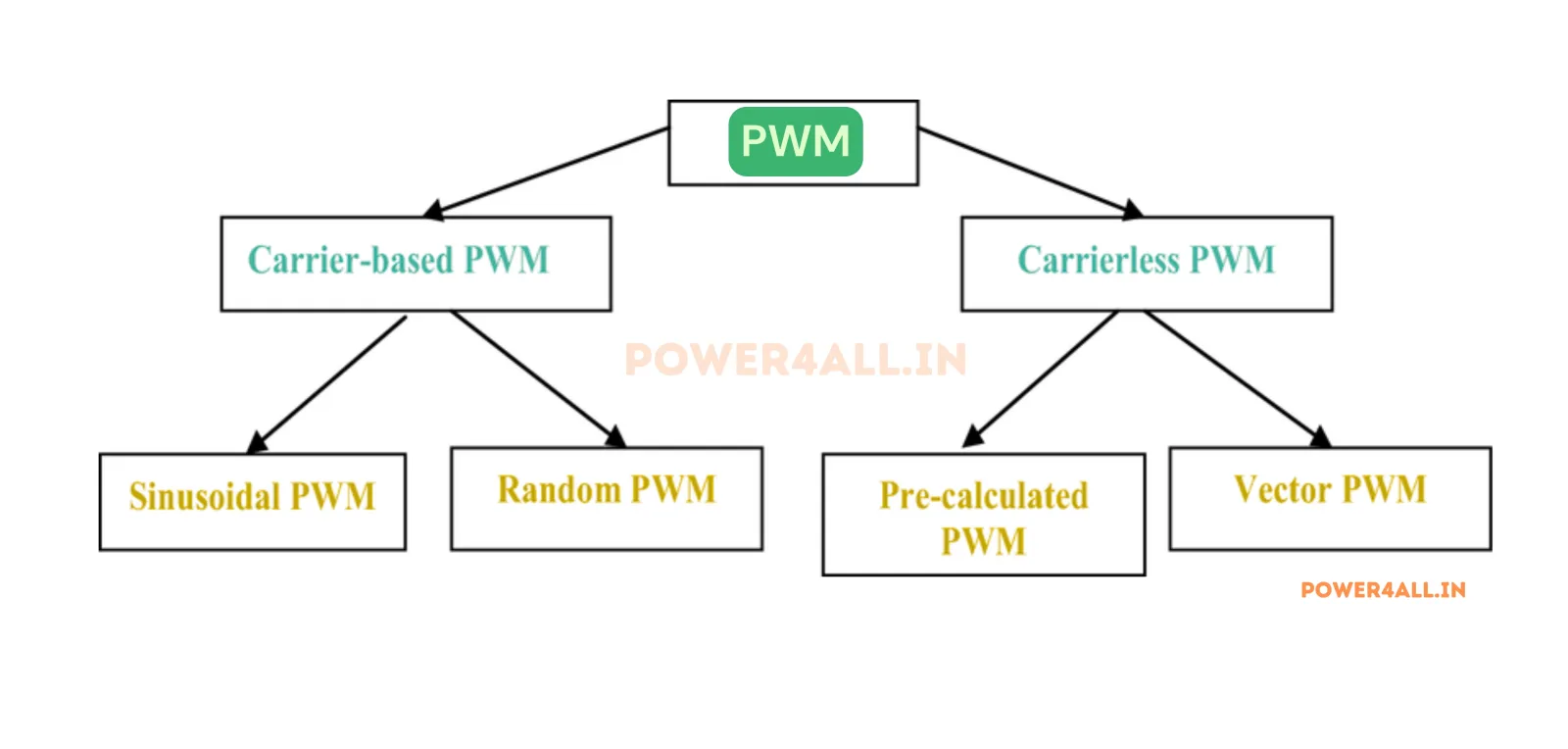
Control Techniques & PWM
Control techniques determine how switches operate to achieve desired output characteristics.
PWM Fundamentals
Basic PWM Principle
PWM controls the average power delivered by rapidly switching between ON and OFF states. The key parameters are switching frequency (1kHz–1MHz), duty cycle (0–100%), and dead time (50ns–2μs) to prevent shoot-through.
D = t_on / T
Duty cycle (D)
Advanced PWM Techniques
Sinusoidal PWM
- Linear modulation
- Low harmonic distortion
- Simple implementation
- 78.5% DC bus utilization
Space Vector PWM
- 15% better DC utilization
- Lower harmonic distortion
- Optimized switching
- Digital implementation
Practical Applications
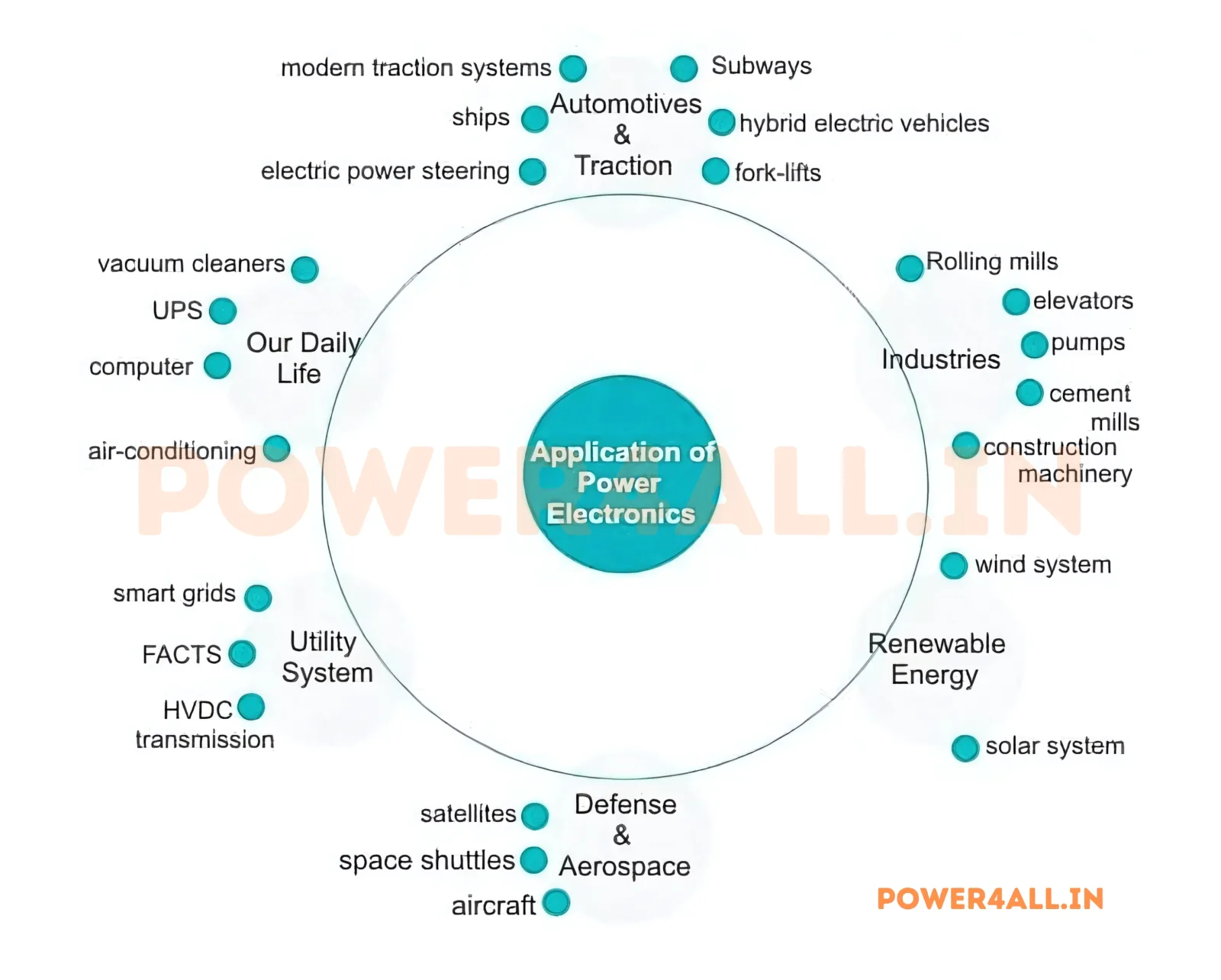
Power electronics revolutionized modern technology, from efficient lighting to electric vehicles and renewable energy systems.
Consumer Electronics
Mobile Device Charging
- USB PD: Up to 240W intelligent negotiation
- GaN chargers: 100W in palm-sized packages
- Wireless charging: Qi standard up to 50W
- Efficiency: >90% with modern designs
LED Lighting
- Efficiency: 130-200 lumens/watt
- Lifespan: 50,000+ hours
- Energy savings: 80-90% vs incandescent
- Control: Dimming, color tuning
Electric Vehicle (EV) Power Electronics
Every EV relies on power electronics: the traction inverter (50–400kW, SiC MOSFETs, >98% efficient), the onboard charger (3–22kW, PFC + LLC resonant), a DC-DC converter that steps the battery down to 12V, and public DC fast chargers (150–350kW).
Renewable Energy Systems
Solar Power
- String inverters: 1-100kW residential/commercial
- Microinverters: Panel-level optimization
- Power optimizers: Module-level MPPT
- Central inverters: MW-scale utility systems
Wind Power
- Power range: 2-15MW per turbine
- Converter efficiency: >97%
- Grid support: Voltage/frequency regulation
- Fault tolerance: Grid disturbance capability
Energy Storage
- Residential: 5-20kWh systems
- Commercial: Peak demand reduction
- Utility-scale: 100MWh+ grid storage
- Microgrids: Islanding capability
Safety Considerations
Safety is paramount in power electronics due to high voltages, currents, and stored energy.
Electrical Safety
| Voltage Level | Classification | Required Precautions | Applications |
|---|---|---|---|
| < 50V | Generally Safe | Basic insulation | Electronics, low voltage |
| 50-1000V AC | Low Voltage | Qualified personnel, PPE | Industrial equipment |
| 1-35kV | Medium Voltage | Specialized training | Distribution systems |
| > 35kV | High Voltage | Expert personnel | Transmission systems |
Protection Systems
Reliable designs include over-current protection (fuses and breakers), thermal protection (temperature monitoring and cooling), ground-fault protection (GFCI and insulation monitoring), and clear emergency shutdown procedures.
Frequently Asked Questions
Common questions about power electronics answered by experts.
What's the difference between power electronics and regular electronics?
Power electronics focuses on converting and controlling electrical power (watts to megawatts), while regular electronics processes information signals (milliwatts to watts).
| Aspect | Regular Electronics | Power Electronics |
|---|---|---|
| Function | Information processing | Energy conversion |
| Power | mW to W | W to MW |
| Focus | Speed, accuracy | Efficiency, reliability |
Why is efficiency so important in power electronics?
- Energy savings: 1% improvement in 1MW system saves $1000+ annually
- Heat reduction: Less cooling required, smaller systems possible
- Battery life: Longer operation in portable devices
- Environmental impact: Reduced power generation requirements
What skills are needed for a career in power electronics?
- Technical foundation: circuit analysis, electromagnetics, control systems, semiconductor physics
- Practical skills: PCB design, simulation tools, oscilloscope use, thermal analysis
- Programming: C/C++ for embedded systems, Python, FPGA
- Soft skills: project management, teamwork, problem-solving
Conclusion & Future of Power Electronics
Power electronics has evolved from simple rectification circuits to sophisticated systems enabling our modern digital world. As we face global challenges in energy efficiency and climate change, power electronics will play an increasingly critical role.
In short: power electronics is about efficient energy conversion using fast switching to reach 95–99% efficiency. From smartphone chargers to electric vehicles and renewable energy, it is everywhere in modern life — and wide-bandgap devices (SiC/GaN) keep pushing efficiency higher.
Keep Learning
Explore our detailed guides and free calculators to go deeper into rectifiers, inverters, converters and power semiconductor devices.
The future of energy is in your hands. The journey starts now.