Example 1: High-Voltage Step-Down (Matches Excel Sheet)
Given: Vs=325V, Vo=56V, Pout=840W, Ripple=10%, fsw=50kHz
- Duty Cycle: D = 56/(325+56) = 0.148 or 14.8%
- Output Current: Iout = 840/56 = 15.0A
- Current Ripple (ΔIL): 0.1 × 15 = 1.5A
- Voltage Ripple (ΔV): 0.1 × 56 = 5.6V
- Inductor (L1=L2): (325×0.148)/(0.2585×50000) = 0.00372 H = 3724.5 µH
- Capacitor (C1=C2): 0.2585/(4×50000×5.6) = 15.87 µF
- Load Resistor: 56/15 = 3.73 Ω
Example 2: Step-Up Mode
Given: Vs=12V, Vo=24V, Pout=48W, Ripple=20%, fsw=100kHz
- Duty Cycle: D = 24/(12+24) = 0.667 or 66.7%
- Output Current: Iout = 48/24 = 2.0A
- Current Ripple (ΔIL): 0.2 × 2 = 0.4A
- Voltage Ripple (ΔV): 0.2 × 24 = 4.8V
- Inductor (L1=L2): (12×0.667)/(0.4×100000) = 0.0002 H = 200 µH
- Capacitor (C1=C2): 0.4/(4×100000×4.8) = 0.000208 µF = 208 nF
- Load Resistor: 24/2 = 12 Ω
Example 3: Moderate Step-Down
Given: Vs=48V, Vo=24V, Pout=120W, Ripple=15%, fsw=75kHz
- Duty Cycle: D = 24/(48+24) = 0.333 or 33.3%
- Output Current: Iout = 120/24 = 5.0A
- Current Ripple (ΔIL): 0.15 × 5 = 0.75A
- Voltage Ripple (ΔV): 0.15 × 24 = 3.6V
- Inductor (L1=L2): (48×0.333)/(0.75×75000) = 0.000284 H = 284 µH
- Capacitor (C1=C2): 0.75/(4×75000×3.6) = 0.000694 µF = 694 nF
- Load Resistor: 24/5 = 4.8 Ω
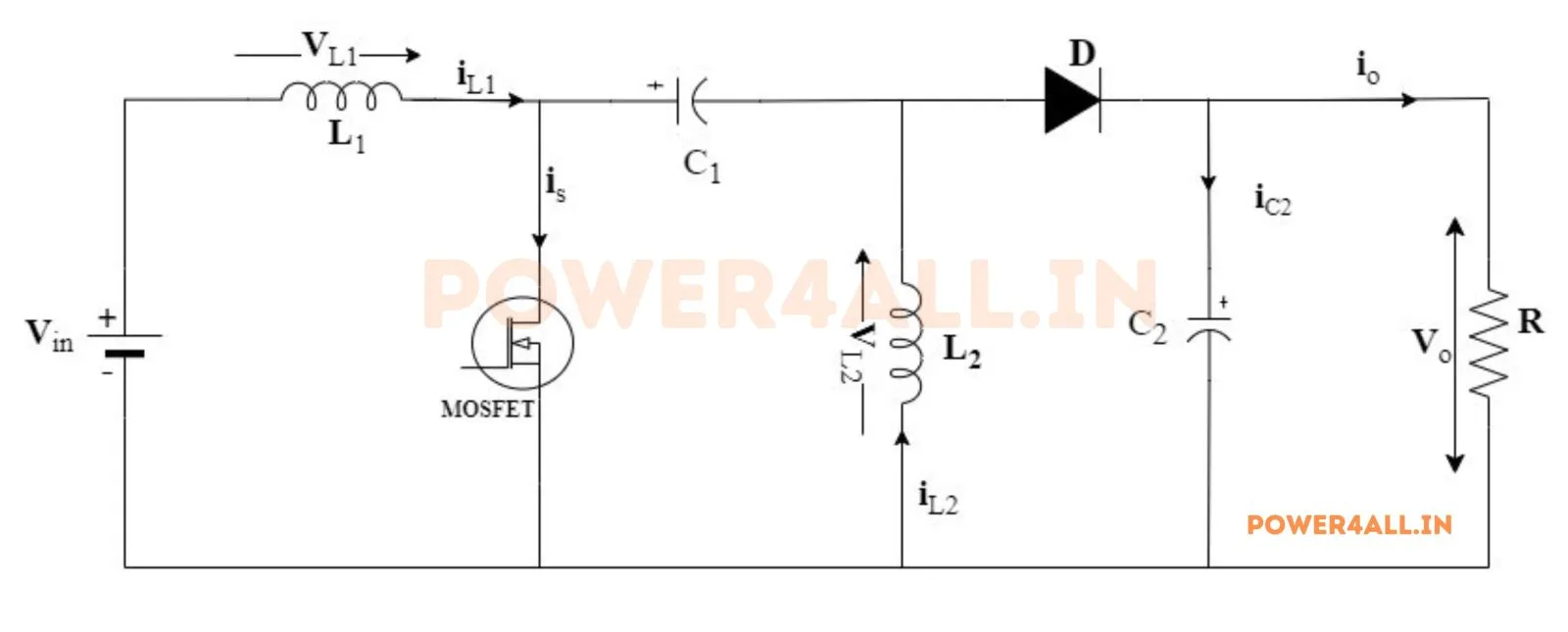
A SEPIC (Single-Ended Primary-Inductor Converter) is a DC-DC converter that can step voltage up or down while keeping the output the same polarity as the input — unlike the classic buck-boost, which inverts. This positive, wide-range output is what makes SEPIC so popular for battery and automotive supplies.
How it works
The SEPIC uses two inductors (often wound on a single core) linked by a coupling capacitor that blocks DC and transfers energy from input to output. When the switch is on, both inductors store energy; when it turns off, the coupling capacitor and the second inductor deliver that energy through the diode to the output. The DC relationship is Vout = Vin × D / (1 − D), so D < 0.5 steps down, D > 0.5 steps up, and D = 0.5 gives unity.
Why choose a SEPIC
Its standout feature is regulating cleanly through the point where input equals output. A 12 V rail from a car battery (which sags to 6 V on cranking and spikes to 15 V) is a textbook SEPIC job. The series coupling capacitor also provides natural input-to-output isolation for shorts and true output disconnect when the switch is off — something a boost cannot offer. The cost is more components (two inductors, a coupling capacitor) and higher ripple current in that capacitor, which must be rated for it.
Where SEPIC converters are used
Automotive 12 V accessory supplies, LED drivers that must run from a varying battery, portable and handheld devices, and any application that needs a fixed positive output from an input that swings above and below it.
Common questions
SEPIC vs boost? A boost can only step up; a SEPIC can step both up and down, and it disconnects the output when off. Choose SEPIC when the input can fall below the target.
SEPIC vs ZETA? Both give a positive step-up/step-down output. SEPIC places the switch at the input side (good for input-current control), while ZETA places it at the output side and generally gives lower output-voltage ripple.