ZETA Converter Calculator
Design and analyze ZETA (non-inverting buck-boost) DC-DC converters for power electronics.
Enter Design Parameters
Enter all parameters and click Calculate.
Given: Vin=12V, Vout=24V, Pout=48W, Ripple=10%, fsw=100kHz
Given: Vin=24V, Vout=12V, Pout=60W, Ripple=15%, fsw=75kHz
Given: Vin=20V, Vout=60V, Pout=72W, Ripple=10%, fsw=50kHz
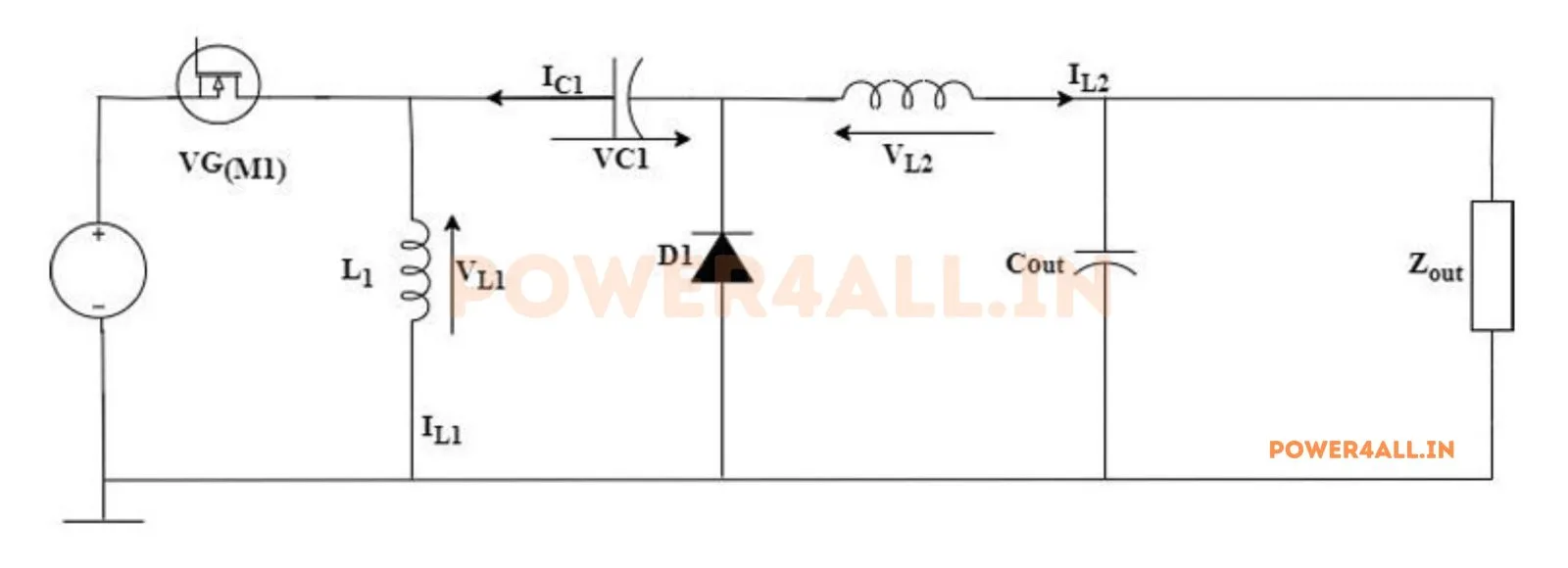
A ZETA converter is a DC-DC converter that can step voltage up or down while producing a positive, non-inverted output. It is closely related to the SEPIC — both use two inductors and a coupling capacitor — but the ZETA is arranged as the “dual” of the SEPIC, with the active switch on the input side referenced to the input and the output taken through the second inductor. The practical benefit is a well-filtered output with low voltage ripple.
During the switch-on time, energy is drawn from the input and stored in the inductors, and the coupling capacitor is charged. When the switch turns off, the coupling capacitor and the output inductor deliver energy to the load through the freewheeling path, maintaining a smooth output. The steady-state relationship is Vout = Vin × D / (1 − D), identical in form to the SEPIC: below 50% duty it bucks, above 50% it boosts.
Because the output inductor sits in series with the load, the ZETA delivers continuous, low-ripple output current, which is attractive for noise-sensitive loads and LED strings. The SEPIC, by contrast, has continuous input current (easier on the source and for PFC). Choosing between them usually comes down to whether you care more about clean output current (ZETA) or clean input current (SEPIC). The ZETA typically needs a robust input capacitor because its input current is pulsating.
LED lighting drivers, battery-powered instruments needing a quiet regulated rail, sensor and audio supplies where output ripple must be small, and automotive electronics that must hold a fixed positive voltage across a wide, fluctuating battery range.
Is the ZETA output inverted? No — like the SEPIC it keeps the output positive, unlike the classic buck-boost.
Can the two inductors share a core? Yes. As with the SEPIC, coupled inductors on one core are common and can reduce ripple, provided they are wound for the correct turns ratio and polarity.