Lenz's Law
The rule that fixes the direction of an induced current — it always opposes the change in magnetic flux that creates it. Lenz's law is the minus sign in Faraday's law ε = −N dΦ/dt, and it is conservation of energy in action. From the copper-tube demo to eddy-current braking.
Complete Learning Path — Lenz's Law
From the statement and formula, to direction, energy, eddy currents and applications
What is Lenz's Law?
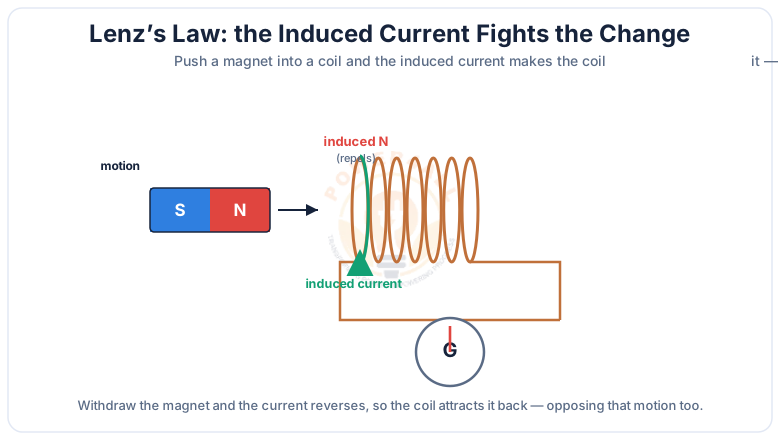
Lenz's law states that the direction of an induced current is always such that it opposes the change in magnetic flux that produced it. In plain words: whatever you do to change the flux through a loop, the induced current fights back.
Push a magnet toward a coil and the induced current turns the coil's near face into a like pole that repels the magnet. Pull the magnet away and the current reverses, making the coil attract it. Either way, the coil resists your motion — that resistance is Lenz's law, and it is why a generator takes effort to turn.
One sentence to remember
The induced current opposes the very change that causes it. If flux is rising, the current tries to keep it down; if flux is falling, the current tries to hold it up.
The Faraday-Lenz Formula
Lenz's law lives inside Faraday's law of induction as its minus sign. Faraday gives the size of the induced EMF; Lenz gives its direction.
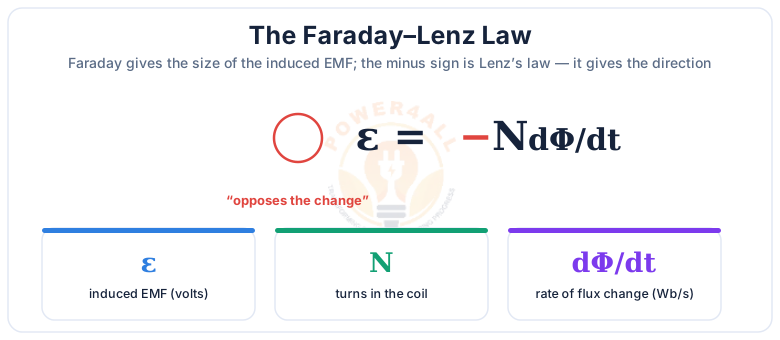
ε = −N · dΦ/dt
ε = induced EMF (V), N = number of turns, dΦ/dt = rate of change of magnetic flux (Wb/s)
Worked example
A 200-turn coil sees its flux change from 0.02 Wb to 0.05 Wb in 0.1 s.
Rate of change dΦ/dt = (0.05 − 0.02)/0.1 = 0.3 Wb/s. Induced EMF ε = −200 × 0.3 = −60 V. The magnitude is 60 V; the minus sign tells you the current flows to oppose the rising flux.
Approaching vs Leaving: Always Opposition
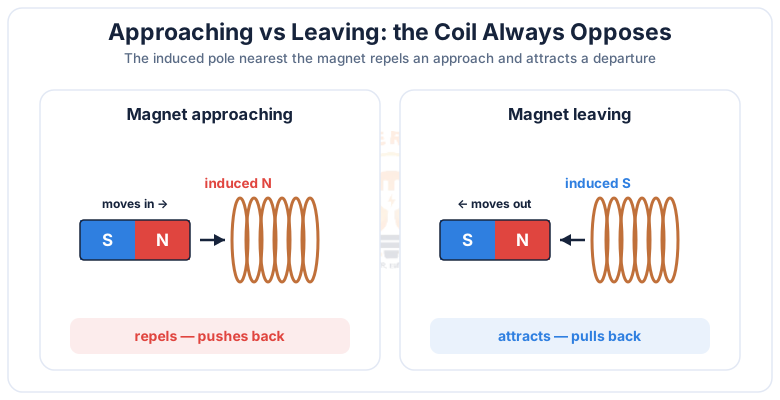
The clearest way to see Lenz's law is to compare a magnet moving in with a magnet moving out. The coil's induced pole always makes the wrong thing happen for you.
| Motion | Flux through coil | Induced near pole | Effect on magnet |
|---|---|---|---|
| Magnet approaches (N first) | Increasing | North | Repelled (pushed back) |
| Magnet leaves (N first) | Decreasing | South | Attracted (pulled back) |
Quick trick
"Like repels like on the way in; opposites attract on the way out." Either way you have to do work — which is exactly where the electrical energy comes from.
Lenz's Law & Conservation of Energy
Lenz's law is not an extra rule — it is conservation of energy applied to induction. The famous demo is a magnet dropped down a copper tube: it drifts down in slow motion.
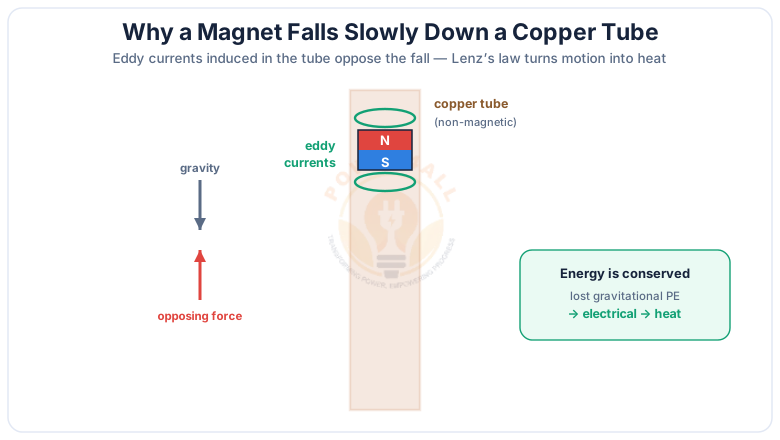
If the induced current instead helped the magnet fall, the magnet would speed up, generate more current, speed up further — free energy forever, which is impossible. The minus sign forbids it. To keep changing the flux you must push against the opposing force, and that mechanical work is the source of the electrical energy a generator delivers.
Why generators need a prime mover
Turning a generator induces currents that oppose the rotation (a braking torque). The engine, turbine or falling water must do work against that torque — that work becomes the electrical output. No opposition would mean electricity for free.
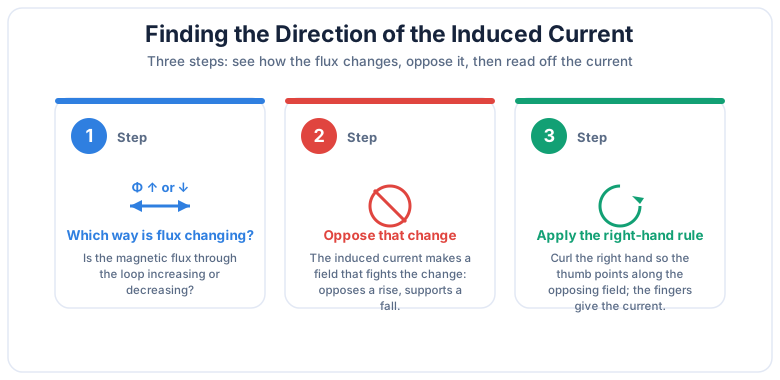
Finding the Direction of the Induced Current
Lenz's law gives a reliable three-step recipe for the direction of any induced current.
Worked example
A magnet's north pole moves toward a horizontal loop from above, so downward flux through the loop is increasing.
By Lenz's law the induced current must oppose the rise — it creates an upward field inside the loop. By the right-hand rule, that means the current flows anticlockwise when viewed from above, making the top face a north pole that repels the incoming magnet.
Eddy Currents & Real-World Applications
When the conductor is a solid block rather than a wire, the induced currents swirl as eddy currents — and Lenz's law makes them oppose the motion, which is enormously useful.
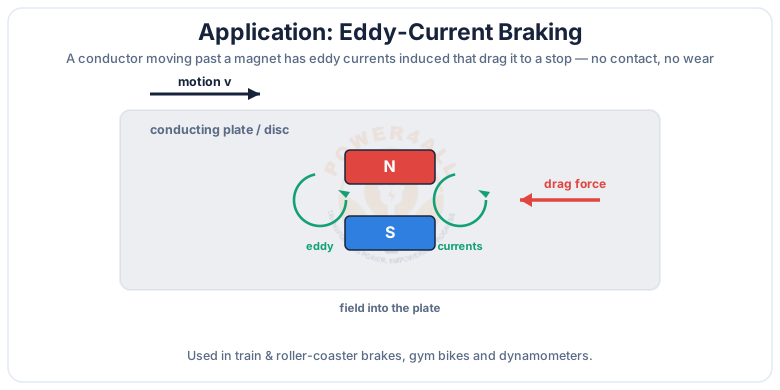
Eddy-current brakes
Trains, roller coasters and exercise bikes brake with no friction pads to wear out.
Induction heating
Induction cooktops and furnaces heat metal directly with eddy currents.
Metal detectors
Eddy currents in hidden metal disturb the field and reveal it.
Damping & meters
Eddy-current damping steadies analogue meters and balances.
Back-EMF in motors
Lenz's law creates the back-EMF that limits a motor's current.
Laminated cores
Transformer and motor cores are laminated to cut wasteful eddy-current loss.
Lenz's Law vs Faraday's Law
The two laws are partners: one gives the magnitude, the other the direction.
| Faraday's Law | Lenz's Law | |
|---|---|---|
| Tells you | How big the induced EMF is | Which way the current flows |
| In the formula | The N dΦ/dt part | The − (minus) sign |
| Rooted in | Rate of change of flux | Conservation of energy |
| Answer type | A number (volts) | A direction (opposition) |
Put them together and you get the complete Faraday-Lenz law: ε = −N dΦ/dt — the foundation of every generator, transformer and inductor. Explore Faraday's Law for the magnitude side in depth.
Key Terms at a Glance
The essential Lenz's-law vocabulary students search for.
Lenz's law
Induced current opposes the flux change.
Induced EMF
Voltage from changing flux, ε.
Magnetic flux (Φ)
Field × area through a loop (Wb).
Eddy currents
Swirling currents in a solid conductor.
Back-EMF
Opposing EMF in a running motor.
Right-hand rule
Turns field direction into current direction.
Frequently Asked Questions
Quick, clear answers to the questions people ask most about Lenz's law.
What is Lenz's law in simple terms?
When a changing magnetic field induces a current, that current always flows in the direction that opposes the change causing it. Push a magnet toward a coil and the induced current makes the coil push back; pull it away and the current tries to pull it back. Nature resists the change.
What is the formula for Lenz's law?
It is the minus sign in the Faraday-Lenz law: ε = −N dΦ/dt, where ε is the induced EMF, N the number of turns and dΦ/dt the rate of change of flux. Faraday gives the size; the minus sign (Lenz) gives the direction — it opposes the change.
Why is there a negative sign in Faraday's law?
The negative sign is Lenz's law. It shows the induced EMF and current oppose the change in flux that created them. Without it an induced current would reinforce the change and create energy from nothing, so the minus sign keeps the law consistent with conservation of energy.
How does Lenz's law relate to conservation of energy?
It is conservation of energy applied to induction. Because the induced current opposes the motion, you must do work against that opposing force, and that work becomes the electrical energy generated (then heat). If the current helped the motion, energy would appear from nowhere — impossible.
What is the difference between Faraday's law and Lenz's law?
Faraday's law gives the magnitude of the induced EMF from the turns and the rate of flux change. Lenz's law gives its direction: the induced current opposes the change. Together they form ε = −N dΦ/dt.
How do you find the direction of an induced current?
First, decide whether the flux through the loop is increasing or decreasing. Second, the induced current must make a field that opposes that change (opposes a rise, supports a fall). Third, apply the right-hand rule to turn that opposing field into the current's direction.
Why does a magnet fall slowly through a copper tube?
The falling magnet induces eddy currents in the copper walls, and by Lenz's law they oppose the fall with an upward drag force. Even though copper is non-magnetic, this braking slows the magnet dramatically, and the lost potential energy turns into heat in the tube.
What are eddy currents?
Eddy currents are loops of current induced inside a solid conductor when the flux through it changes. By Lenz's law they oppose the change. They are useful for braking and induction heating, but cause losses in transformer and motor cores, which is why those cores are laminated.
What are the applications of Lenz's law?
Eddy-current brakes in trains and roller coasters, induction cooktops and furnaces, metal detectors, electromagnetic damping in meters, the back-EMF that limits motor current, and the eddy-current losses engineers design out of laminated cores.
Does Lenz's law violate conservation of energy?
No — it is what enforces it. Because the induced effects oppose the change, energy must be supplied to keep the change going, and it reappears as electrical energy and heat. A current that reinforced the change would violate conservation of energy, which is why it never happens.
Conclusion & Key Takeaways
Lenz's law is the direction rule of induction: the induced current always opposes the change that makes it — nature's way of conserving energy.
Opposes the change
Current fights the flux change.
ε = −N dΦ/dt
The minus sign is Lenz's law.
Repel in, attract out
The coil always resists motion.
Energy conserved
Work in → electricity → heat.
Eddy currents
Braking, heating, detection.
Faraday's partner
Size from Faraday, direction from Lenz.