Loop & Branch Analysis
The complete guide to the two workhorse methods for solving any circuit with Kirchhoff’s laws — the branch current method and the loop (mesh) current method. From the meaning of a branch, node, loop and mesh, to counting independent loops with L = b − n + 1, to a fully worked two-loop example.
Complete Learning Path — Loop & Branch Analysis
From terminology, to the two methods, counting independent loops, a worked example and a comparison with nodal analysis
What is Loop & Branch Analysis?
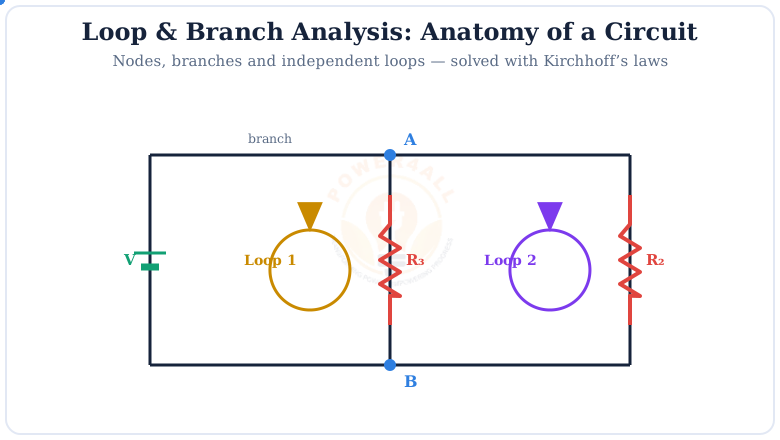
Loop and branch analysis are the two systematic ways to solve a circuit that is too complex for simple series–parallel rules. Both turn the circuit into a set of simultaneous equations using Kirchhoff’s laws and Ohm’s law, then solve for the unknown currents.
The branch current method assigns a current to every branch and uses both of Kirchhoff’s laws (KCL and KVL). The loop (mesh) current method assigns a circulating current to each independent loop and uses only KVL — usually the faster route. Together they underpin mesh analysis and complement nodal analysis.
Why we need it
A single loop is just Ohm’s law. But add a second source or a bridging branch and the currents interact — you can no longer “collapse” the network. Loop and branch analysis handle any linear circuit, no matter how tangled.
Branch, Node, Loop & Mesh
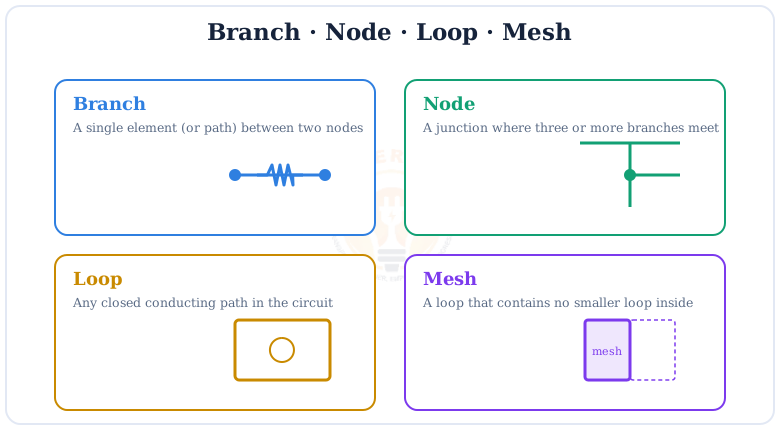
Get these four words right and the rest is easy — they define exactly what your equations count.
| Term | Meaning | Counts as |
|---|---|---|
| Branch | A single element (or unbroken path) between two nodes | One unknown current |
| Node | A junction where three or more branches meet | One KCL equation |
| Loop | Any closed conducting path | A possible KVL equation |
| Mesh | A loop that encloses no smaller loop (a “window pane”) | The natural independent loop |
Essential vs ordinary nodes
Only essential nodes (three or more branches) matter for KCL. A simple corner where two wires just bend is not a real node — the same current flows straight through.
The Branch Current Method
The most direct method: give every branch its own current, then let Kirchhoff’s two laws pin them all down.
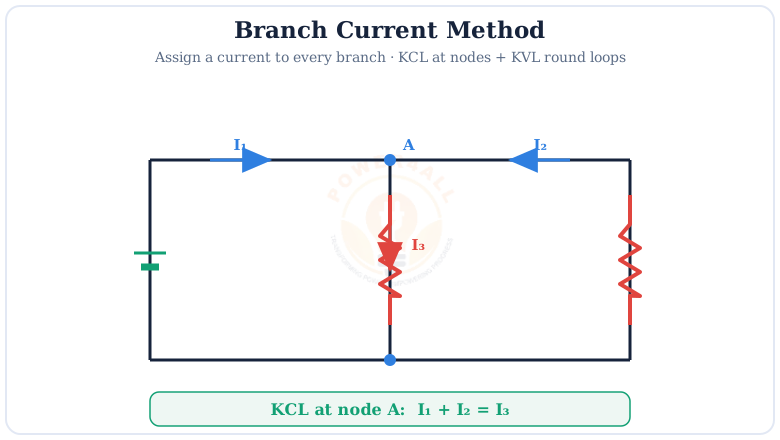
- Label an unknown current, with an assumed direction, in each branch.
- Write KCL at each essential node (
n−1independent equations). - Write KVL around each independent loop (
b−n+1equations), using V = IR for each resistor. - Solve the simultaneous equations. A negative answer just means the real current flows opposite to your guess.
How many equations?
A circuit with b branches has b unknown currents. KCL gives n−1 and KVL gives b−n+1 — together exactly b equations. The maths always closes.
The Loop (Mesh) Current Method
A slicker approach: assign a circulating current to each loop. KCL is then satisfied automatically, so you only ever write KVL.
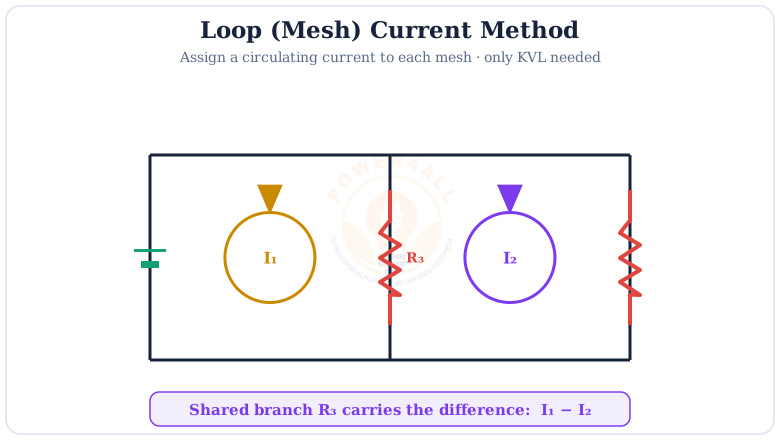
- Identify the independent loops (usually the meshes) and give each a clockwise loop current.
- Write KVL around each loop. For a shared branch, its current is the difference of the two loop currents.
- Solve the
b−n+1equations for the loop currents. - Get any branch current by combining the loop currents that pass through it.
Why it’s faster
Because each loop current automatically enters and leaves every node, KCL is built in. You solve b−n+1 equations instead of b — fewer unknowns, less algebra.
How Many Independent Loops? L = b − n + 1
You can draw endless loops in a big circuit, but only a fixed number are truly independent. Graph theory gives the exact count.
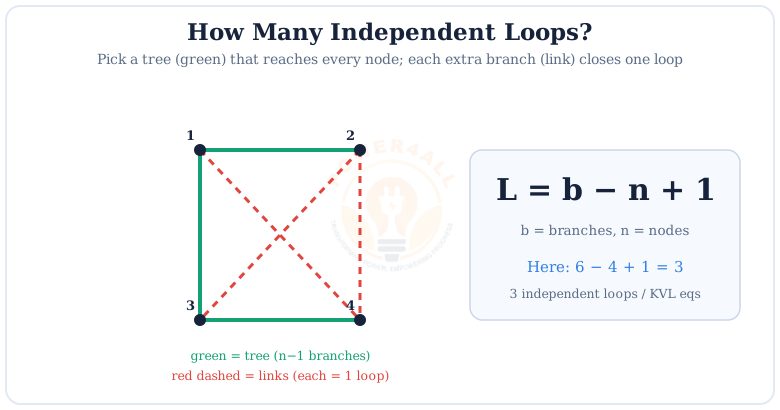
L = b − n + 1
L = independent loops (KVL equations) · b = branches · n = nodes
Pick a tree connecting all nodes with no loops (it needs n−1 branches). The leftover branches are links; adding any one link back to the tree creates exactly one loop. So the number of independent loops is b−(n−1) = b−n+1.
Worked Example: a Two-Loop Circuit
Let’s solve a real two-source, two-loop circuit end to end with the branch current method.
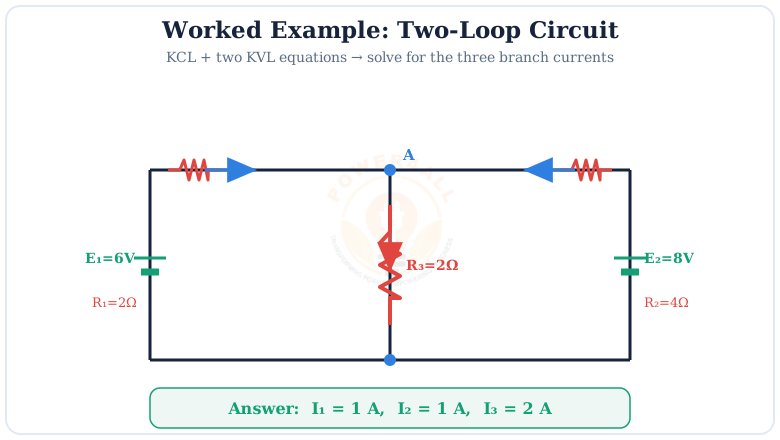
Step 1 — assign currents & write KCL
Let I₁ flow in from the left source, I₂ from the right, and I₃ down through R₃. KCL at node A: I₁ + I₂ = I₃.
Step 2 — write KVL for each loop
Loop 1 (left): E₁ = I₁R₁ + I₃R₃ → 6 = 2I₁ + 2I₃
Loop 2 (right): E₂ = I₂R₂ + I₃R₃ → 8 = 4I₂ + 2I₃
Step 3 — substitute I₃ = I₁ + I₂ and solve
6 = 2I₁ + 2(I₁+I₂) = 4I₁ + 2I₂ → 2I₁ + I₂ = 3
8 = 4I₂ + 2(I₁+I₂) = 2I₁ + 6I₂ → I₁ + 3I₂ = 4
Solving the pair: I₁ = 1 A, I₂ = 1 A, I₃ = 2 A. All positive, so every assumed direction was correct.
Check with Ohm’s law
Voltage across R₃ = I₃R₃ = 2×2 = 4 V. Loop 1: 2(1) + 4 = 6 V = E₁ ✓. Loop 2: 4(1) + 4 = 8 V = E₂ ✓. The mesh method gives the same answers.
Loop / Branch vs Nodal Analysis
All three methods give the same answer — the smart choice is the one with the fewest unknowns.
| Method | Unknowns | Laws used | Best when… |
|---|---|---|---|
| Branch current | b branch currents | KCL + KVL | You want every branch current directly |
| Loop / mesh | b−n+1 loop currents | KVL only | Voltage sources; few loops |
| Nodal | n−1 node voltages | KCL only | Current sources; few nodes |
Rule of thumb: if the circuit has fewer loops than nodes, reach for loop/mesh; if it has fewer nodes than loops, reach for nodal. For source transformation and reducing a network first, see Thévenin’s theorem.
Tips, Sign Rules & Pitfalls
Most mistakes in loop analysis are sign errors, not algebra. Keep these habits.
Pick one direction
Make all loop currents clockwise, then be ruthless about signs — consistency beats intuition.
Rise vs drop
Going through a source from − to + is a rise (+E); through a resistor with the current is a drop (−IR).
Shared branches
A branch in two meshes carries the difference of the loop currents — watch which way.
Current sources
A source between two loops needs a supermesh: one KVL round both, plus a current constraint.
Key Terms at a Glance
The essential loop-and-branch vocabulary students and engineers search for.
Branch
Element/path between two nodes.
Node
Junction of 3+ branches.
Mesh
Loop with no loop inside.
Loop current
Circulating current per loop.
L = b−n+1
Number of independent loops.
Supermesh
Two loops merged over a current source.
Frequently Asked Questions
Quick, exam-ready answers to the questions people ask most about loop and branch analysis.
What is loop and branch analysis?
Two systematic ways to solve a circuit with Kirchhoff’s laws. The branch current method assigns an unknown current to every branch and uses KCL at nodes and KVL round loops. The loop (mesh) current method assigns a circulating current to each independent loop and uses only KVL, usually giving fewer equations.
What is the difference between a branch, node, loop and mesh?
A branch is a single element or path between two nodes; a node is a junction of three or more branches; a loop is any closed path; a mesh is a loop that encloses no smaller loop — like a single window pane of the circuit.
What is the branch current method?
You assign a separate current to every branch, write KCL at each independent node (n−1 equations) and KVL round each independent loop (b−n+1 equations), then solve the simultaneous set. A negative result means the true current is opposite to your assumed direction.
What is the loop or mesh current method?
You assign a circulating current (usually clockwise) to each independent loop and write KVL once per loop. A branch shared by two loops carries the difference of the two loop currents. It needs only b−n+1 equations and no separate KCL, so it is usually quicker.
How many independent loop equations are needed?
The number of independent loops is L = b − n + 1, where b is branches and n is nodes. You also get n−1 independent KCL equations. Together they give exactly b equations for the b branch currents.
What is the difference between mesh analysis and loop analysis?
Mesh analysis is loop analysis for planar circuits where the chosen loops are the meshes (smallest window-pane loops). General loop analysis can use any independent set of b−n+1 loops and works even for non-planar circuits. For planar circuits both agree.
When should I use loop analysis instead of nodal?
Prefer loop/mesh when the circuit has fewer loops than nodes, or is dominated by voltage sources; prefer nodal when it has fewer nodes than loops, or is dominated by current sources. Both are correct — pick the one with fewer unknowns.
Which laws does the method use?
Kirchhoff’s laws and Ohm’s law. KCL: currents into a node sum to zero. KVL: voltage changes round a closed loop sum to zero. Ohm’s law V = IR relates each resistor’s voltage to its current.
How does loop analysis handle current sources?
A current source in a single loop simply fixes that loop current. A current source shared by two loops needs a supermesh: write one KVL around the outside of both loops, then add the constraint that the two loop currents differ by the source current.
Branch current or mesh current — which is better?
Mesh (loop) current is usually better because it needs fewer equations (b−n+1 instead of b) and no separate KCL. Use the branch current method when you specifically need every individual branch current laid out explicitly.
Conclusion & Key Takeaways
Loop and branch analysis turn any linear circuit into simultaneous equations you can always solve — the core skill of network analysis.
Two methods
Branch current & loop current.
Kirchhoff’s laws
KCL at nodes, KVL round loops.
L = b−n+1
Count independent loops.
Loop = faster
Fewer unknowns, KVL only.
Shared branch
Carries I₁ − I₂.
Same answer
Loop, branch & nodal agree.