Delta-Wye (Star-Delta) Transformation
Swap a triangle (Δ) of three resistors for an equivalent star (Y) — and back — without changing anything at the three terminals. The trick that cracks bridge circuits that have no series or parallel path.
Complete Learning Path — Delta-Wye Transformation
From the two networks and the conversion formulas, to the balanced case, bridge circuits and uses
What Is the Delta-Wye Transformation?
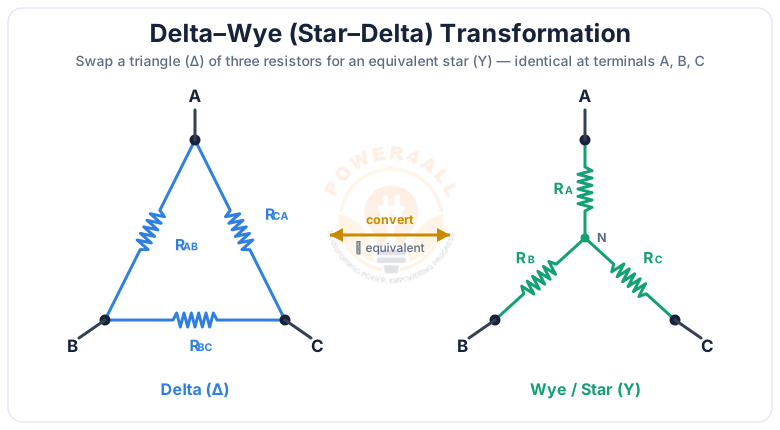
The Delta-Wye (or Star-Delta) transformation swaps a triangle of three resistors for an equivalent star of three resistors, or the other way round. The two blocks are chosen so that the resistance between every pair of the three terminals A, B and C is identical — so the rest of the circuit behaves exactly the same.
Why bother? Because many circuits — the classic example being a bridge network — have no resistors in simple series or parallel. Converting one delta into a wye (or vice versa) breaks the deadlock and turns an "unsolvable" circuit into a plain series-parallel one.
Names you'll see
Delta = triangle = π (pi) network. Wye = star = T network. "Delta-Wye", "Star-Delta", "Δ-Y" and "π-T" all describe the same transformation.
The Delta (Δ) Network
In a delta connection the three resistors form a closed triangle between the terminals — one resistor on each side, and no central node.
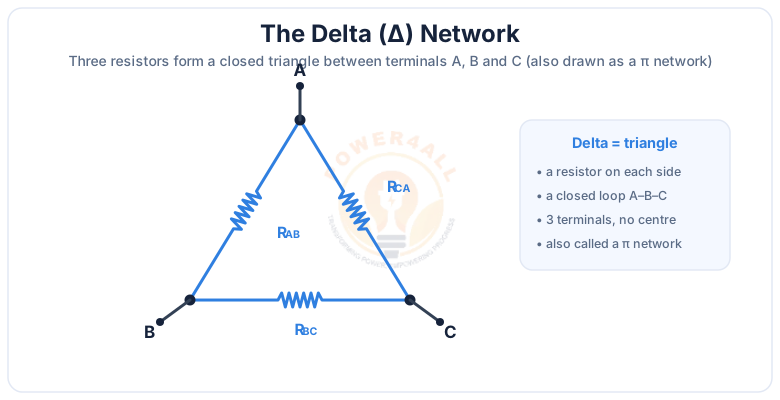
Because every terminal connects to the other two through a resistor, a delta is a closed loop. There is no neutral or star point to tap — which is exactly why some circuits are easier to analyse after converting it to a wye.
The Wye / Star (Y) Network
In a wye (or star) connection each resistor runs from one terminal to a common central node N — the star or neutral point.
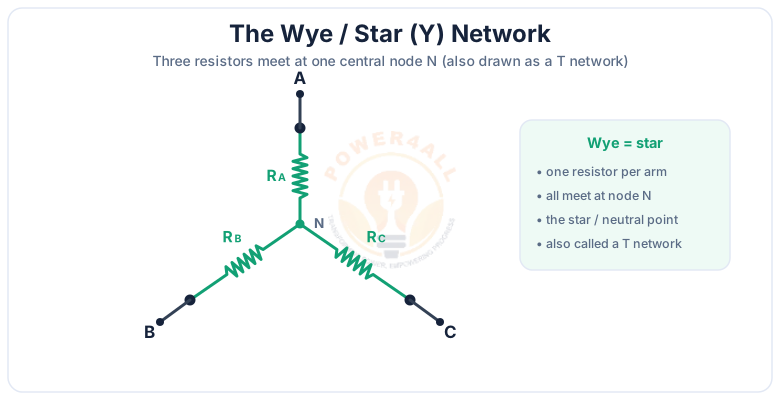
The central node gives the wye an extra connection point that a delta does not have. In three-phase systems this is the neutral point, and converting between star and delta is an everyday task.
Delta → Wye Conversion Formulas
To go from delta to wye, each star resistor is the product of the two adjacent delta resistors divided by the sum of all three.
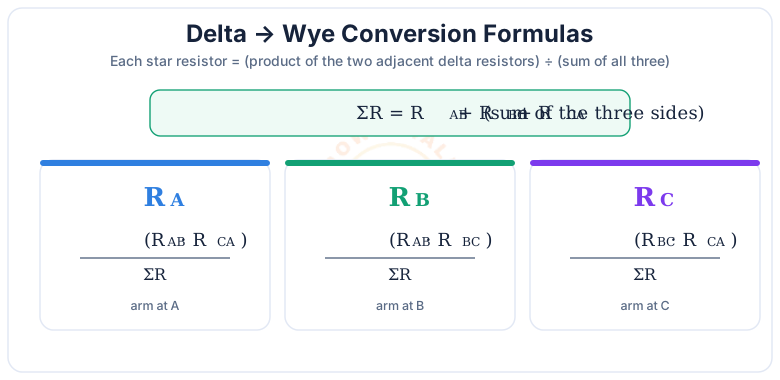
RA = RABRCA / ΣR · RB = RABRBC / ΣR · RC = RBCRCA / ΣR
ΣR = RAB + RBC + RCA; each star arm = product of the two delta sides meeting at that terminal, over ΣR
Worked example
A delta has RAB = 10 Ω, RBC = 20 Ω, RCA = 30 Ω. Sum ΣR = 60 Ω.
RA = (10×30)/60 = 5 Ω, RB = (10×20)/60 = 3.33 Ω, RC = (20×30)/60 = 10 Ω. Check it instantly with the Delta-Wye Calculator.
Wye → Delta Conversion Formulas
Going the other way, each delta resistor is the sum of the pairwise products of the star resistors divided by the opposite arm.
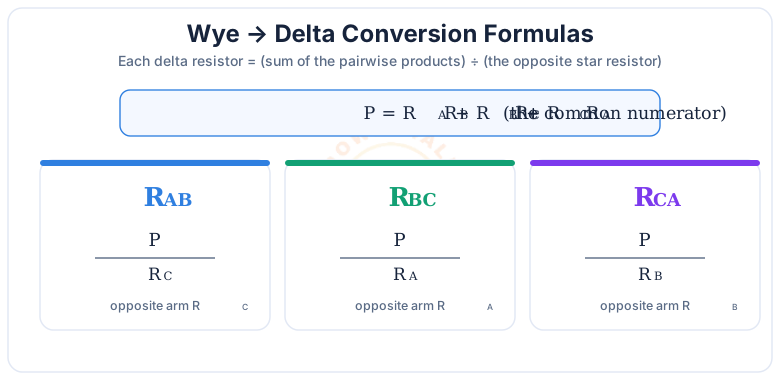
RAB = P / RC · RBC = P / RA · RCA = P / RB where P = RARB + RBRC + RCRA
Each delta resistor uses the same numerator P and divides by the star resistor opposite it
Worked example
Take the star from the example above: RA = 5 Ω, RB = 3.33 Ω, RC = 10 Ω. Then P = (5×3.33) + (3.33×10) + (10×5) ≈ 100.
RAB = 100/10 = 10 Ω, RBC = 100/5 = 20 Ω, RCA = 100/3.33 = 30 Ω — exactly the original delta. The two conversions are perfect inverses.
The Balanced Case: RΔ = 3RY
When all three resistors are equal, the formulas collapse to one memorable rule: the delta resistance is three times the wye resistance.
RΔ = 3 RY ⇔ RY = RΔ / 3
for a balanced network where all delta resistors equal RΔ and all wye resistors equal RY
Where the "factor of 3" shows up
This is the same factor of three behind a star-delta motor starter: starting a motor in star gives each winding less voltage and cuts the starting current to about one third, before switching to delta for full-power running.
Why It Matters: Solving a Bridge Circuit
The headline use of the transformation is the unbalanced bridge (Wheatstone) network, which has no resistors in plain series or parallel.
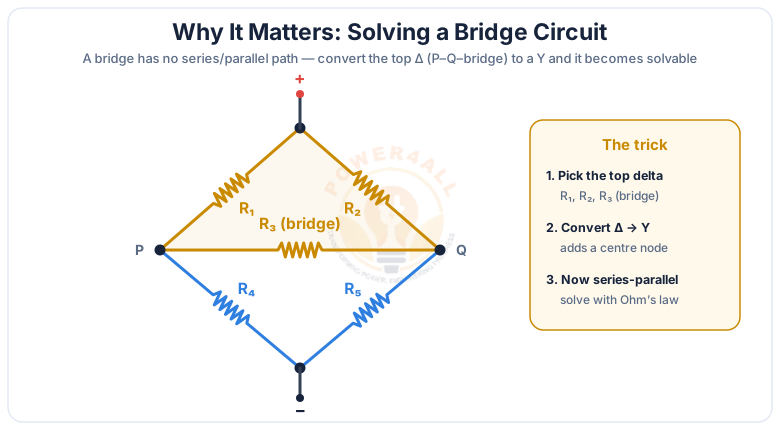
The method in three steps
1. Pick a delta — here the top three resistors R₁, R₂ and the bridge R₃.
2. Convert Δ→Y with the formulas above; this adds a new centre node.
3. The bridge is now series-parallel — combine the resistors and finish with Ohm's law. (Other methods such as mesh or nodal analysis also work, but Δ-Y is often the quickest by hand.)
Applications
The transformation appears anywhere three-terminal resistor or impedance blocks need simplifying.
Bridge circuits
Solve unbalanced Wheatstone bridges that have no series/parallel reduction.
Three-phase power
Convert star and delta connections of sources, loads and three-phase transformers.
Motor starters
Star-delta starting cuts inrush current to one third before switching to delta.
Filters & networks
π-to-T conversions in attenuators, matching networks and RF filters.
Power systems
Reduce meshed transmission networks for fault and load-flow studies.
Impedance blocks
The same formulas work for impedances (Z), not just resistors.
Key Terms at a Glance
The essential delta-wye vocabulary students and engineers search for.
Delta (Δ)
Triangle of 3 resistors; a π network.
Wye / Star (Y)
3 arms to a centre node; a T network.
Star point (N)
The common node of a wye / neutral.
Δ→Y
arm = adjacent sides’ product ÷ ΣR.
Y→Δ
side = P ÷ opposite arm.
Balanced
RΔ = 3RY.
Frequently Asked Questions
Quick, clear answers to the questions people ask most about the delta-wye transformation.
What is the delta-wye (star-delta) transformation?
It replaces a delta network of three resistors (a triangle) with an equivalent wye or star network (three arms to a central node), or the reverse. The two behave identically at their three terminals, so the rest of the circuit is unaffected. It is used to simplify circuits that are neither series nor parallel.
What is the difference between a delta and a wye connection?
In a delta the three resistors form a closed loop with one on each side of a triangle and no centre. In a wye (star) each resistor runs from a terminal to a common central node. A delta is also called a π network; a wye is also called a T network.
What is the formula for delta to wye conversion?
Each wye arm equals the product of the two delta sides meeting at that terminal over the sum of all three: RA = RABRCA/ΣR, RB = RABRBC/ΣR, RC = RBCRCA/ΣR, with ΣR = RAB+RBC+RCA.
What is the formula for wye to delta conversion?
Form P = RARB + RBRC + RCRA, then divide by the opposite arm: RAB = P/RC, RBC = P/RA, RCA = P/RB.
What is the relation in a balanced network?
If all three resistors are equal, RΔ = 3 RY (equivalently RY = RΔ/3). This factor of three is the basis of star-delta motor starting and many three-phase calculations.
Why do we use the delta-wye transformation?
Some circuits, such as a Wheatstone bridge, have no resistors in simple series or parallel, so the usual reduction fails. Converting a delta to a wye (or the reverse) breaks that deadlock and makes the circuit series-parallel and solvable with Ohm's law.
Are delta-wye and pi-T the same thing?
Yes. A delta drawn flat looks like π and a wye drawn flat looks like T, so Δ-Y is the same as π-T. The conversion formulas are identical; only the drawing style and names differ.
Does the transformation change the rest of the circuit?
No. The wye is chosen so the resistance between every pair of the three terminals matches the original delta. Because the terminals behave identically, all external voltages and currents stay the same — only the three internal resistors differ.
How do you solve a bridge with it?
Identify a delta in the bridge (often the two upper arms plus the bridge resistor), convert it to a wye to add a central node, then combine the resulting series and parallel resistors and finish with Ohm's law.
What is a star-delta starter?
A motor starter that first connects a three-phase induction motor in star — lowering each winding's voltage and cutting starting current to about one third — then reconnects it in delta for full-voltage running. It uses the same star-delta relationship.
Conclusion & Key Takeaways
The delta-wye transformation is the tool that turns an "unsolvable" three-terminal block into an equivalent one you can actually combine.
Δ ↔ Y
Triangle ↔ star, same at 3 terminals.
Δ→Y
adjacent product ÷ sum.
Y→Δ
P ÷ opposite arm.
Balanced
RΔ = 3RY.
Cracks bridges
Makes them series-parallel.
π-T & 3φ
Same maths for filters & power.