What is Impedance (Z)?
The complete guide to impedance — the total opposition a circuit offers to alternating current. From Z = R + jX and the impedance triangle to the impedance of R, L and C, how it changes with frequency, and Ohm’s law for AC.
Complete Learning Path — Impedance
From what impedance is and the impedance triangle, to the complex form, R/L/C impedance, frequency response and Ohm’s law for AC
What is Impedance?
Impedance is the total opposition a circuit offers to alternating current. It is the AC version of resistance, but it also includes the opposition from inductors and capacitors — called reactance. It has the symbol Z and is measured in ohms (Ω).
Unlike plain resistance, impedance depends on frequency and it shifts the phase between voltage and current. It is the single quantity that fully describes how a component or circuit resists AC.
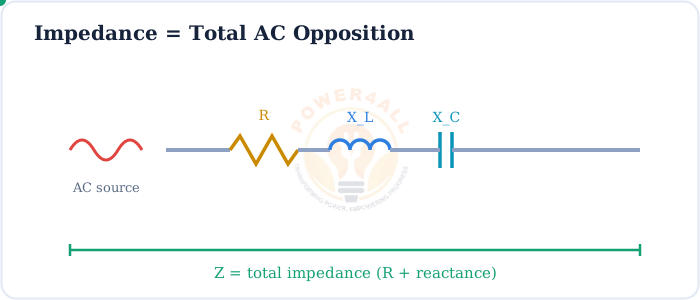
Resistance + reactance
Impedance = resistance (energy lost as heat) plus reactance (energy stored and returned by L and C). Both are measured in ohms, but they combine at right angles — not by simple addition.
Impedance vs Resistance
Resistance is only part of the story. In DC, opposition is just resistance; in AC, the full opposition is impedance.
| Property | Resistance (R) | Impedance (Z) |
|---|---|---|
| Applies to | DC and AC | AC circuits |
| Includes reactance? | No | Yes (R + X) |
| Depends on frequency? | No | Yes |
| Phase shift? | None (0°) | Yes (−90° to +90°) |
| Nature | Real number | Complex (R + jX) |
| Unit | ohm (Ω) | ohm (Ω) |
When Z = R
In a purely resistive circuit (no L or C, or at resonance where they cancel), the reactance is zero and impedance is simply the resistance: Z = R.
The Impedance Triangle
Because resistance and reactance act at 90° to each other, they add like the two sides of a right triangle. The hypotenuse is the impedance.
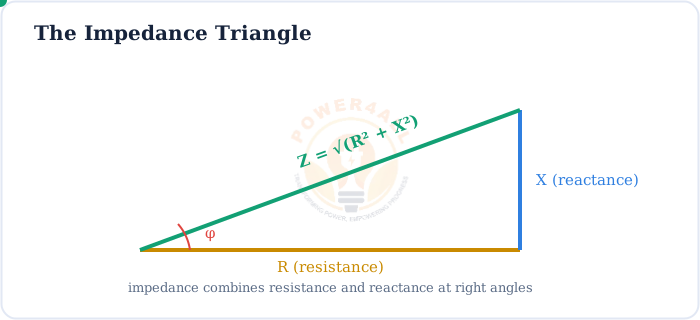
|Z| = √(R² + X²)
Magnitude of impedance from resistance and net reactance (X = XL − XC)
φ = tan⁻¹(X / R)
Phase angle — how far current leads or lags the voltage
Worked example
A circuit has R = 30 Ω and net reactance X = 40 Ω. Its impedance is:
|Z| = √(30² + 40²) = √2500 = 50 Ω
φ = tan⁻¹(40/30) = 53° — the current lags the voltage by 53°.
The Complex Form: Z = R + jX
Engineers write impedance as a complex number, Z = R + jX. The real part is resistance; the imaginary part (with j = √−1) is reactance. This makes AC circuit maths as easy as adding vectors.
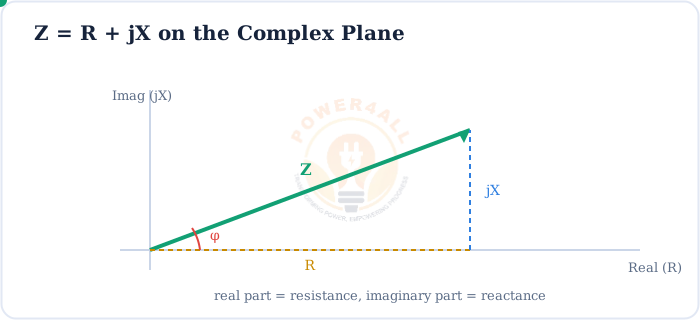
Z = R + jX
Positive X = inductive (current lags); negative X = capacitive (current leads)
Why complex numbers?
Writing Z as R + jX captures both the size and the phase of the opposition in one number, so series impedances just add: Ztotal = Z₁ + Z₂ + …
Impedance of a Resistor, Inductor & Capacitor
Each basic component has its own impedance. Only the resistor dissipates power; the inductor and capacitor store energy and contribute reactance.
Resistor
ZR = R
Purely real — same for AC and DC, no phase shift.
Dive deeper into the reactive parts on the Reactance (XL & XC) page.
Impedance vs Frequency & Resonance
Because reactance depends on frequency, so does impedance. In a series RLC circuit the impedance dips to a minimum equal to R at the resonant frequency, where XL and XC cancel.
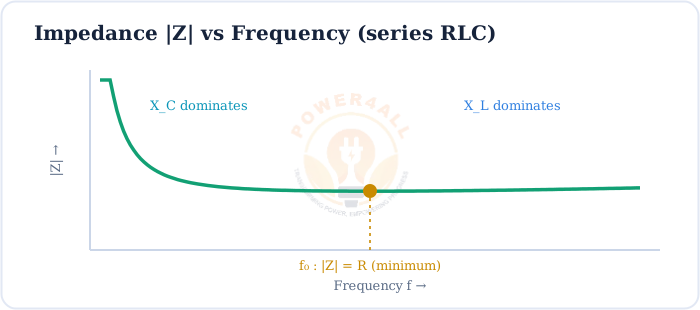
f₀ = 1 / (2π√(LC))
Series-resonant frequency, where XL = XC and impedance is minimum
Compute it with the RLC Resonant Frequency Calculator and the Reactance Calculator.
Ohm’s Law for AC: V = I × Z
Impedance slots straight into Ohm’s law for AC. Use phasors (magnitude and angle) and impedance does the rest — it sets both the size ratio and the phase.
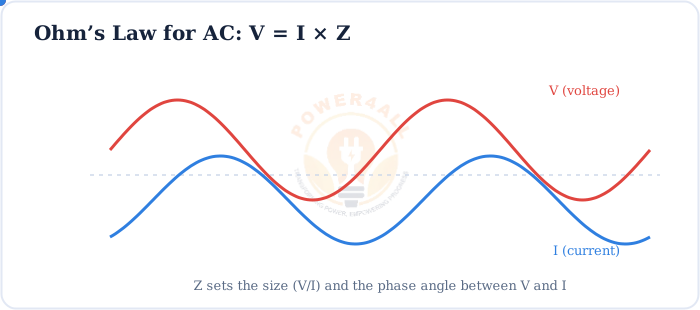
V = I × Z · I = V / Z
Ohm’s law for AC, with V, I and Z as phasors (complex quantities)
Worked example
A 230 V (RMS) supply drives a load of Z = 50 Ω. The current magnitude is:
I = V / Z = 230 / 50 = 4.6 A
Where Impedance Matters
Impedance is central to audio, RF, power and signal integrity.
Audio
Speakers are rated by impedance (4 Ω, 8 Ω); amps must match for full, safe power.
RF & transmission
Cables and antennas use a characteristic impedance (often 50 Ω); mismatches cause reflections.
Power systems
Line and transformer impedance set voltage drop, fault currents and power flow.
Filters & tuning
Frequency-dependent impedance is how filters, tuners and matching networks work.
Key Terms at a Glance
The essential impedance vocabulary students and engineers search for.
Impedance (Z)
Total AC opposition; Z = R + jX, in ohms.
Resistance (R)
Real part; energy lost as heat.
Reactance (X)
Imaginary part; from L and C.
Phase angle (φ)
tan⁻¹(X/R) — V-to-I phase.
Magnitude |Z|
√(R²+X²).
Admittance (Y)
Reciprocal of impedance, Y = 1/Z.
Frequently Asked Questions
Quick, expert answers to the questions people ask most about impedance.
What is impedance in simple words?
Impedance is the total opposition a circuit gives to alternating current. It is like resistance but also includes the effect of inductors and capacitors (reactance). Its symbol is Z and its unit is the ohm.
What is the formula for impedance?
Z = R + jX in complex form; its magnitude is |Z| = √(R² + X²) and its phase is φ = tan⁻¹(X/R).
What is the difference between impedance and resistance?
Resistance opposes current and dissipates energy in both DC and AC. Impedance is the AC opposition that also includes reactance from L and C, so it depends on frequency and causes a phase shift. When there is no reactance, Z = R.
What is the unit of impedance?
The ohm (Ω) — the same unit as resistance and reactance, since all measure opposition to current.
What is the impedance triangle?
A right triangle with R on the base, X vertical and Z as the hypotenuse. It shows Z = √(R²+X²) and the phase angle φ between R and Z.
What is the impedance of an inductor and a capacitor?
An inductor has ZL = jωL (rises with frequency) and a capacitor has ZC = 1/jωC (falls with frequency). A resistor has Z = R.
What is Ohm’s law for AC?
V = I × Z, using phasors. The magnitude of Z gives the voltage-to-current ratio and the angle of Z gives the phase difference between voltage and current.
Why does impedance change with frequency?
Because reactance is frequency-dependent: XL rises and XC falls with frequency. So the combined impedance changes too, hitting a minimum equal to R at resonance in a series RLC circuit.
Conclusion & Key Takeaways
Impedance is the complete picture of AC opposition — resistance and reactance combined into one complex quantity, Z = R + jX.
Total AC opposition
Symbol Z, unit ohm.
Z = R + jX
Resistance + reactance.
|Z| = √(R²+X²)
From the impedance triangle.
Frequency-dependent
Min = R at resonance.
V = I × Z
Ohm’s law for AC.
Sets phase too
φ = tan⁻¹(X/R).