Harmonics & THD
The complete guide to harmonics and Total Harmonic Distortion (THD) — the extra frequencies that distort AC voltage and current. From harmonic order and the THD formula THD = √(V₂²+V₃²+…)/V₁, to odd, even and triplen harmonics, the spectrum, sources, effects and mitigation.
Complete Learning Path — Harmonics & THD
From what harmonics are, to their orders, THD, the spectrum, sources, effects, standards and mitigation
What are Harmonics?
Harmonics are unwanted voltage or current components at integer multiples of the fundamental frequency. If the fundamental (1st harmonic) is 50 Hz, the 3rd harmonic is 150 Hz, the 5th is 250 Hz, and so on. When they add to the fundamental, a clean AC sine wave becomes distorted.
A perfect power supply would be a pure sinusoid at one frequency. In reality, nonlinear loads pull current in bursts, and by Fourier analysis any repeating distorted wave is exactly a fundamental sine plus a series of harmonic sines.
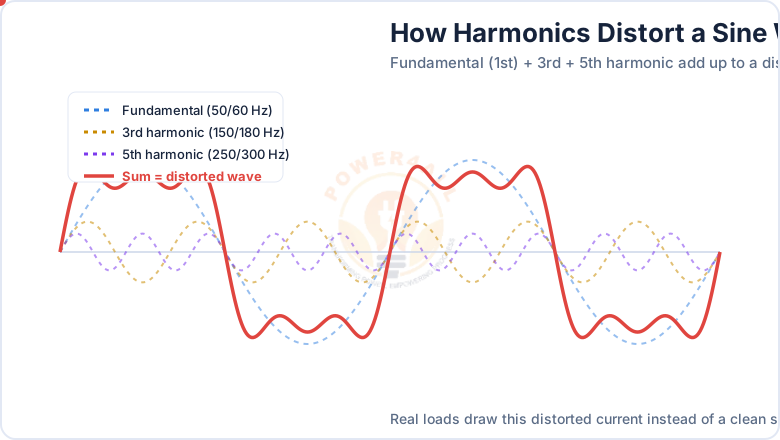
Fundamental = 1st harmonic
The fundamental (the 50 or 60 Hz supply frequency) is itself the 1st harmonic. The word "harmonics" in day-to-day use means the higher-order components (2nd, 3rd, 5th…) that distort the wave.
Harmonic Orders: Odd, Even & Triplen
The harmonic order n tells you the frequency: harmonic n sits at n × fundamental. Orders group into three families that behave very differently.
| Family | Orders | Frequency (50 Hz base) | Behaviour |
|---|---|---|---|
| Fundamental | 1 | 50 Hz | The real supply frequency |
| Odd | 3, 5, 7, 11, 13… | 150, 250, 350… Hz | Dominant in most systems |
| Even | 2, 4, 6… | 100, 200, 300… Hz | Usually cancel (small) |
| Triplen | 3, 9, 15… | 150, 450, 750… Hz | Add up in the neutral |
Most loads have half-wave symmetry (the negative half mirrors the positive), which mathematically eliminates the even harmonics — so real-world distortion is dominated by the odd harmonics: 3rd, 5th and 7th.
Quick rule
Harmonic order n at fundamental f has frequency n × f. Example: the 7th harmonic of a 60 Hz supply is 7 × 60 = 420 Hz.
Total Harmonic Distortion (THD)
Total Harmonic Distortion (THD) puts one number on how distorted a wave is: the combined size of all the harmonics compared with the fundamental. A pure sine has THD = 0%.
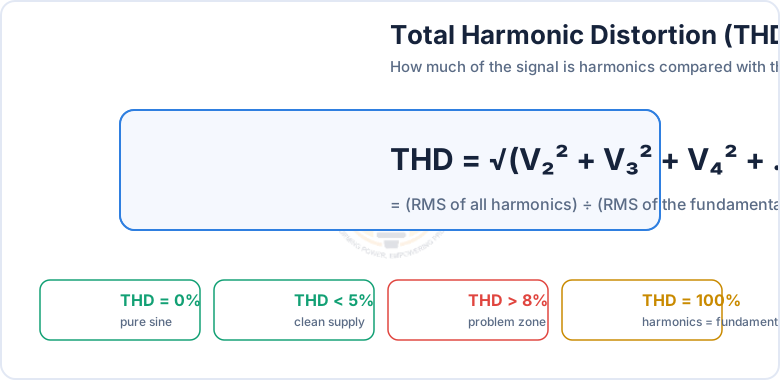
THD = √(V₂² + V₃² + V₄² + …) / V₁ × 100%
V₁ is the fundamental RMS; V₂, V₃… are the harmonic RMS values (same formula for current with I)
Worked example
A current has a fundamental of 100 A and harmonics: 3rd = 33 A, 5th = 20 A, 7th = 14 A.
THD = √(33² + 20² + 14²) / 100 = √(1089+400+196)/100 = √1685/100 ≈ 41%. Try the THD Calculator.
The Harmonic Spectrum (FFT)
A distorted wave is easiest to read in the frequency domain. An FFT (fast Fourier transform) breaks it into a harmonic spectrum — a bar for each order showing its size as a percentage of the fundamental.
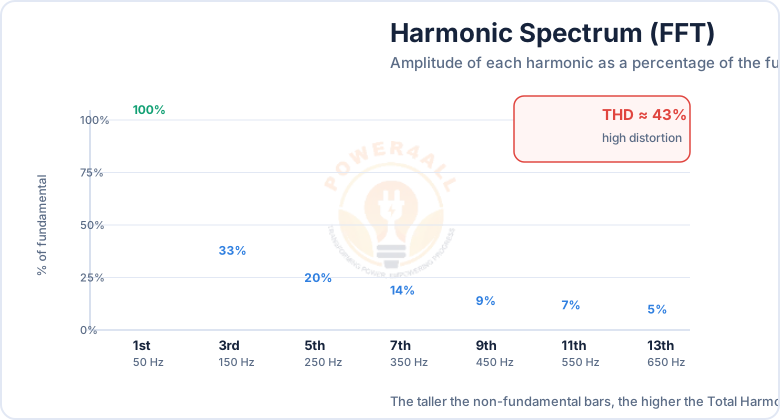
The spectrum instantly shows which harmonics dominate. A classic six-pulse rectifier, for example, produces characteristic harmonics of order 6k ± 1 (5th, 7th, 11th, 13th…). Engineers use spectra to design the right filter.
Where Harmonics Come From: Nonlinear Loads
Harmonics are created by nonlinear loads — devices that draw current in sharp pulses instead of smoothly following the voltage. A resistor draws a clean sine; a diode rectifier does not.
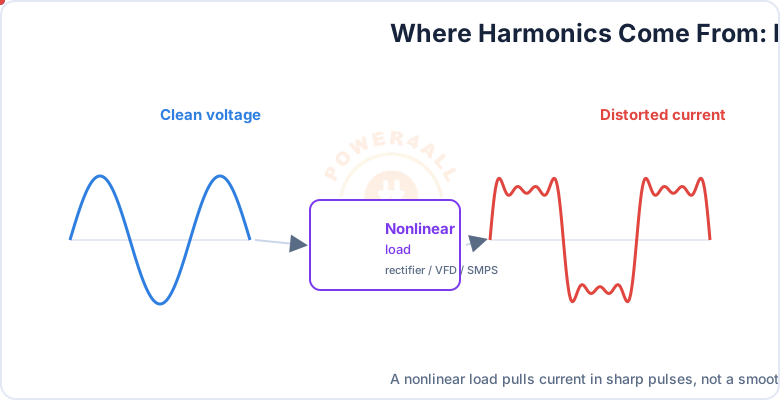
Rectifiers & drives
Diode/thyristor rectifiers, VFDs and UPS front-ends — the biggest industrial source.
Electronics & SMPS
Computers, chargers and switch-mode supplies draw pulsed current rich in 3rd harmonic.
LED & fluorescent
Electronic ballasts and LED drivers add harmonic current across many small loads.
Arcing & saturation
Arc furnaces, welders and saturated transformers inject harmonics too.
Effects & Problems of Harmonics
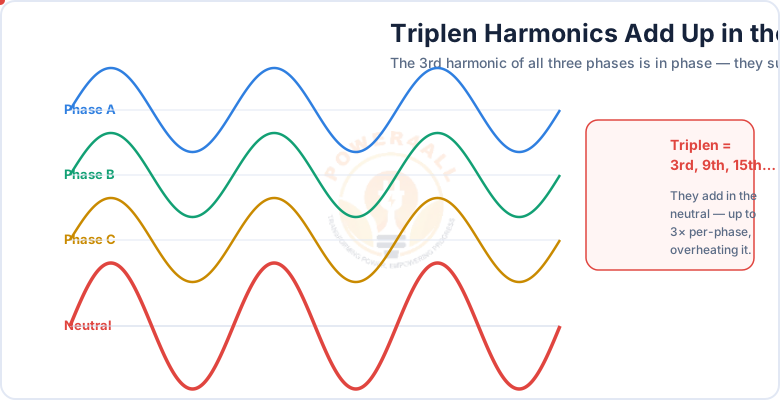
Harmonics waste energy and stress equipment. The most notorious problem is triplen harmonics overloading the neutral of a three-phase system.
Overheating
Higher-frequency currents raise I²R and eddy losses in cables, motors and transformers.
Neutral overload
Triplen harmonics sum in the neutral, sometimes exceeding the phase current.
Capacitor & resonance
PF-correction capacitors attract harmonic current and can resonate and fail.
Poor power factor
Distortion lowers the true power factor, wasting supply capacity.
How to Reduce Harmonics (Mitigation)
Once you know the spectrum, you can filter or design out the worst harmonics.
Passive filters
Tuned LC traps shunt a specific harmonic (e.g. 5th) to ground — cheap and reliable.
Active filters
Power electronics inject equal-and-opposite harmonic current in real time.
Line reactors / chokes
Series inductance on drives smooths the current pulse and cuts THD.
Multi-pulse & K-factor
12/18-pulse rectifiers and phase-shift or K-rated transformers cancel harmonics.
Distortion power factor
True power factor = displacement factor (cosφ) × distortion factor. As THD rises, the distortion factor falls, so mitigating harmonics also improves the real power factor.
Harmonic Standards & Limits
Utilities cap harmonics so one customer's distortion does not disturb the grid. The key references are IEEE 519 and IEC 61000.
| Metric | Typical limit | Meaning |
|---|---|---|
| Voltage THD (< 1 kV) | ≤ 8% (often ≤ 5%) | Overall voltage distortion at the point of common coupling |
| Individual voltage harmonic | ≤ 5% (often ≤ 3%) | Any single harmonic order |
| Current TDD | 5%–20% | Depends on short-circuit-to-load ratio (ISC/IL) |
Current limits use TDD (total demand distortion), referenced to peak demand current rather than the instantaneous fundamental — a close cousin of THD.
Key Terms at a Glance
The essential harmonics vocabulary students and engineers search for.
Harmonic
Component at n× the fundamental frequency.
Harmonic order (n)
The multiple: 3rd = 3×f.
THD
√(∑Vn²)/V₁; distortion %.
Triplen
3rd, 9th, 15th; add in neutral.
Spectrum
Amplitude vs harmonic order.
Nonlinear load
Draws non-sinusoidal current.
Frequently Asked Questions
Quick, expert answers to the questions people ask most about harmonics and THD.
What are harmonics in simple words?
Harmonics are extra voltage or current waves at whole-number multiples of the mains frequency. A 50 Hz supply can carry a 150 Hz (3rd), 250 Hz (5th) and higher waves. Added together they distort the smooth sine into a jagged or flat-topped shape.
What is THD (total harmonic distortion)?
THD is one number for how distorted a wave is: the combined RMS of all harmonics divided by the fundamental RMS, as a percentage. THD = √(V₂²+V₃²+…)/V₁. A pure sine is 0%; higher means more distortion.
How do I calculate THD?
Square each harmonic RMS value, add them, take the square root, and divide by the fundamental RMS. Example: fundamental 100 A, harmonics 33, 20, 14 A gives √(33²+20²+14²)/100 ≈ 41%. The THD Calculator does it for you.
What are triplen harmonics and why do they overload the neutral?
Triplen harmonics are the odd multiples of three (3rd, 9th, 15th). In a balanced three-phase system the fundamentals cancel in the neutral, but the triplens of all three phases are in phase, so they add. The neutral can then carry up to three times the per-phase triplen current and overheat.
What causes harmonics?
Nonlinear loads that draw pulsed current: diode/thyristor rectifiers, variable frequency drives, switch-mode power supplies, computers, LED and fluorescent lighting, welders, arc furnaces and saturated transformers.
Why are odd harmonics more common than even ones?
Most loads have half-wave symmetry — the negative half-cycle mirrors the positive. That symmetry mathematically cancels the even harmonics (2nd, 4th…), leaving the odd harmonics (3rd, 5th, 7th) to dominate.
What is an acceptable THD level?
IEEE 519 recommends voltage THD below 5% for general systems, with any single harmonic under 3%. Under ~5% is clean; above ~8% often causes overheating and nuisance tripping. Current limits (TDD) depend on the short-circuit-to-load ratio.
How are harmonics reduced?
With passive LC filters tuned to a harmonic, active filters that inject cancelling current, line reactors or DC chokes on drives, 12- or 18-pulse rectifiers, and phase-shifting or K-factor transformers.
Conclusion & Key Takeaways
Harmonics are the higher-frequency multiples that distort AC waves, and THD is the single number that quantifies that distortion.
Harmonic = n×f
Integer multiples of the fundamental.
Odd dominate
3rd, 5th, 7th; evens cancel.
THD = √(∑Vn²)/V₁
Distortion as a percentage.
Triplens add
Overload the neutral.
Nonlinear loads
Rectifiers, VFDs, SMPS.
Keep THD < 5%
Filter to meet IEEE 519.