What is RMS Value?
The complete guide to the root-mean-square value — the effective value of AC. From why the average is useless and the heating argument, to the square–mean–root process, Vrms = Vm/√2, the RMS of sine, square and triangular waves, form & crest factor, and true-RMS measurement.
Complete Learning Path — RMS Value
From the effective-value idea and the square–mean–root process, to the sine-wave result, other waveforms, form & crest factor, power and measurement
What is RMS Value?
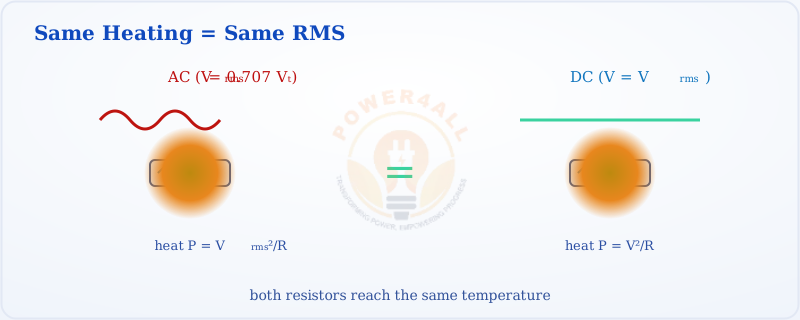
The RMS (root mean square) value of an alternating current or voltage is its effective value — the steady DC value that would deliver exactly the same average power to a resistor.
Because AC constantly changes, we need one honest number for its “strength”. The RMS value is that number: a 230 V AC supply heats a heater element just as much as a 230 V battery would — that is precisely what “230 V RMS” means.
The one-line definition
RMS value = the equivalent DC value that dissipates the same power in a resistor. That is why almost every AC voltage and current you ever quote — 230 V, 5 A — is an RMS figure.
Why RMS, Not the Average?
The obvious idea — just average the waveform — fails for AC. Over a full cycle the positive and negative halves cancel, so the average of a symmetrical AC wave is exactly zero. Yet it clearly delivers power. RMS solves this.
The trick: power depends on the square of voltage or current (P = V²/R), and a squared value is always positive. Averaging the squares captures the real power, then the square root brings us back to volts or amps. That is the essence of root-mean-square.
Average = 0, but power ≠ 0
A heater on AC gets hot even though the current’s average is zero. Power comes from I²R, which is positive on both halves of the cycle — so we must square first, then average.
The Square–Mean–Root Process
The name says the method, read backwards: take the Root of the Mean of the Square. Three steps turn a changing waveform into one effective number.
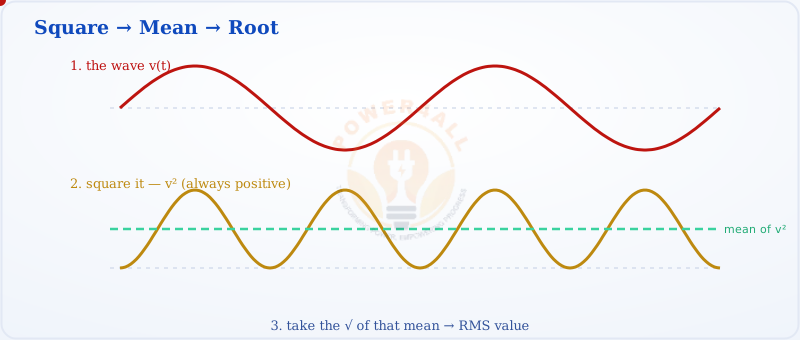
Vrms = √( mean of v² )
Root of the Mean of the Square — taken over one complete cycle
RMS of a Sine Wave: Vrms = Vm/√2
Apply square–mean–root to a pure sine and a clean result drops out: the mean of sin² over a cycle is exactly ½, so the RMS is the peak divided by √2.
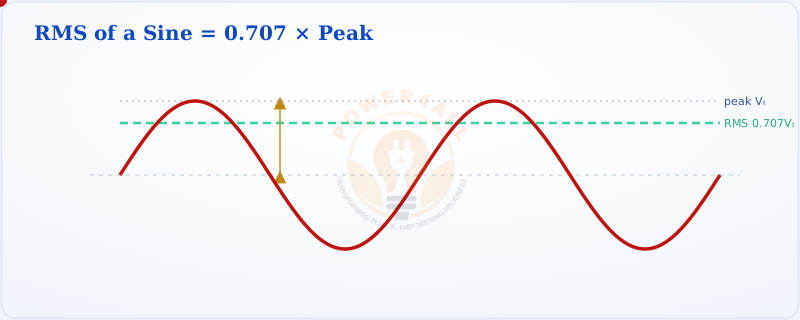
Vrms = Vm/√2 ≈ 0.707 Vm
and conversely Vm = √2 × Vrms ≈ 1.414 Vrms
Worked example — the 230 V mains
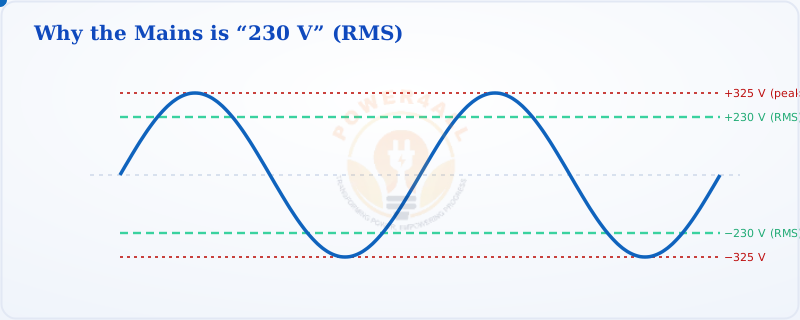
The mains is quoted as Vrms = 230 V. Its peak is:
Vm = √2 × 230 = 1.414 × 230 ≈ 325 V
So the waveform actually swings to ±325 V, but its effective value — what does the heating — is 230 V.
RMS of Other Waveforms
The 0.707 factor is only for a sine. Each waveform shape has its own RMS relationship to its peak — a common exam trap.
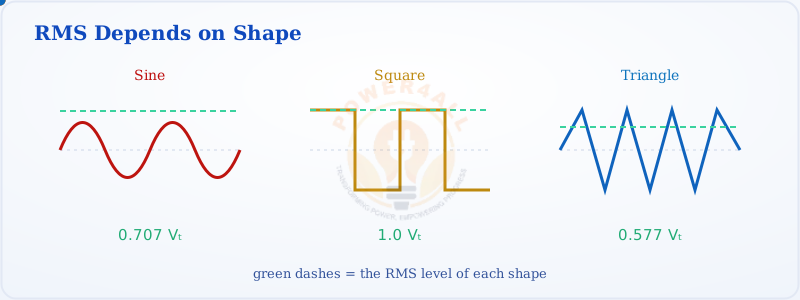
| Waveform | RMS value | Average (half-cycle) | Crest factor |
|---|---|---|---|
| Sine | Vm/√2 = 0.707 Vm | 0.637 Vm | 1.414 |
| Square | Vm (1.0 Vm) | Vm | 1.0 |
| Triangle / sawtooth | Vm/√3 = 0.577 Vm | 0.5 Vm | 1.732 |
| Full-wave rectified sine | 0.707 Vm | 0.637 Vm | 1.414 |
Form Factor & Crest Factor
Two ratios summarise a waveform’s shape and are built directly from its RMS value.
Form factor
kf = RMS / average
For a sine, 1.11. It links the RMS to the average-responding reading of a cheap meter.
Crest factor
kc = peak / RMS
For a sine, 1.414 (√2). High crest factor means sharp, spiky peaks — hard on components.
Why they matter
They let you convert between peak, average and RMS for any known shape, and they warn when a waveform is peaky.
RMS & Power
RMS exists for power. Put RMS values into the DC power formulas and they give the correct average AC power directly.
P = Vrms × Irms × cosφ
Real (average) AC power — cosφ is the power factor
P = Irms² × R = Vrms² / R
Heating power in a resistor — identical in form to the DC case
Worked example — a 230 V heater
A heater of R = 52.9 Ω on the 230 V RMS mains dissipates:
P = Vrms² / R = 230² / 52.9 ≈ 1000 W
Using the peak (325 V) here would over-estimate the power by a factor of two — which is exactly why RMS is used.
Measuring RMS
Most meters report RMS — but how they get there matters when the waveform is not a clean sine.
True-RMS meter
Actually squares, averages and roots the signal, so it is accurate on any waveform — distorted mains, PWM, spiky loads.
Average-responding meter
Measures the average and multiplies by 1.11 (the sine form factor). Correct only for pure sines; wrong on distorted signals.
Oscilloscope
Shows the peak directly; many scopes also compute true RMS from the captured waveform.
Use true-RMS on modern loads
LED drivers, variable-speed motors and switch-mode supplies draw non-sinusoidal current. An average-responding meter can read many percent low — use a true-RMS meter.
Key Terms at a Glance
The essential RMS vocabulary students and engineers search for.
RMS value
Root mean square; the effective, heating-equivalent value.
Peak value (Vm)
Maximum instantaneous value; Vm = √2 Vrms for a sine.
Average value
Mean over a half-cycle (0.637 Vm for a sine); zero over a full cycle.
Form factor
RMS ÷ average = 1.11 for a sine.
Crest factor
Peak ÷ RMS = 1.414 for a sine.
True RMS
A real square–mean–root measurement, accurate on any shape.
Frequently Asked Questions
Quick, expert answers to the questions people ask most about RMS value.
What is RMS value in simple words?
The RMS value is the effective value of AC — the steady DC value that would heat a resistor by the same amount. It is how we give a single, meaningful number to a current or voltage that is constantly changing.
What is the RMS value of a sine wave?
For a sine, Vrms = Vm/√2 ≈ 0.707 Vm. Equivalently the peak is √2 (1.414) times the RMS. The same 0.707 factor applies to sinusoidal current.
Why do we use RMS instead of the average?
The average of a full AC cycle is zero because the positive and negative halves cancel, yet AC clearly delivers power. Since power depends on the square of the value (always positive), the root-mean-square captures the true effective value.
How do you calculate RMS?
Square the waveform, take the mean of the squares over one cycle, then take the square root — root of the mean of the square. For a sine this gives peak divided by √2.
Why is 230 V mains an RMS value?
Because 230 V is the effective (heating) value of the supply. The actual peak is about 325 V (230 × √2). Voltmeters display the RMS by convention, so appliances are rated in RMS too.
What is the RMS of a square wave?
For a symmetrical square wave the RMS equals the peak (1.0 Vm), because the magnitude is always at maximum. Its crest factor is therefore 1. A triangle, by contrast, has RMS 0.577 Vm.
What is the difference between RMS and peak?
The peak is the maximum the waveform reaches; the RMS is its effective, heating-equivalent value. For a sine, RMS = 0.707 × peak and peak = 1.414 × RMS.
What is a true-RMS meter and do I need one?
A true-RMS meter performs the real square–mean–root calculation, so it is accurate on distorted or non-sinusoidal waveforms. If you measure LED drivers, motor drives or switch-mode supplies, you need one; a cheap average-responding meter will read low.
Conclusion & Key Takeaways
The RMS value turns a restless AC waveform into one honest number — the DC it is worth in heating power. It is behind every AC voltage and current you ever quote.
Effective value
Same heating as an equal DC.
Root-mean-square
Square → mean → root.
Sine: 0.707 × peak
Vrms = Vm/√2.
Shape matters
Square = 1.0, triangle = 0.577.
Drives power
P = Vrms²/R.
230 V is RMS
Peak is ~325 V.