Complete Learning Path — Magnetic Field
From what a magnetic field is and how currents make one, through solenoids, flux density and force, to magnetic materials and the B–H curve
What is a Magnetic Field?
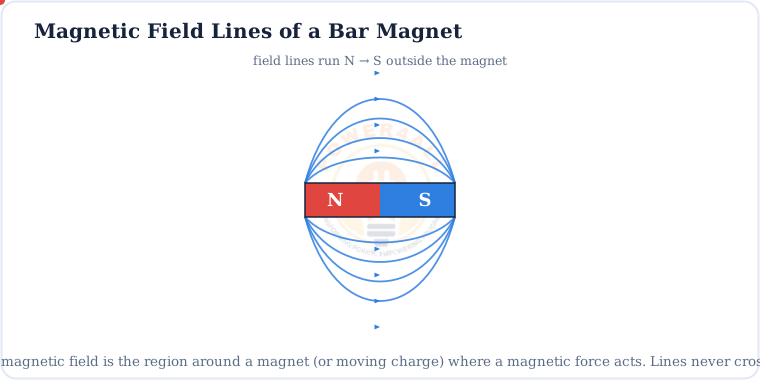
A magnetic field is the invisible region around a magnet or a moving electric charge where a magnetic force can be felt. It is a vector quantity — it has both a strength and a direction at every point — and we picture it with magnetic field lines.
Field lines run from the north (N) pole to the south (S) pole outside a magnet, and from S to N inside it, forming closed loops. Where the lines are packed close together the field is strong; where they spread out it is weak. Field lines never cross.
How strong is a magnetic field?
The Earth’s field is about 25–65 µT, a fridge magnet around 5 mT, and an MRI scanner 1.5–3 T — tens of thousands of times stronger. All are measured in tesla (T).
Magnetic Field Around a Current
Magnetism is not just for magnets. In 1820 Oersted found that every electric current creates a magnetic field circling around it — the link between electricity and magnetism.
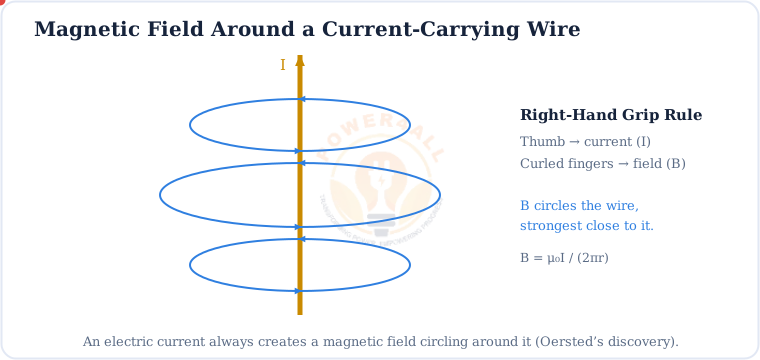
B = μ0I / (2πr)
Flux density at distance r from a long straight wire carrying current I (μ0 = 4π×10⁻⁷ T·m/A)
Worked example
A wire carries 10 A; find B at 5 cm:
B = (4π×10⁻⁷ × 10) / (2π × 0.05) = 4×10⁻⁵ T = 40 µT — about the size of Earth’s field.
Solenoids & Electromagnets
Wind that current-carrying wire into a coil — a solenoid — and the little circular fields add up into a strong, uniform field just like a bar magnet. Add current and it is a magnet you can switch on and off: an electromagnet.
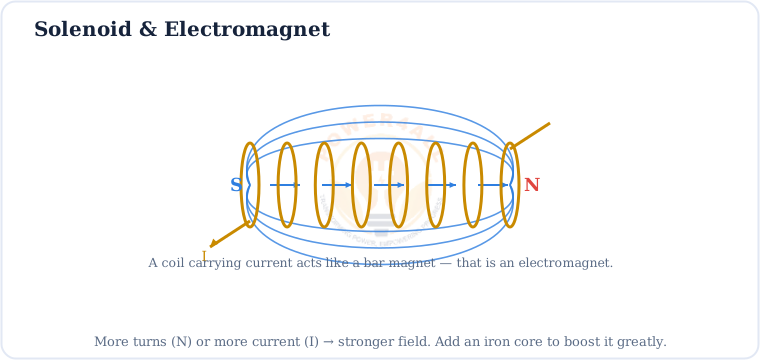
B = μ0 n I (inside a long solenoid, n = turns per metre)
Stronger with more turns, more current, or an iron core (B = μ0μr n I)
Worked example
A solenoid with 1000 turns/m carries 2 A:
B = 4π×10⁻⁷ × 1000 × 2 ≈ 2.5 mT. An iron core (μr ≈ 1000) could raise this to over 2 T.
Electromagnets are everywhere
The switchable field of an electromagnet drives relays, transformers, motors, loudspeakers, MRI machines and scrap-yard lifting magnets.
Magnetic Flux (Φ) & Flux Density (B)
Two closely-related quantities describe “how much” field there is. Magnetic flux Φ is the total field passing through an area; flux density B is how concentrated it is.
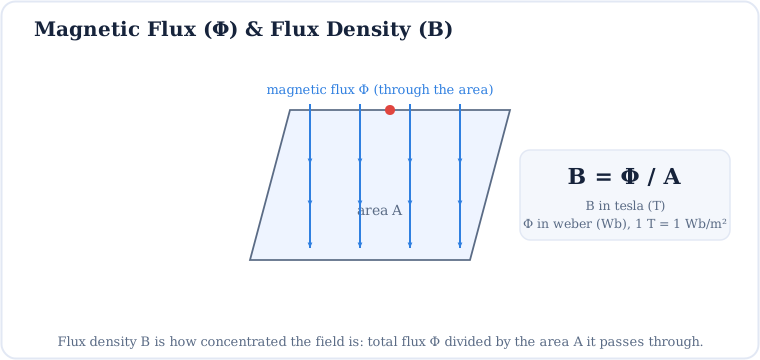
B = Φ / A · Φ = B·A·cosθ
Flux density (tesla, 1 T = 1 Wb/m²) and flux (weber) through an area at angle θ
Worked example
A field of 0.8 T passes straight through an area of 0.01 m²:
Φ = B·A = 0.8 × 0.01 = 8×10⁻³ Wb = 8 mWb.
Convert flux-density units quickly with the Magnetic Flux Density Converter (tesla ↔ gauss ↔ Wb/m²).
Force on a Current in a Field (F = BIL)
Put a current-carrying wire into a magnetic field and the two fields interact, pushing the wire sideways. This motor force is the reason electric motors turn.
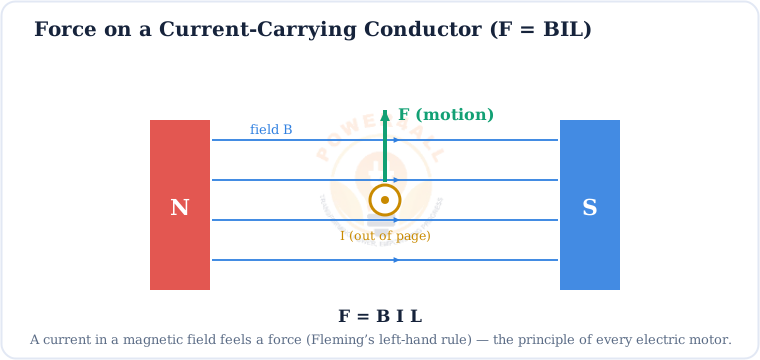
F = B I L sinθ · F = q v B (moving charge)
Force on a conductor (max when perpendicular, θ = 90°) and on a single moving charge
Worked example
A 0.2 m wire carrying 3 A sits square in a 0.5 T field:
F = B I L = 0.5 × 3 × 0.2 = 0.3 N.
Magnetic Materials & the B–H Curve
Some materials — iron, steel, nickel, cobalt — concentrate a magnetic field enormously. Their behaviour is captured by the B–H curve, which relates the flux density B to the applied field strength H.
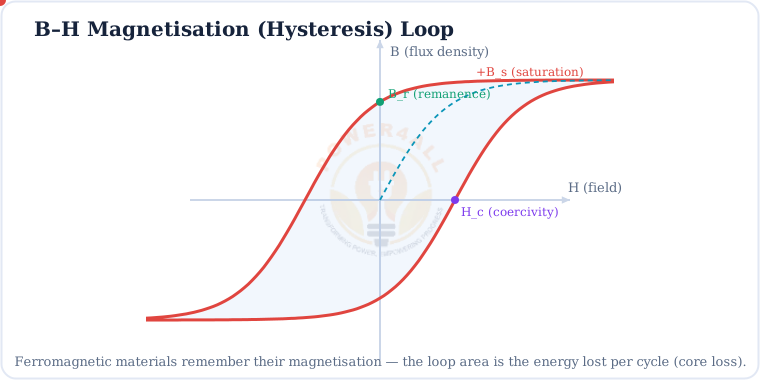
B = μH = μ0μrH
Permeability μ links B and H; relative permeability μr can be thousands for iron
Hard vs soft magnetic materials
Soft materials (transformer steel, ferrite) have a thin loop and low loss — ideal for transformers and inductors. Hard materials have a fat loop and keep their magnetism — used for permanent magnets. The loop area is the energy lost as heat each cycle.
Where Magnetic Fields Are Used
Magnetic fields are one of the pillars of electrical engineering — almost every machine relies on them.
Motors & generators
The F = BIL force spins motors; moving fields induce voltage in generators.
Transformers
A shared magnetic field in an iron core couples the windings of a transformer.
Relays & solenoids
An electromagnet pulls a contact or plunger in relays and valves.
Data storage
Hard drives and magnetic tape store data as tiny magnetised regions.
Medical (MRI)
Powerful, precise magnetic fields image the body without radiation.
Sensing & navigation
Compasses, Hall-effect sensors and current sensors all read magnetic fields.
Key Terms at a Glance
The essential magnetic-field vocabulary students and engineers search for.
Magnetic field
Region where a magnetic force acts.
Field lines
N→S loops; closer = stronger.
Flux Φ
Total field through an area (weber).
Flux density B
B = Φ/A (tesla).
Right-hand rule
Direction of field around a current.
Permeability μ
B = μH; μr huge for iron.
F = BIL
Force on a current (motor rule).
Hysteresis
B–H loop; saturation, remanence, coercivity.
Frequently Asked Questions
Quick, expert answers to the questions people ask most about magnetic fields.
What is a magnetic field in simple words?
It is the invisible area around a magnet or a moving charge where a magnetic force can push or pull magnetic materials. We draw it as field lines that run from the north pole to the south pole, closer together where the field is stronger.
How does electricity make a magnetic field?
Any moving charge — an electric current — is surrounded by a magnetic field that circles around it. For a straight wire, B = μ0I/2πr, and the right-hand grip rule gives its direction.
What is the right-hand rule?
Grip the wire with your right hand, thumb pointing along the current. Your curled fingers then point in the direction of the magnetic field lines around the wire.
What is flux density and its unit?
Flux density B is the magnetic flux per unit area, B = Φ/A. Its unit is the tesla (T), where 1 T = 1 Wb/m². An older unit is the gauss (1 T = 10,000 gauss).
What is the difference between flux and flux density?
Magnetic flux Φ (webers) is the total field through an area; flux density B (tesla) is the flux per unit area, B = Φ/A. Flux is the amount; flux density is the concentration.
What is the force on a wire in a magnetic field?
A wire of length L carrying current I perpendicular to a field B feels F = BIL. Fleming’s left-hand rule gives the direction. This force turns every electric motor.
What is an electromagnet and how do you make it stronger?
An electromagnet is a current-carrying coil (solenoid). Make it stronger with more turns, more current, or — most of all — an iron core, since B = μ0μrnI and iron’s μr is in the thousands.
What does the B-H hysteresis loop tell us?
It shows how a material magnetises: it saturates, keeps some magnetism when the field is removed (remanence), and needs a reverse field to demagnetise (coercivity). The loop area equals the energy lost as heat each cycle — important for transformer core loss.
Conclusion & Key Takeaways
The magnetic field is the invisible partner of electric current — the basis of motors, generators, transformers and more.
Region of force
Around magnets & currents.
Current makes field
B = μ0I/2πr.
Coil = electromagnet
B = μ0nI.
B = Φ/A
Flux density in tesla.
F = BIL
The motor force.
B–H loop
How materials magnetise.