What is Direct Current (DC)?
The complete, advanced guide to direct current — electricity that flows in one steady direction. From the definition, symbol and DC vs AC to batteries, solar, AC-to-DC rectification, pulsating vs pure DC, the key formulas and where DC powers the modern world.
Complete Learning Path — Direct Current
From what DC is and how it differs from AC, to sources, rectification, pure vs pulsating DC, formulas, measurement and applications
What is Direct Current (DC)?
Direct current (DC) is electric current that flows in only one direction. Its polarity never reverses — charge streams steadily from the negative terminal, around the circuit, to the positive terminal, and keeps doing so for as long as the source is connected.
The quantity of current uses the symbol I and is measured in amperes (A), while the one-directional nature is labelled DC. A battery, a solar cell and the supply inside your phone are all direct current: a constant push in a single, unchanging direction.
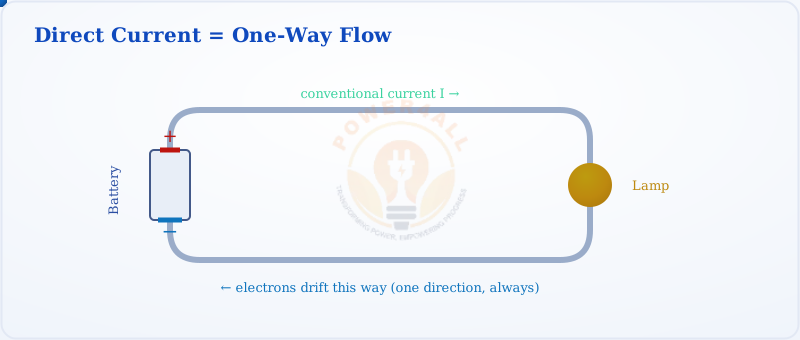
The key idea
What makes current “direct” is not that it is constant in size, but that it never changes direction. Even current that rises and falls is still DC as long as it always flows the same way — that is called pulsating DC.
DC vs AC: The Fundamental Difference
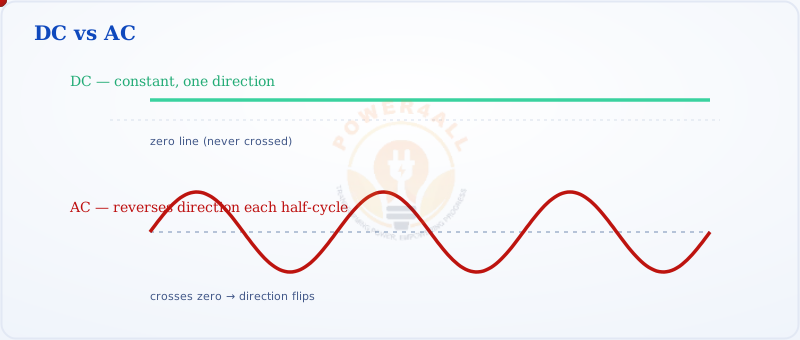
The two families of electricity are direct current (DC) and alternating current (AC). DC flows one way at a steady level; AC swings back and forth, reversing direction many times each second.
| Property | Direct Current (DC) | Alternating Current (AC) |
|---|---|---|
| Direction of flow | One direction only | Reverses periodically |
| Frequency | 0 Hz (no reversal) | 50 Hz or 60 Hz mains |
| Typical source | Battery, solar cell, rectifier | Generator / alternator, grid |
| Waveform | Flat line (steady) | Sine wave |
| Voltage change | Hard to change level | Easy — transformers step up/down |
| Long-distance transmission | HVDC (special) | Standard for the grid |
| Used by | Electronics, batteries, EVs, solar | Homes, motors, industry |
Why the grid is AC, but your phone is DC
AC won the grid because transformers can raise it to high voltage for low-loss transmission. But chips, LEDs and batteries need steady DC — so every charger quietly converts AC back to DC.
Sources of Direct Current
Direct current comes from any source with a fixed positive and negative terminal — a steady electromotive force that pushes charge one way.
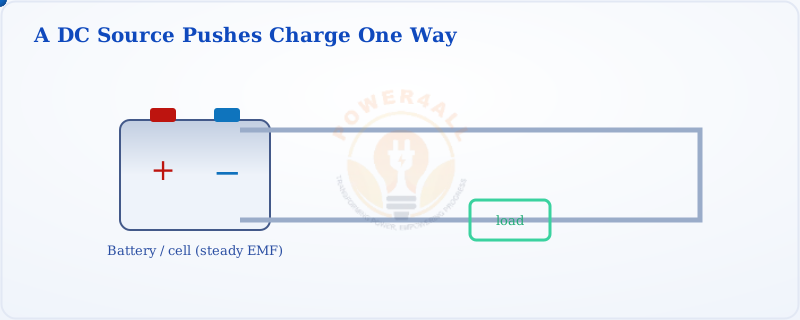
Batteries & cells
Chemical reactions keep one terminal positive, one negative — the classic portable DC source for phones, cars and torches.
Solar cells (PV)
Sunlight frees charge in a semiconductor, producing DC directly — before any inverter turns it into AC.
Rectified supplies
Chargers and adapters use a diode rectifier to turn AC mains into the DC electronics need.
DC generators / dynamos
A commutator flips the output so a rotating machine delivers current in one direction.
Turning AC into DC: Rectification
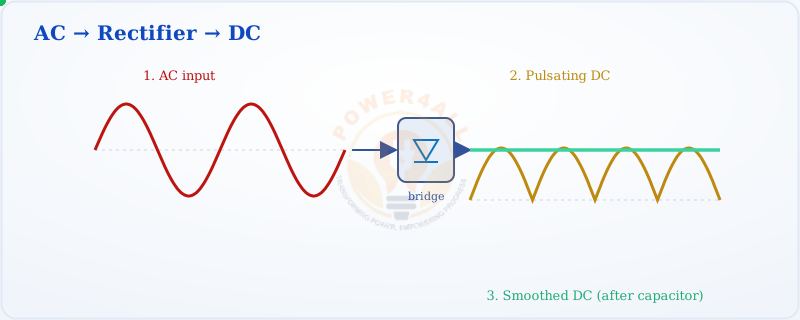
Most DC in the world does not come from batteries — it is made by rectifying AC. A rectifier uses diodes to let current pass in only one direction, and a smoothing capacitor flattens the result.
Explore the devices behind this in Diodes and Capacitors, and see full converter designs in the Power Electronics Guide.
Pure DC vs Pulsating DC
All DC flows one way, but it need not be flat. Engineers distinguish pure (steady) DC, pulsating DC and variable DC — all direct, but with different smoothness.
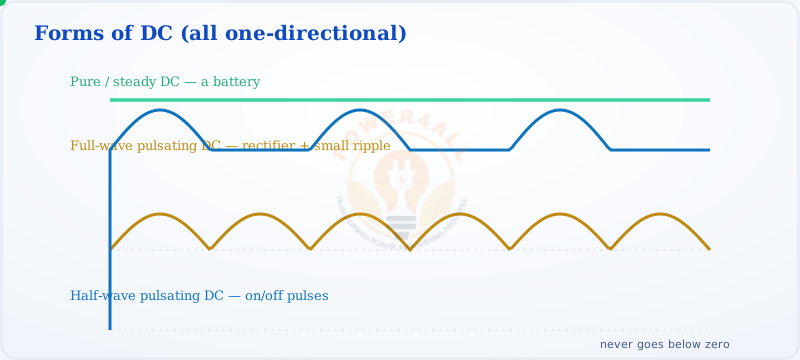
Pure (steady) DC
A constant value that never changes — the ideal from a fresh battery or a well-filtered supply.
Pulsating DC
Rises and falls but never reverses — the raw output of a rectifier before smoothing. The wobble is called ripple.
Variable DC
One-directional current whose level is deliberately changed — as in a DC motor speed controller or a dimmable LED driver.
Direct Current Formulas
Because DC is steady and does not involve phase or reactance, its maths is the simplest in all of electricity — just Ohm’s law and the power law.
I = Q / t
Current (amperes) = charge (coulombs) ÷ time (seconds)
V = I × R
Ohm’s law: voltage = current × resistance
P = V × I = I²R = V²/R
DC power (watts) — no power factor, because voltage and current are in step
Worked example — a 12 V LED strip
A 12 V DC LED strip draws 0.5 A. Its resistance and power are:
R = V / I = 12 / 0.5 = 24 Ω
P = V × I = 12 × 0.5 = 6 W
Run for 3 hours it uses E = P × t = 6 × 3 = 18 Wh.
DC makes the sums easy
With DC there is no frequency, no reactance and no power factor — P = VI is exact. Try it with the Ohm’s Law topic and the Energy Cost Calculator.
Measuring Direct Current
DC is measured with the same instruments as any current — but polarity matters: connect the meter the right way round.
Multimeter (DC mode)
Select V₋ / A₋ (the straight-line symbol). Red to +, black to −; a negative reading just means the leads are reversed.
DC clamp meter
Uses a Hall-effect sensor to read DC current without breaking the circuit — ordinary clamp meters read AC only.
Shunt resistor
A tiny known resistance in series; measure the small voltage across it and use I = V/R to find large DC currents.
Mind the polarity
Unlike AC, DC has a fixed + and −. Connecting a polarised component such as an electrolytic capacitor or an LED backwards can damage it — always check before powering up.
Where Direct Current is Used
DC quietly runs the digital world — every device with a chip inside ultimately runs on direct current.
Electronics
Chips, transistors, LEDs and logic all need steady DC — supplied at 5 V, 3.3 V, 1.8 V and lower.
EVs & batteries
Electric-vehicle packs store and deliver DC; DC fast chargers feed the battery directly at high power.
Solar & storage
Solar panels and battery banks are DC; an inverter converts to AC only when the grid needs it.
HVDC transmission
High-voltage DC moves bulk power over long distances and undersea links with lower losses than AC.
Go deeper with the Power Electronics Guide, Diodes and Capacitors.
Key Terms at a Glance
The essential direct-current vocabulary students and engineers search for.
Direct current (DC)
Current that flows in one direction only, with fixed polarity.
Polarity
The fixed + and − of a DC source; sets the direction of flow.
Rectification
Converting AC to DC using diodes.
Pulsating DC
One-directional current that rises and falls (has ripple).
Ripple
The leftover AC wobble on top of rectified DC.
HVDC
High-voltage direct current, for long-distance transmission.
Frequently Asked Questions
Quick, expert answers to the questions people ask most about direct current.
What is direct current (DC) in simple words?
Direct current is electricity that flows in only one direction. The source keeps one terminal positive and one negative, so charge always moves the same way. A battery is the classic example — it delivers steady DC until it runs flat.
What is the difference between AC and DC?
DC flows one way at a steady level; AC reverses direction periodically (50 or 60 times a second on the mains). AC is easy to transform to high voltage for transmission, so the grid uses it, while electronics, batteries and solar systems use DC.
What is the symbol for direct current?
DC is marked by the letters DC or a straight solid line above a dashed line (─ with ··· under it). AC uses a wavy line. The current itself has the symbol I and is measured in amperes (A).
What are some examples of direct current?
Batteries in phones, laptops and cars; USB ports; solar panels; and the low-voltage supplies inside TVs, routers and chargers. Anything powered by a cell or a rectified adapter runs on DC.
How is AC converted into DC?
A rectifier — usually four diodes in a bridge — lets current pass in only one direction, giving pulsating DC. A smoothing capacitor then fills the gaps to produce steady DC. That is what a phone charger does.
What is pulsating DC?
Pulsating DC rises and falls but never reverses direction. It is the raw output of a rectifier before filtering. The residual wobble is called ripple, and a capacitor or filter reduces it toward pure DC.
What is the formula for DC power?
For DC, P = V × I. Using Ohm’s law this is also P = I²R or P = V²/R. There is no power factor because voltage and current are always in step. Energy is E = P × t.
Why do electronic devices use DC?
Transistors, microchips and LEDs need a steady, one-directional voltage to operate, so almost all electronics run on DC. Chargers and power supplies exist precisely to convert the AC mains into the low-voltage DC these circuits require.
Is a battery AC or DC?
A battery is DC. Its chemistry fixes one terminal as positive and one as negative, so it can only push current in a single direction. To get AC from a battery you need an inverter.
What is HVDC and why is it used?
HVDC is high-voltage direct current. It carries bulk power over very long overhead or undersea distances with lower losses than AC and can link grids running at different frequencies. AC is rectified to DC for the line and inverted back to AC at the far end.
Conclusion & Key Takeaways
Direct current is the steady, one-way flow that powers everything digital. Understand it and batteries, chargers, solar and electronics all make sense.
One direction
DC never reverses; polarity is fixed.
0 Hz
No frequency — it does not cross zero.
From cells & rectifiers
Batteries, solar, and AC-to-DC rectifiers.
Pure vs pulsating
Both are DC; ripple is smoothed by a capacitor.
P = V × I
Simple maths — no power factor.
Powers electronics
Chips, LEDs, EVs, solar and HVDC.