What is the Average Value of AC?
The complete guide to the average (mean) value of a waveform — why the full-cycle average is zero, the half-cycle and rectified average Vavg = 0.637 Vm = 2Vm/π, how it is found from the area under the curve, its value for different waveforms, and how it differs from RMS.
Complete Learning Path — Average Value
From the mean of a waveform and why the full cycle is zero, to the half-cycle average, area-over-time, other waveforms, average vs RMS and measurement
What is Average Value?
The average value of an alternating voltage or current is simply the mean of all its instantaneous values over a chosen time — the steady level that carries the same area under the curve.
It is written Vavg (or Vav) for voltage and Iavg for current. There is a catch that makes average value more subtle than it first appears: for a symmetrical AC wave, the average over a full cycle is exactly zero — so we almost always mean the half-cycle (or rectified) average.
Average = area ÷ time
Whatever the shape, the average value is the total area under the curve divided by the time interval — the height of a rectangle holding the same area.
Why the Full-Cycle Average is Zero
Over one complete cycle the positive half and the negative half of a symmetrical wave are mirror images. Their areas are equal and opposite, so they cancel exactly — the full-cycle average is zero.
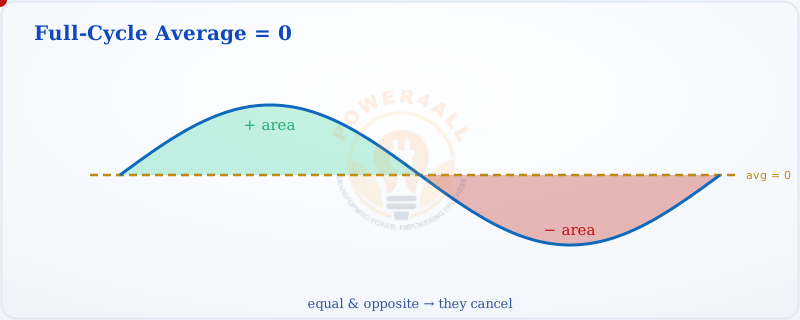
So we use the half cycle
To get a meaningful figure we average over just one half-cycle, or equivalently over a rectified waveform where the negative half is flipped positive.
Half-Cycle Average: Vavg = 0.637 Vm
Average one half-cycle of a sine — or a full-wave rectified sine over a whole cycle — and you get a clean result: 0.637 times the peak, which is exactly 2Vm/π.
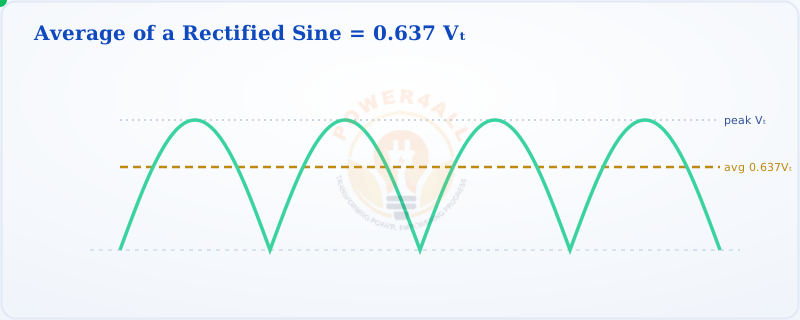
Vavg = 2Vm/π ≈ 0.637 Vm
Half-cycle (and full-wave rectified) average of a sine — likewise Iavg = 2Im/π
Worked example — average of a 325 V peak sine
A sine with Vm = 325 V (the 230 V mains peak) has a half-cycle average:
Vavg = 0.637 × 325 ≈ 207 V
Note this is lower than the 230 V RMS — average and RMS are different measures.
Average as Area ÷ Time
The deepest way to see the average value: it is the height of a rectangle that holds the same area as the waveform over the same time. That is literally what “mean” means.
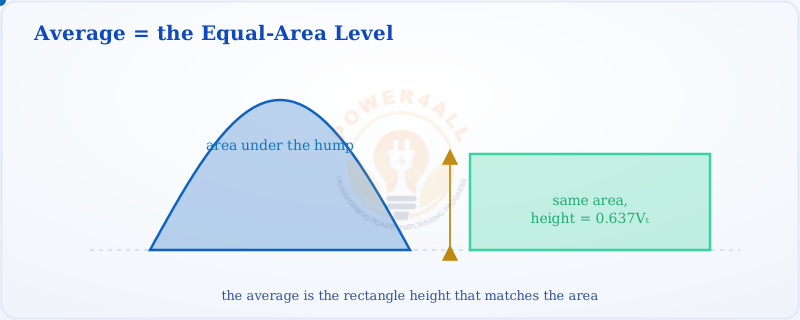
Vavg = (area under curve) / (time interval)
The general definition — works for any waveform shape
Average Value of Other Waveforms
Like RMS, the average-to-peak ratio depends on the shape. Here are the common ones (half-cycle / rectified basis).
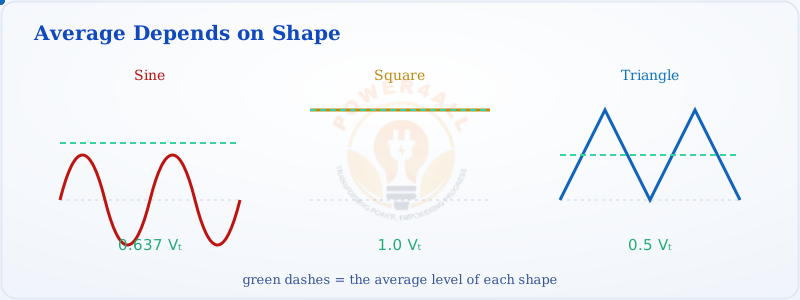
| Waveform | Average (half-cycle / rectified) | RMS | Form factor |
|---|---|---|---|
| Sine | 0.637 Vm (2Vm/π) | 0.707 Vm | 1.11 |
| Full-wave rectified sine | 0.637 Vm | 0.707 Vm | 1.11 |
| Half-wave rectified sine | 0.318 Vm (Vm/π) | 0.5 Vm | 1.57 |
| Square | Vm (1.0) | Vm | 1.0 |
| Triangle / sawtooth | 0.5 Vm | 0.577 Vm | 1.155 |
Average vs RMS Value
Average and RMS answer different questions. Average is the plain mean (area over time); RMS is the effective heating value. For a sine, RMS is always the bigger of the two.
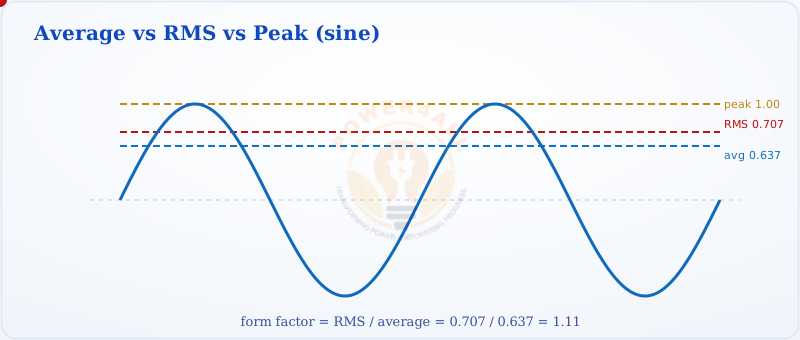
Form factor = Vrms / Vavg = 0.707 / 0.637 = 1.11
The bridge between the average value and the RMS value for a sine
Where the Average Value is Used
Average value is not just theory — it is what several real instruments and circuits actually respond to.
Moving-coil (DC) meters
A moving-coil movement responds to the average current, which is why it reads zero on raw AC and needs a rectifier first.
Rectifier output
The DC level from a rectifier before smoothing is its average value — 0.637 Vm for full-wave.
Average-responding meters
Cheap multimeters measure the average and multiply by the 1.11 form factor to display RMS — correct only for sines.
Measuring the Average Value
Because raw AC averages to zero, the average value is measured on a rectified signal or a DC level.
Rectify, then read DC
Pass the AC through a rectifier and measure the resulting DC level on a moving-coil or DC meter — that is the average.
Oscilloscope (mean)
Most digital scopes offer a “Mean” measurement that computes the average of the displayed waveform directly.
DMM DC vs AC
A DMM in DC mode reads the average (DC component); in AC mode it reports RMS. Know which you need.
Don’t confuse average with RMS
They are different numbers (0.637 vs 0.707 of peak for a sine). Ratings, power and heating use RMS; rectifier DC output and moving-coil readings use the average.
Key Terms at a Glance
The essential average-value vocabulary students and engineers search for.
Average value (Vavg)
Mean of the instantaneous values; area ÷ time.
Full-cycle average
Zero for a symmetrical AC wave.
Half-cycle average
0.637 Vm = 2Vm/π for a sine.
Rectified average
Average after flipping negatives positive.
Form factor
RMS ÷ average = 1.11 for a sine.
RMS value
Effective value; 0.707 Vm for a sine.
Frequently Asked Questions
Quick, expert answers to the questions people ask most about the average value of AC.
What is the average value of AC in simple words?
It is the plain mean of the waveform — the area under the curve divided by the time. For a full symmetrical cycle it is zero, so we normally take it over a half cycle, where a sine averages 0.637 of its peak.
Why is the average value of AC zero over a full cycle?
Because the positive and negative halves are equal and opposite, so their areas cancel exactly. The net mean over one complete cycle is therefore zero — which is why the half-cycle or rectified average is used.
What is the average value of a sine wave?
Over a half cycle, Vavg = 2Vm/π ≈ 0.637 Vm. A full-wave rectified sine has the same 0.637 average over a whole cycle.
What is the formula for average value?
Generally it is the area under the curve divided by the time interval. For a sine half cycle this comes out to 2Vm/π = 0.637 Vm; for current, Iavg = 2Im/π.
What is the difference between average and RMS value?
Average is the ordinary mean (0.637 of peak for a sine); RMS is the effective heating value (0.707 of peak). RMS is larger, and their ratio is the form factor, 1.11.
What is the average of a half-wave rectified signal?
A half-wave rectified sine averages Vm/π ≈ 0.318 Vm over a full cycle — half the full-wave figure, because one half of each cycle is missing.
Where is the average value actually used?
It is what a moving-coil (DC) meter responds to, and it is the DC output level of a rectifier before smoothing. Average-responding multimeters measure it and multiply by 1.11 to show RMS for sine inputs.
What is the form factor?
The form factor is RMS divided by average value. For a sine it is 0.707 / 0.637 = 1.11. It lets an average-responding meter estimate the RMS, and it is only exact for a pure sine.
Conclusion & Key Takeaways
The average value is the plain mean of a waveform — zero over a full AC cycle, but a useful 0.637 of the peak over a half cycle. It is the DC a rectifier produces and the value a moving-coil meter sees.
Mean = area / time
The equal-area level.
Full cycle = 0
Positive and negative cancel.
Half cycle = 0.637Vm
2Vm/π for a sine.
Shape-dependent
Square 1.0, triangle 0.5.
Not the RMS
RMS is 0.707Vm; ratio 1.11.
Rectifier & meters
The DC level moving-coil meters read.