What is Duty Cycle?
The complete guide to duty cycle — the single number that says how much of each cycle a signal is ON. From the formula D = ton/T and its percentage, to average voltage, complementary duty & dead-time, how to measure it, and why it is the master control knob behind PWM.
Complete Learning Path — Duty Cycle
From definition and formula, to percentage, average value, complementary duty, measurement and real-world uses
What is Duty Cycle?
The duty cycle of a signal is the fraction of one period for which it is ON (HIGH). It is the master control knob of any switched waveform: change the duty cycle and you change how much average power reaches the load — without changing the voltage or the frequency.
Duty cycle appears wherever things are switched rapidly on and off: PWM motor drives, LED dimmers, switch-mode power supplies, heaters, radio transmitters and even welding machines. It is written either as a plain fraction from 0 to 1, or — far more often — as a percentage from 0% to 100%. It is also called the duty ratio or duty factor.
One sentence to remember
Duty cycle answers “what fraction of the time is it on?” — and that fraction, multiplied by the supply, is the average the load actually feels.
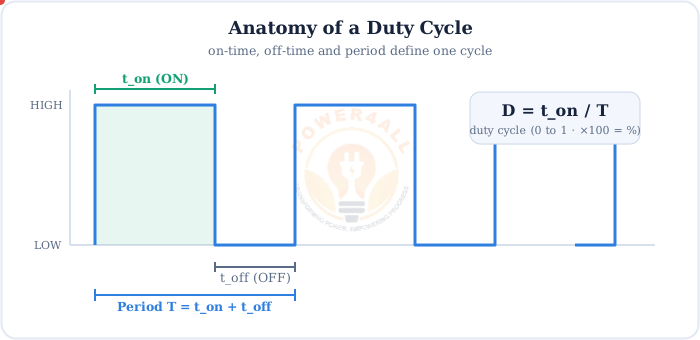
On-time, Off-time & Period
Duty cycle is built from three simple times. Get these straight and every duty-cycle calculation becomes easy.
On-time (ton)
How long the signal stays HIGH each cycle — also called the pulse width.
Off-time (toff)
How long it stays LOW each cycle.
Period (T)
One full ON+OFF cycle: T = ton + toff. Linked to frequency by T = 1/f.
Duty cycle (D)
The on-time as a fraction of the period: D = ton/T.
T = ton + toff · f = 1 / T
The period is on-time plus off-time; frequency is the number of cycles per second
Duty cycle is about ratio, not speed
Two signals can share the same duty cycle at completely different frequencies. Doubling the frequency shrinks both ton and toff equally, so the ratio — and therefore the average — is unchanged.
The Duty Cycle Formula & Percentage
Duty cycle is a pure ratio of times, so it has no unit. Multiply by 100 to turn the fraction into the familiar percentage.
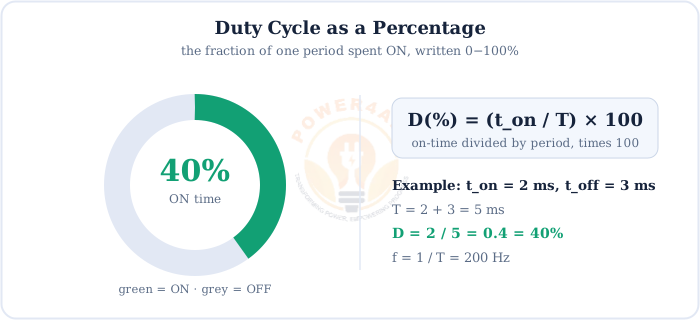
D = ton / T · D(%) = (ton / T) × 100
Duty cycle as a fraction (0–1), or times 100 for a percentage (0–100%)
Worked example 1 — from times
A pulse is HIGH for ton = 2 ms and LOW for toff = 3 ms.
T = 2 + 3 = 5 ms, so D = 2/5 = 0.4 = 40%.
The frequency is f = 1/T = 1/0.005 = 200 Hz.
Worked example 2 — find ton
A 10 kHz PWM signal (period T = 100 µs) needs a 30% duty cycle.
ton = D × T = 0.30 × 100 µs = 30 µs HIGH, and 70 µs LOW.
Duty cycle vs mark-space ratio
Some textbooks quote the mark-to-space ratio = ton : toff instead. A 50% duty cycle is a 1:1 mark-space ratio; a 75% duty cycle is 3:1. Both describe the same waveform.
Duty Cycle from 0% to 100%
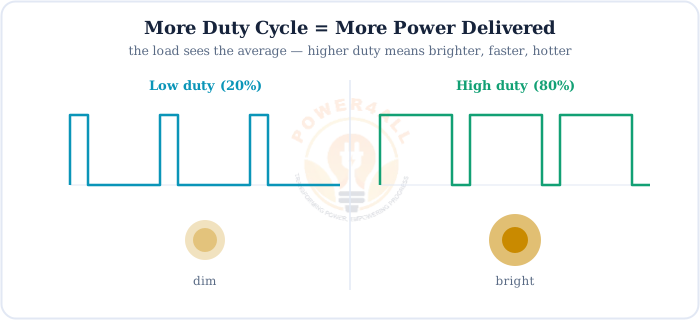
Keep the frequency fixed and slide the duty cycle up: the pulses grow wider, and the average the load feels rises steadily with them.
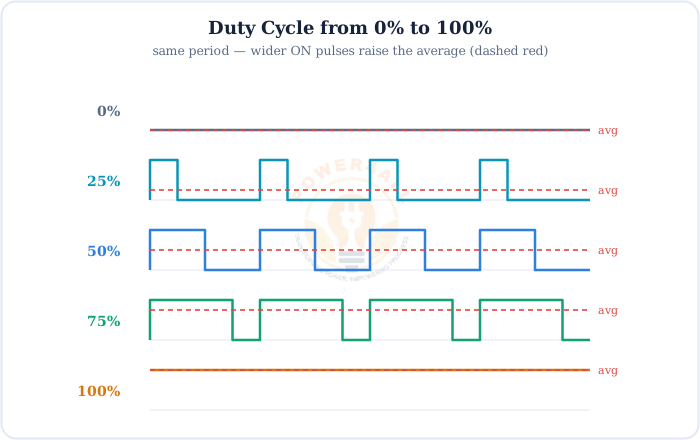
| Duty cycle | Waveform | Average (on a 12 V supply) |
|---|---|---|
| 0% | Always OFF | 0 V |
| 25% | ON a quarter of each cycle | 3 V |
| 50% | Symmetric square wave | 6 V |
| 75% | ON three-quarters of each cycle | 9 V |
| 100% | Always ON (steady DC) | 12 V |
Duty Cycle & Average Value
The reason duty cycle matters so much is this: for a signal that switches between 0 and a supply V, the average value is directly proportional to the duty cycle.
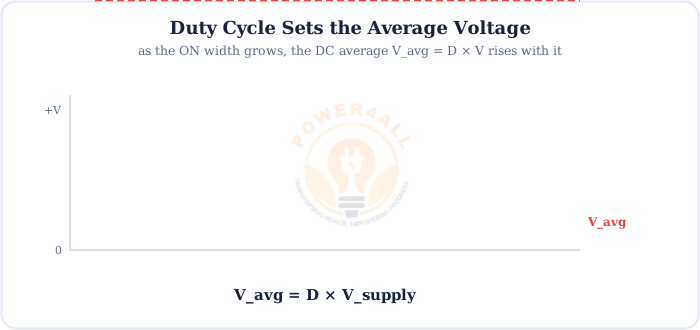
Vavg = D × Vsupply
Average (DC) value from duty cycle D and the HIGH level Vsupply
Worked example
A 12 V supply is switched at D = 75%:
Vavg = 0.75 × 12 = 9 V. Need 6 V instead? Set D = 6/12 = 50%.
This linear link is exactly why PWM works: it lets a purely digital ON/OFF switch deliver any average between 0 and the full supply, simply by choosing the duty cycle. In a buck converter the same rule gives Vout = D × Vin.
Complementary Duty Cycle & Dead-time
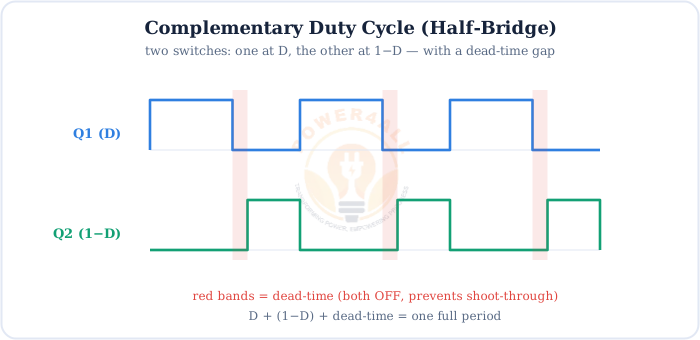
In half-bridge and full-bridge circuits two switches share the same leg. One runs at duty D, the other at 1 − D, so they take turns — but never at the exact same instant.
Why dead-time is essential
Real MOSFETs and IGBTs take time to turn off. If the top switch is still closing while the bottom one opens, both conduct at once — a shoot-through short across the DC bus that can destroy the devices. A small dead-time (tens to hundreds of nanoseconds) guarantees a clean hand-over.
Dhigh + Dlow + dead-time = 1 (one full period)
The two complementary duties plus the dead-time fill exactly one period
How to Measure Duty Cycle
Duty cycle is easy to read once you can see or time the waveform. Three common ways:
Oscilloscope
Measure ton and T with cursors and divide — or use the scope’s automatic +Duty readout.
Multimeter
Many DMMs have a % duty function on the frequency range — probe the signal and read directly.
Microcontroller
Use input-capture timers to record the HIGH and LOW durations, then compute ton/(ton+toff).
Estimate from the average
If you can only measure the DC average with a filtered meter, reverse the formula: D = Vavg / Vsupply. A 3 V average on a 12 V rail means a 25% duty cycle.
Where Duty Cycle Matters
Because it sets the delivered average, duty cycle is the control variable in an enormous range of systems.
Motor speed
The duty cycle of the PWM drive sets DC and BLDC motor speed and fan RPM.
LED dimming
Brightness follows duty cycle without shifting the LED colour.
SMPS & converters
Buck/boost regulators hold the output by trimming the switch duty cycle.
Servos & ESCs
Pulse-width (a duty within a fixed frame) sets servo angle and throttle.
Heaters
Slow on/off duty (a few Hz) sets average heating power in ovens and irons.
Transmitters & welding
“Duty cycle” also rates how long RF gear or a welder can run before it must cool.
Another meaning: equipment duty rating
On a welder or transmitter, a “60% duty cycle” means it can operate for 6 minutes out of every 10 before overheating. Same ratio idea — on-time over total time — applied to thermal limits.
Key Terms at a Glance
The essential duty-cycle vocabulary students and engineers search for.
Duty cycle (D)
ton/T — fraction of time ON.
On-time (ton)
Pulse width; time HIGH each cycle.
Off-time (toff)
Time LOW each cycle.
Duty ratio / factor
Other names for duty cycle.
Mark-space ratio
ton : toff.
Dead-time
Both switches OFF; stops shoot-through.
Frequently Asked Questions
Quick, expert answers to the questions people ask most about duty cycle.
What is duty cycle in simple words?
Duty cycle is the fraction of each cycle that a signal stays ON (HIGH). If a pulse is on for half of every cycle, its duty cycle is 50 percent. A higher duty cycle means the signal is on for longer and delivers more average power.
What is the formula for duty cycle?
Duty cycle D = ton / T, where ton is the on-time and T is the period (ton + toff). To get a percentage, multiply by 100, so D(%) = (ton / T) × 100.
How do you calculate duty cycle as a percentage?
Divide the on-time by the period and multiply by 100. For example, if a pulse is on for 2 ms and off for 3 ms, the period is 5 ms, so the duty cycle is (2 / 5) × 100 = 40 percent.
What does a 50 percent duty cycle mean?
A 50 percent duty cycle means the signal is ON for exactly half of every period and OFF for the other half. This produces a symmetric square wave and delivers an average equal to half the supply voltage.
What is the unit of duty cycle?
Duty cycle has no unit because it is a ratio of two times. It is expressed either as a fraction between 0 and 1 or, more commonly, as a percentage between 0 and 100 percent.
How does duty cycle affect average voltage?
The average (DC) output of a switched signal is Vavg = D × Vsupply. A higher duty cycle raises the average voltage in direct proportion, which is exactly how PWM controls motor speed, LED brightness and converter output.
What is the difference between duty cycle and frequency?
Frequency is how many cycles occur per second and is usually kept fixed. Duty cycle is the fraction of each cycle that is ON and is varied to control the output. You change duty cycle to set power and choose frequency for smooth, quiet operation.
What is complementary duty cycle and dead-time?
In a half-bridge, one switch runs at duty D and the other at 1 minus D so they are never on together. A short dead-time is inserted between them, when both are off, to prevent shoot-through, a damaging short across the supply.
How do you measure duty cycle?
With an oscilloscope you measure the on-time and the period from the waveform and divide them, or use the scope’s automatic duty measurement. Many multimeters have a percent duty mode, and microcontrollers can time the high and low durations directly.
What is the maximum duty cycle?
In principle the maximum is 100 percent, meaning the signal is always ON. In real switching circuits it is limited to slightly less than 100 percent because time is needed to switch, refresh gate drives or insert dead-time.
Conclusion & Key Takeaways
Duty cycle is one small ratio with huge reach — the number that turns a digital switch into a precise, efficient power controller.
D = ton/T
Fraction of the period spent ON.
0–100%
A unitless ratio, usually a %.
Vavg = D×V
Duty sets the average value.
Independent of f
Same ratio at any frequency.
1−D + dead-time
Complementary duty in bridges.
Control everywhere
PWM, motors, LEDs, SMPS.