Period & Frequency
The complete guide to the two sides of a repeating wave — the period T (the time for one cycle) and the frequency f (cycles per second) — and the simple reciprocal that binds them: T = 1/f. With units, how to read the period on a scope, angular frequency and real mains examples.
Complete Learning Path — Period & Frequency
From the period and frequency, to the reciprocal T = 1/f, units, reading the period, angular frequency, mains examples and applications
What is the Period?
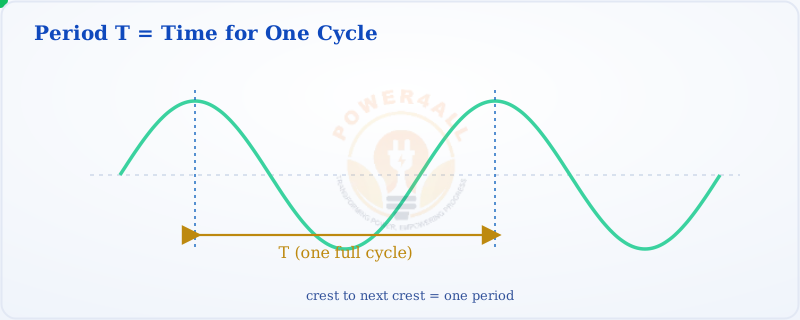
The period is the time taken for one complete cycle of a repeating wave. It has the symbol T and is measured in seconds. Whether it is a swinging pendulum, an AC voltage or a sound wave, the period is simply how long one full repetition lasts.
Any matching points
You can measure the period between any two identical points — crest to crest, trough to trough, or between rising zero-crossings. They all give the same T.
What is Frequency?
Frequency is the flip side of the period: the number of complete cycles per second. It has the symbol f and is measured in hertz (Hz), where one hertz is one cycle per second.
Where the period asks “how long is one cycle?”, the frequency asks “how many cycles fit in a second?” They describe the same repetition from opposite ends — which is exactly why they are reciprocals. For a deeper dive on frequency alone, see the full Frequency guide.
Two questions, one wave
Period is a duration (seconds); frequency is a rate (per second). A 50 Hz wave fits 50 cycles into a second, and each of those cycles lasts 1/50 s.
The Reciprocal Relationship: T = 1/f
Period and frequency always multiply to one, so each is the reciprocal of the other. Squeeze more cycles into a second (higher f) and each cycle must get shorter (smaller T), and vice-versa.
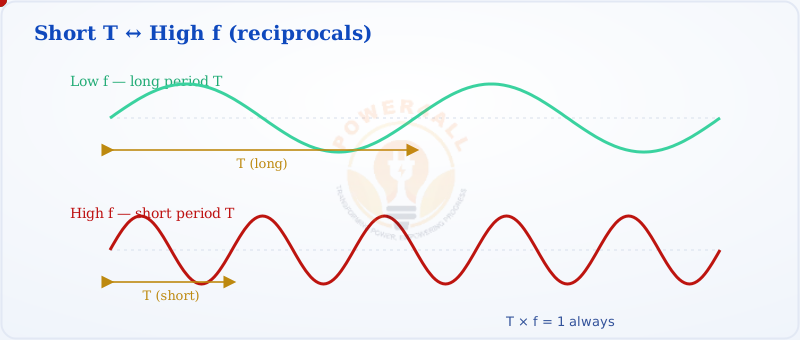
T = 1 / f · f = 1 / T
Period (seconds) = 1 ÷ frequency (hertz), and vice-versa
Worked example — both directions
A signal has a frequency of f = 2 kHz. Its period is:
T = 1 / f = 1 / 2000 = 0.5 ms
And a wave whose period is T = 4 ms has f = 1 / 0.004 = 250 Hz.
Units & Conversions
Because the period is a time, it uses time units. High frequencies mean tiny periods, so the prefixes shrink fast — from seconds down to nanoseconds.
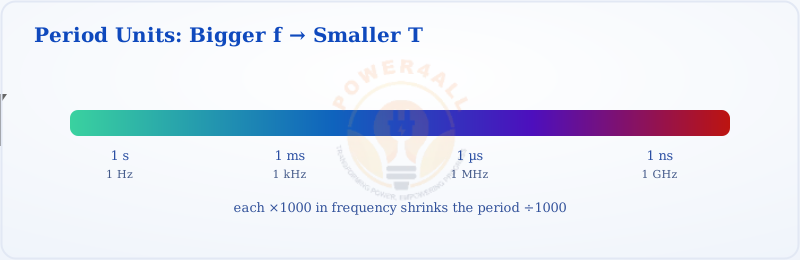
| Frequency | Period (T = 1/f) | Typical example |
|---|---|---|
| 1 Hz | 1 s | A slow blink |
| 50 Hz | 20 ms | Indian / EU mains |
| 1 kHz | 1 ms | Audio tone |
| 1 MHz | 1 µs | AM radio |
| 1 GHz | 1 ns | CPU clock / Wi-Fi |
Reading the Period on a Scope
On an oscilloscope, the period is a distance you read straight off the horizontal (time) axis. Count the divisions for one cycle, multiply by the time-per-division, and you have T — then f = 1/T.
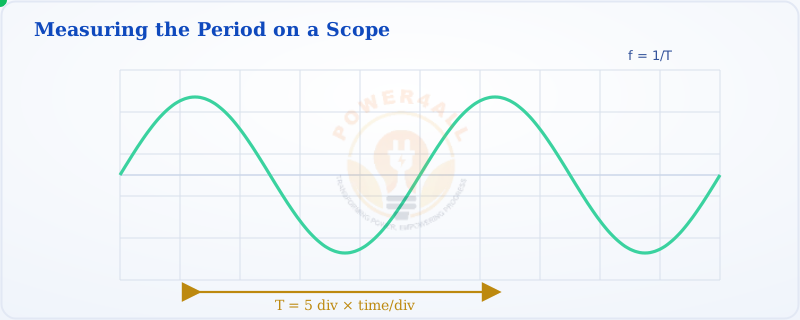
Measure a whole cycle
Always span exactly one complete cycle (matching point to matching point). Measuring part of a cycle, or crest-to-trough (half a cycle), gives the wrong period.
Period & Angular Frequency
In AC maths the period also sets the angular frequency ω — the rate the phase spins, in radians per second. Since one cycle is 2π radians and takes a time T, ω = 2π/T = 2πf.
ω = 2π / T = 2πf
Angular frequency (rad/s) from the period or the frequency
Worked example — angular frequency of mains
The 50 Hz mains has a period T = 20 ms. Its angular frequency is:
ω = 2π / T = 2π / 0.02 ≈ 314 rad/s
This is the 314 that appears in reactance formulas such as XL = ωL.
Period of the Mains & Everyday Signals
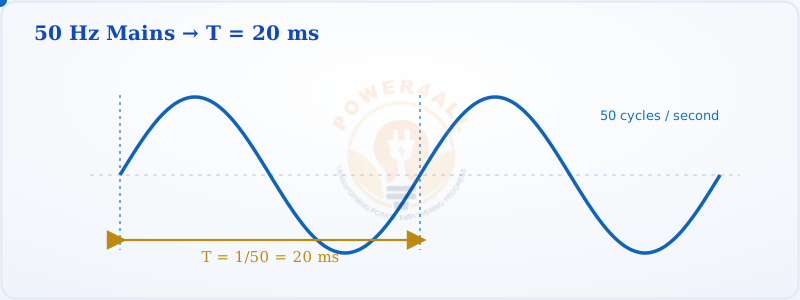
The clearest example is the power grid: a 50 Hz supply has a 20 ms period, and a 60 Hz supply has a 16.67 ms period.
Where Period & Frequency Matter
The period–frequency pair is the backbone of timing everywhere in electronics.
Clocks & timing
A CPU’s clock period sets how long each operation gets; a 1 GHz clock has a 1 ns period.
Power systems
Grid timing (20 ms at 50 Hz) governs synchronising, protection and firing angles.
Communications
Bit periods and carrier periods set data rates and channel spacing.
555 timers & PWM
Oscillator and PWM design starts from the target period, then sets R and C.
Work with timing directly using the Frequency guide, Phase, and the Power Electronics Guide.
Key Terms at a Glance
The essential period / frequency vocabulary students and engineers search for.
Period (T)
Time for one cycle, in seconds. T = 1/f.
Frequency (f)
Cycles per second, in hertz. f = 1/T.
Cycle
One complete repetition of the waveform.
Hertz (Hz)
Unit of frequency; 1 Hz = 1 cycle/s.
Angular frequency (ω)
Phase rate; ω = 2π/T.
Reciprocal
T and f multiply to one: T×f = 1.
Frequently Asked Questions
Quick, expert answers to the questions people ask most about period and frequency.
What is the period of a wave in simple words?
The period is how long one complete cycle of a repeating wave takes, measured in seconds and given the symbol T. If a wave repeats every 20 ms, its period is 20 ms.
What is the relationship between period and frequency?
They are reciprocals: T = 1/f and f = 1/T. A short period means a high frequency and a long period means a low frequency, because T and f always multiply to one.
What is the formula linking period and frequency?
T = 1/f, with T in seconds and f in hertz. Rearranged, f = 1/T. So 50 Hz gives T = 1/50 = 20 ms.
What is the period of 50 Hz and 60 Hz mains?
A 50 Hz supply has T = 1/50 = 20 ms; a 60 Hz supply has T = 1/60 ≈ 16.67 ms. Each is the time for one full voltage cycle.
What is the unit of period?
The second (s), because the period is a time. Short periods are given in milliseconds (ms), microseconds (µs) or nanoseconds (ns) as the frequency rises.
How do you find the period from the frequency?
Divide one by the frequency: T = 1/f. For 1 kHz, T = 1 ms; for 1 MHz, T = 1 µs. To go the other way, f = 1/T.
How is the period measured on an oscilloscope?
Count the horizontal divisions for one full cycle and multiply by the time-per-division. The frequency is then f = 1/T. Digital scopes usually display both automatically.
What is angular frequency in terms of the period?
Angular frequency is ω = 2π/T = 2πf, in radians per second, because one cycle is 2π radians and takes a time T. At 50 Hz it is about 314 rad/s.
Conclusion & Key Takeaways
Period and frequency are two views of the same repetition — one a duration, one a rate — tied together by the simplest relationship in electronics: T = 1/f.
Period = time/cycle
Symbol T, in seconds.
Frequency = cycles/s
Symbol f, in hertz.
T = 1/f
Exact reciprocals; T×f = 1.
Units shrink fast
1 Hz→1 s, 1 GHz→1 ns.
ω = 2π/T
Angular frequency from period.
50 Hz = 20 ms
The everyday mains example.