What is Electromotive Force (EMF)?
The complete guide to electromotive force — the energy a source gives to every unit of charge to drive current around a circuit. From ε = W/Q and why EMF is not really a force, to the crucial difference between EMF and terminal voltage with internal resistance (V = ε − Ir), the sources of EMF, and cells in series and parallel.
Complete Learning Path — Electromotive Force
From what EMF is and ε = W/Q, to EMF vs terminal voltage, internal resistance, the V-I graph, sources of EMF and cell combinations
What is Electromotive Force?
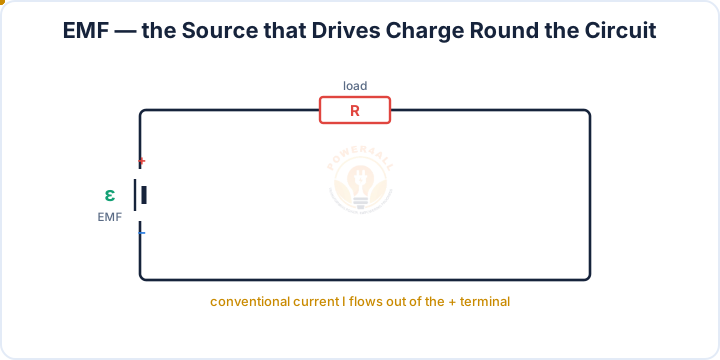
Electromotive force (EMF) is the energy a source — a battery, cell, generator or solar panel — gives to each unit of charge to push it around a circuit. It is the “driving voltage” of the source, given the symbol ε and measured in volts (V).
Think of the source as a charge pump: it does work on the charges, raising their energy so they can flow through the external circuit and deliver that energy to the resistances and devices along the way.
EMF is not a force!
Despite the name, EMF is not measured in newtons and is not a mechanical force. It is energy per unit charge, measured in volts (joules per coulomb). The name is just a historical hangover from early electrical science.
EMF = Energy per Unit Charge (ε = W/Q)
The precise definition: EMF is the work done by the source per unit charge in moving charge through it. If the source does work W on charge Q, its EMF is ε = W/Q.
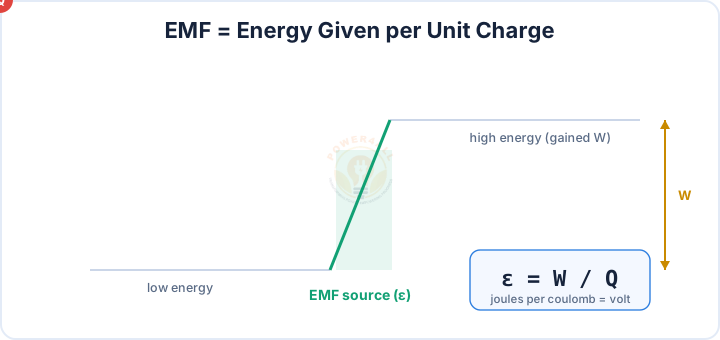
ε = W / Q
EMF (volts) = work done by the source (joules) ÷ charge moved (coulombs)
One volt = one joule per coulomb
A source with an EMF of 1 V gives 1 joule of energy to every 1 coulomb of charge that passes through it. This is the same volt used for voltage and potential difference.
EMF vs Terminal Voltage & Internal Resistance
This is the most important idea on the page. The EMF is what a source could deliver; the terminal voltage is what you actually measure across it once current flows — and it is always lower because of internal resistance.
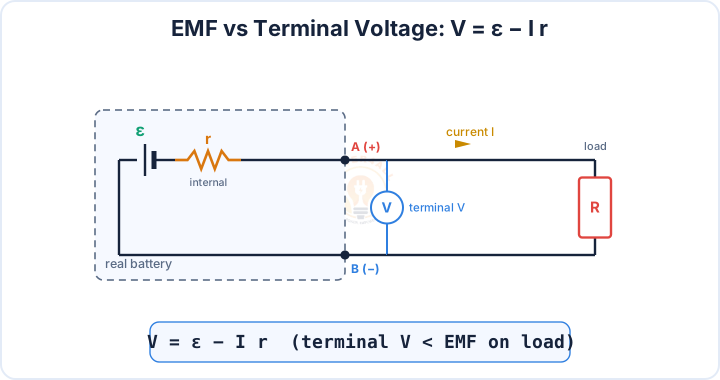
V = ε − I r
Terminal voltage = EMF − the voltage lost across the internal resistance
ε = I (R + r)
Full-circuit equation: the EMF drives current through both the load R and the internal resistance r
Worked example
A cell of EMF ε = 1.5 V and internal resistance r = 0.5 Ω drives a current of I = 0.6 A. The terminal voltage is:
V = ε − Ir = 1.5 − (0.6 × 0.5) = 1.5 − 0.3 = 1.2 V. The 0.3 V is lost inside the cell.
At no load, terminal voltage = EMF
When no current flows (an open circuit, I = 0), there is no Ir drop, so a high-impedance voltmeter across the terminals reads the full EMF. That is how you (approximately) measure EMF.
The Terminal-Voltage vs Current Graph
Plot terminal voltage against current and you get a straight line that reveals both the EMF and the internal resistance at a glance.
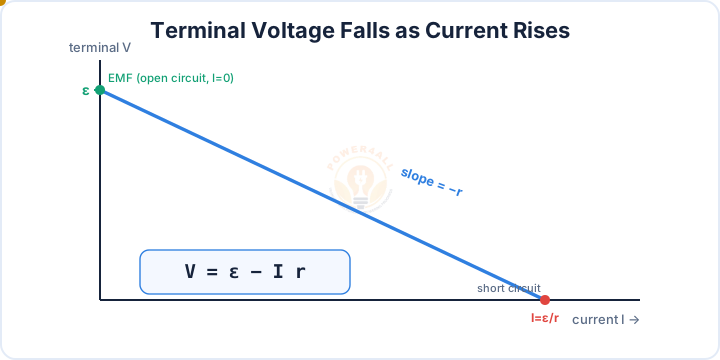
Intercept = EMF
Where the line meets the V-axis (I = 0) is the EMF ε — the open-circuit voltage.
Slope = −r
The steeper the fall, the larger the internal resistance r.
x-intercept = ε/r
The short-circuit current, when the terminal voltage collapses to zero.
Sources of EMF
Anything that converts another form of energy into electrical energy acts as a source of EMF.
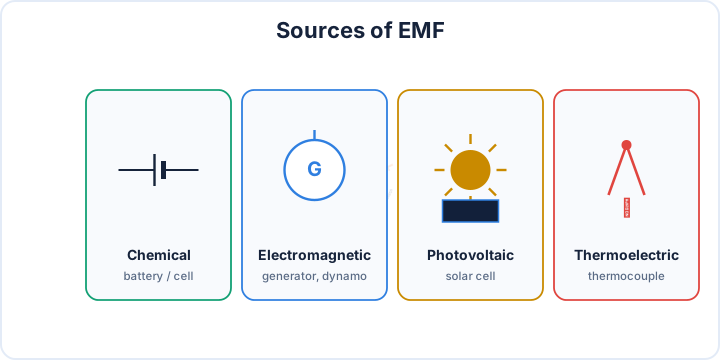
Chemical
Cells and batteries convert chemical energy into electrical energy via reactions at their electrodes.
Electromagnetic
Generators and dynamos induce an EMF by Faraday's law when a coil moves in a magnetic field.
Photovoltaic
Solar cells convert light energy directly into an EMF at a semiconductor junction.
Thermoelectric
Thermocouples produce a small EMF from a temperature difference between two joined metals.
Cells in Series & Parallel
Combine cells and their EMFs combine in predictable ways — the basis of every battery pack.
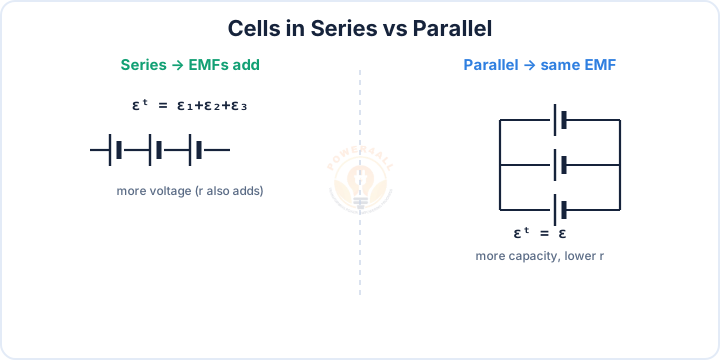
Series
εtotal = ε₁ + ε₂ + ε₃
Voltages add (so do the internal resistances). Four 1.5 V cells in series give 6 V. See series circuits.
Parallel
εtotal = ε
Same EMF, but more current capacity and lower internal resistance. See parallel circuits.
Where EMF Matters — Including Back-EMF
EMF underpins every power source and, in motors, a special “back-EMF” that power electronics engineers must respect.
Batteries & packs
Cell EMF and internal resistance set a pack's usable voltage under load and its maximum current.
Motors & back-EMF
A spinning motor generates a back-EMF opposing the supply (Lenz's law), limiting its running current — central to motor drives.
Generators
Power stations, alternators and wind turbines all deliver energy as an induced EMF.
Solar & sensing
Solar EMF powers PV systems; thermocouple EMF is used to sense temperature.
Key Terms at a Glance
The essential EMF vocabulary students and engineers search for.
EMF (ε)
Energy per charge from a source; ε = W/Q, in volts.
Terminal voltage (V)
What you measure on load; V = ε − Ir.
Internal resistance (r)
Resistance inside the source; causes the Ir drop.
Lost volts
Ir — voltage dropped inside the source.
Open-circuit voltage
Terminal voltage at I = 0, equals the EMF.
Back-EMF
EMF a motor generates opposing its supply.
Frequently Asked Questions
Quick, expert answers to the questions people ask most about electromotive force.
What is electromotive force in simple words?
EMF is the energy a source gives to each unit of charge to push it around a circuit — the “driving voltage” of a battery or generator. Its symbol is ε, its unit is the volt, and ε = W/Q.
Is EMF a force?
No. Even though it is called a “force”, EMF is energy per unit charge, measured in volts (joules per coulomb), not newtons. The name is historical.
What is the formula for EMF?
The definition is ε = W/Q (work per charge). In a full circuit ε = I(R + r), and the terminal voltage is V = ε − Ir.
What is the difference between EMF and terminal voltage?
EMF is the full energy per charge the source can supply (measured open-circuit). Terminal voltage is what you get on load, lower by the internal drop: V = ε − Ir. See Voltage.
What is internal resistance?
It is the small resistance inside a real source (the electrolyte and plates of a battery, the windings of a generator). It causes a voltage drop Ir when current flows, so the terminal voltage falls below the EMF.
Why is terminal voltage less than EMF?
Because part of the EMF is used driving current through the source's own internal resistance. The lost volts are Ir, leaving V = ε − Ir at the terminals. With no current, terminal voltage equals the EMF.
How do cell EMFs add in series and parallel?
In series the EMFs add: εtotal = ε₁ + ε₂ + ε₃ (internal resistances add too). In parallel, identical cells keep the same EMF but give lower internal resistance and more capacity.
What is back-EMF?
Back-EMF is the voltage a spinning motor generates that opposes its own supply (Lenz's law). It limits the running current of a motor and is a key idea in motor drives and power electronics.
Conclusion & Key Takeaways
EMF is the energy per charge that drives every circuit — and understanding the gap between EMF and terminal voltage is the key to real sources.
Driving energy
Symbol ε, unit volt.
ε = W/Q
Work per unit charge.
Not a force
It's energy per charge.
V = ε − Ir
Terminal voltage on load.
Internal resistance
Causes the lost volts.
Series adds EMF
Parallel keeps it, lowers r.