What is Phase & Phase Difference?
The complete guide to phase — where a wave is in its cycle — and phase difference, the angular offset φ between two waves. From in-phase, quadrature and anti-phase to leading vs lagging, phasors, and the phase between voltage and current in R, L and C circuits.
Complete Learning Path — Phase & Phase Difference
From the phase angle and phase difference, to in/out of phase, leading vs lagging, phasors, phase in R L C circuits, power factor and measurement
What is Phase?
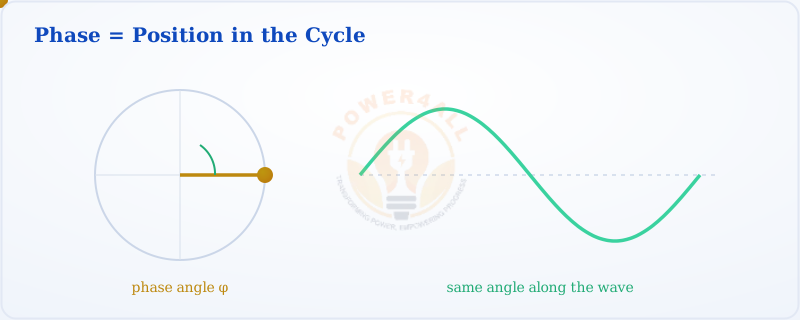
The phase of an alternating quantity is where it is in its cycle at a given instant — expressed as an angle. It is the φ term in the wave equation, setting where the sine begins relative to a reference.
v(t) = Vm sin(ωt + φ)
φ is the phase angle — the head-start (or delay) of the wave, in radians or degrees
Because a full cycle is 360° (2π radians), phase is measured in the same units as an angle. A phase of 90° means the wave is a quarter of a cycle along; 180° means it is half a cycle along.
Phase Difference
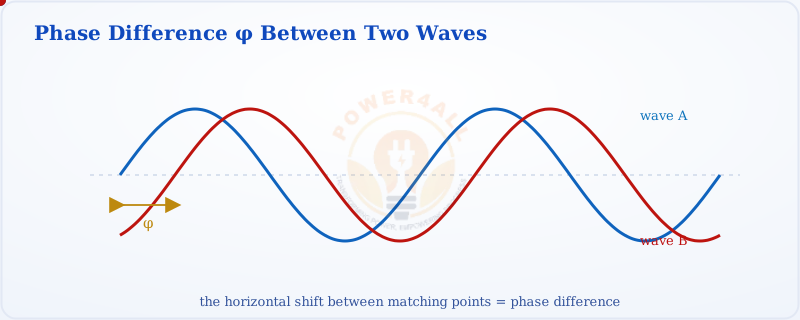
Phase difference is the angular gap φ between two waves of the same frequency. It measures how far one wave is shifted in time relative to the other — the horizontal offset between their matching points.
Same frequency only
Phase difference is only meaningful for waves of the same frequency. If the frequencies differ, the offset keeps changing and there is no fixed phase difference.
In Phase, Quadrature & Anti-phase
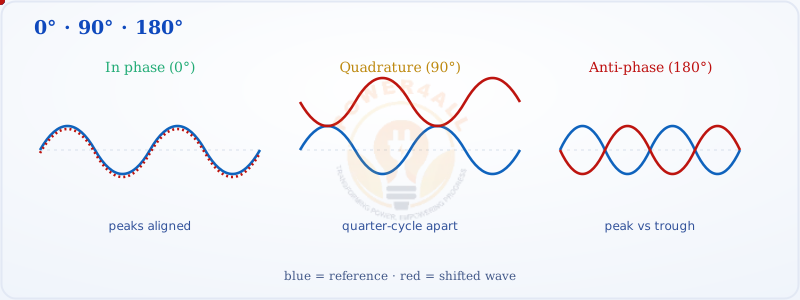
Three phase differences come up again and again: 0° (in phase), 90° (quadrature) and 180° (anti-phase).
In phase (0°)
Peaks and zero-crossings line up. The two waves reinforce — they add directly.
Quadrature (90°)
A quarter-cycle apart — one is at its peak when the other is at zero. The R–L–C case.
Anti-phase (180°)
Exact opposites — one peaks as the other troughs. Equal anti-phase waves cancel.
Leading vs Lagging
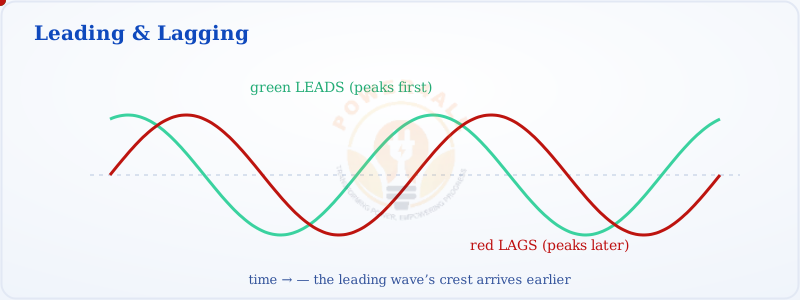
When two waves differ in phase, one reaches its peak before the other. The earlier one leads; the later one lags. It is all about which crest arrives first in time.
ELI the ICE man
The classic memory aid: in an L (inductor), voltage E leads current I → ELI. In a C (capacitor), current I leads voltage E → ICE.
Phasors: Phase as an Arrow
A phasor is a rotating arrow whose angle is the phase. Drawing waves as phasors turns tricky trigonometry into simple geometry — the angle between two phasors is their phase difference.
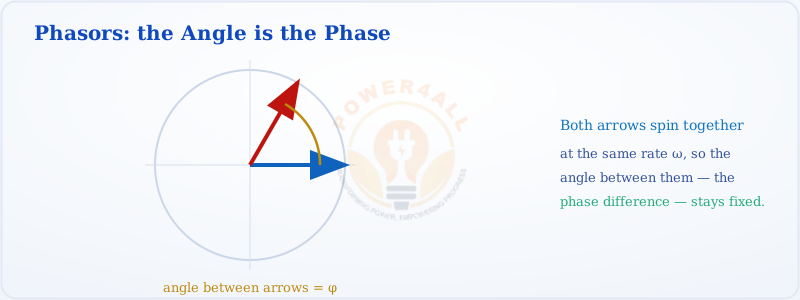
Phasors are the everyday tool behind reactance, impedance and power-factor calculations.
Phase in Resistors, Inductors & Capacitors
Phase is where R, L and C really differ. In a resistor voltage and current stay in step; an inductor makes current lag 90°; a capacitor makes current lead 90°.
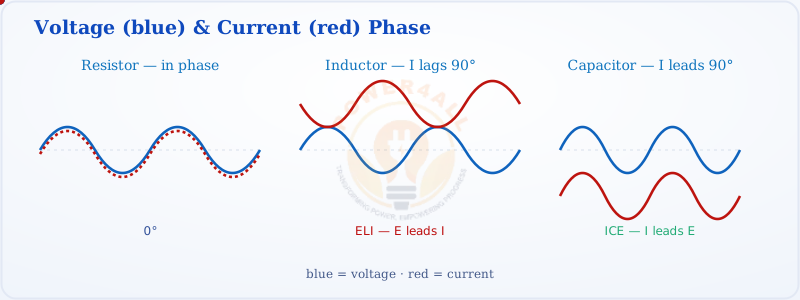
Resistor (R)
Voltage and current in phase (0°). All the power is real; power factor = 1.
Inductor (L)
Current lags voltage by 90° — ELI. Stores energy in a magnetic field.
Capacitor (C)
Current leads voltage by 90° — ICE. Stores energy in an electric field.
Phase & Power Factor
The phase angle between voltage and current decides how much power is actually useful. The power factor is simply the cosine of that angle.
Power factor = cosφ
φ = phase angle between voltage and current — 1 when in phase, 0 at 90°
Worked example — a 30° lagging load
A motor draws current lagging the voltage by φ = 30°. Its power factor is:
cos 30° = 0.866 (lagging)
So only 86.6% of the apparent power does useful work; the rest is reactive power sloshing back and forth.
Why phase costs money
A big phase angle means a poor power factor: more current for the same real power, bigger cables and utility penalties. Capacitor banks add leading phase to correct a lagging (inductive) load.
Measuring Phase Difference
Phase difference is measured by comparing two signals in time — the oscilloscope is the classic tool.
Dual-trace scope
Display both waves, read the time shift Δt between matching points, then φ = 360° × Δt / T.
Lissajous figure
Feed one signal to X and the other to Y; the resulting ellipse shape reveals the phase angle directly.
Phase meter / analyzer
Power and network analyzers compute the phase between voltage and current, and hence the power factor, automatically.
Time-to-angle
Convert a measured time shift to phase with φ = (Δt / T) × 360°, where T is the period. A 1 ms shift on a 20 ms (50 Hz) wave is an 18° phase difference.
Key Terms at a Glance
The essential phase vocabulary students and engineers search for.
Phase (φ)
Position within a cycle, as an angle.
Phase difference
Angular offset between two same-frequency waves.
In phase
0° — peaks aligned.
Quadrature
90° — a quarter cycle apart.
Anti-phase
180° — opposite; they cancel.
Lead / lag
Which wave crests first (C leads, L lags).
Frequently Asked Questions
Quick, expert answers to the questions people ask most about phase and phase difference.
What is phase in simple words?
Phase is where a wave is in its cycle at a given moment, expressed as an angle. In v = Vm sin(ωt + φ), the φ term is the phase — the wave’s head-start relative to a reference.
What is phase difference?
It is the angular gap between two waves of the same frequency, measured in degrees or radians. It shows how far one wave is shifted in time compared with the other — such as 90° or 180°.
What does in phase and out of phase mean?
In phase (0°) means the peaks and zero-crossings line up. Out of phase means they are shifted; a 180° shift is anti-phase, where one peaks as the other troughs and equal waves cancel.
What is the difference between leading and lagging?
A wave leads if its peak arrives earlier in time and lags if it arrives later. In a capacitor the current leads the voltage by 90°; in an inductor the current lags by 90°.
What is a 90 degree phase difference called?
Quadrature. The two waves are a quarter cycle apart, so one is at its peak when the other is at zero. Inductors and capacitors create this 90° shift between voltage and current.
How does phase affect power factor?
The power factor is cosφ, the cosine of the phase angle between voltage and current. In phase gives a power factor of 1 (all useful power); a big phase angle lowers it and raises reactive power.
What is ELI the ICE man?
A memory aid for phase in reactive components: in an inductor (L), voltage E leads current I → ELI; in a capacitor (C), current I leads voltage E → ICE.
How do you measure phase difference?
With a dual-trace oscilloscope: measure the time shift Δt between the waves and use φ = 360° × Δt / T. A Lissajous figure or a power analyzer can also give the phase directly.
Conclusion & Key Takeaways
Phase tells you where a wave is in its cycle, and phase difference tells you how two waves line up. It governs interference, reactance and power factor across all of AC.
Phase = position
The angle φ in a cycle.
Phase difference
Offset between two same-f waves.
0° / 90° / 180°
In phase, quadrature, anti-phase.
Lead & lag
Which crest arrives first.
ELI the ICE man
L lags, C leads by 90°.
cosφ = power factor
Phase decides useful power.