What is Reactance (XL & XC)?
The complete guide to reactance — the frequency-dependent opposition of inductors and capacitors to AC. From XL = ωL and XC = 1/ωC to net reactance, the 90° phase shift, and how reactance differs from resistance.
Complete Learning Path — Reactance
From what reactance is, to inductive and capacitive reactance, net reactance, phase, and reactance vs resistance
What is Reactance?
Reactance is the opposition to alternating current from inductors and capacitors. Its symbol is X and its unit is the ohm (Ω). Unlike resistance, reactance does not waste energy as heat — it stores energy and gives it back, and it shifts the phase between voltage and current by 90°.
Reactance depends on frequency. There are two kinds: inductive reactance XL (which rises with frequency) and capacitive reactance XC (which falls with frequency). Together with resistance, reactance makes up impedance.
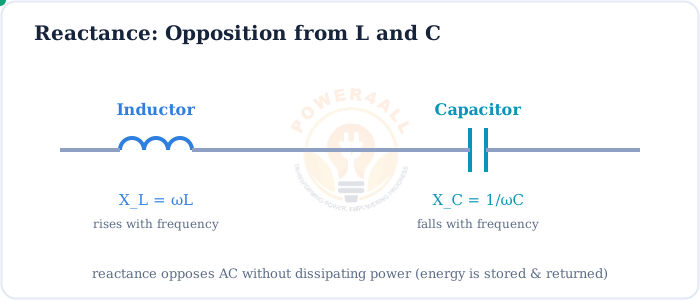
Reactance stores, resistance burns
A resistor converts energy to heat; a reactance (L or C) parks energy in a magnetic or electric field and returns it later. That is why reactance causes a phase shift but no power loss.
Inductive Reactance: XL = 2πfL
An inductor opposes changes in current, so the faster the current alternates, the harder it fights back. Inductive reactance rises with frequency.
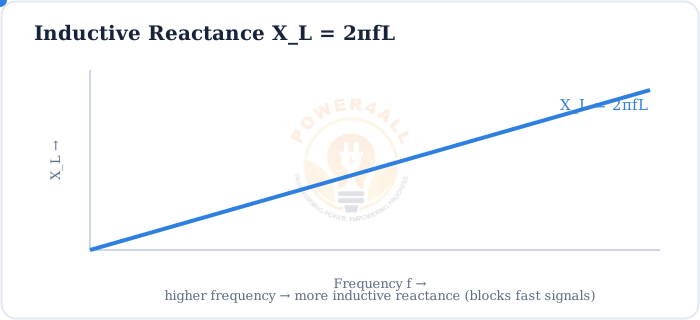
XL = 2πfL = ωL
Inductive reactance (Ω) — rises with frequency f and inductance L
Worked example
A 100 mH inductor at 50 Hz:
XL = 2π × 50 × 0.1 ≈ 31.4 Ω. At 5 kHz it would be 100× larger (≈ 3140 Ω).
Capacitive Reactance: XC = 1/2πfC
A capacitor passes current more easily the faster the voltage changes, so capacitive reactance falls with frequency. It blocks DC completely.
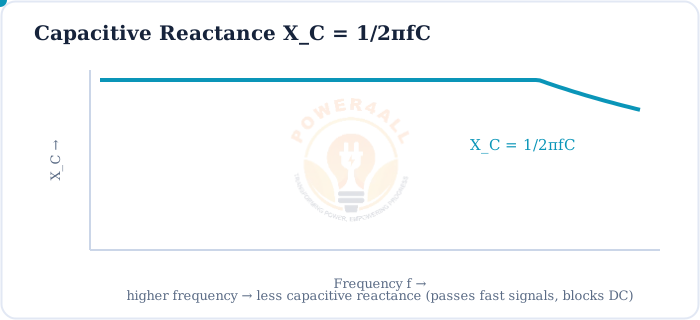
XC = 1 / (2πfC) = 1 / ωC
Capacitive reactance (Ω) — falls as frequency f or capacitance C rises
Worked example
A 1 µF capacitor at 50 Hz:
XC = 1 / (2π × 50 × 1×10⁻⁶) ≈ 3183 Ω. At 5 kHz it drops to about 31.8 Ω.
Net Reactance & Resonance
When an inductor and capacitor are in series, their reactances oppose each other. The net reactance is X = XL − XC. Where they are equal, they cancel — that is resonance.
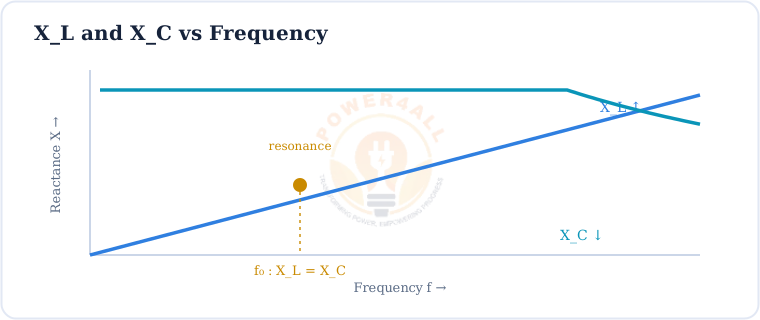
X = XL − XC · f₀ = 1/2π√(LC)
Net reactance, and the resonant frequency where XL = XC (X = 0)
Inductive or capacitive?
If XL > XC the circuit is net inductive (current lags); if XC > XL it is net capacitive (current leads). At resonance it looks purely resistive.
Reactance & Phase (ELI the ICE man)
Reactance always puts voltage and current 90° out of phase. The classic memory aid tells you which way.
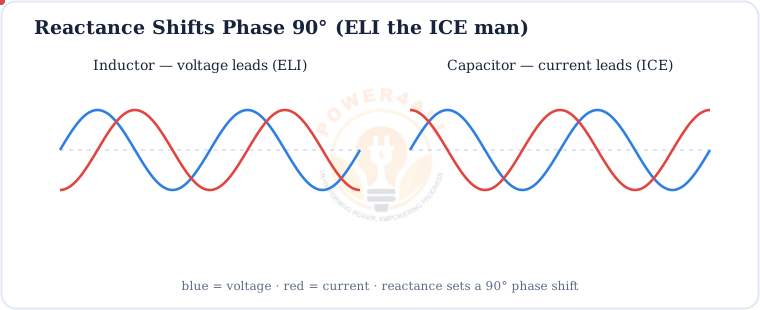
ELI the ICE man
E-L-I: in an inductor (L), voltage E leads current I. I-C-E: in a capacitor (C), current I leads voltage E.
Reactance vs Resistance vs Impedance
All three are measured in ohms, but they behave differently.
| Property | Resistance (R) | Reactance (X) | Impedance (Z) |
|---|---|---|---|
| From | Resistors | Inductors & capacitors | All combined |
| Dissipates power? | Yes (heat) | No (stores energy) | Only the R part |
| Frequency-dependent? | No | Yes | Yes |
| Phase shift | 0° | ±90° | −90° to +90° |
| Symbol | R | X (XL, XC) | Z = R + jX |
Reactance is the imaginary part of impedance: Z = R + jX.
Where Reactance Matters
Frequency-dependent reactance is the basis of filtering, tuning and power-factor control.
Filters
Because XL and XC change with frequency, RC and LC networks pass some frequencies and block others.
Tuning & resonance
Radios tune by finding where XL = XC to select one station.
Power factor
Inductive loads (motors) add lagging reactance; capacitor banks add leading reactance to correct it.
Reactors & chokes
Inductive reactance limits inrush and smooths current in drives and supplies.
Try the Reactance Calculator and the RLC Resonant Frequency Calculator.
Key Terms at a Glance
The essential reactance vocabulary students and engineers search for.
Reactance (X)
AC opposition from L and C; in ohms.
Inductive reactance
XL = 2πfL; rises with f.
Capacitive reactance
XC = 1/2πfC; falls with f.
Net reactance
X = XL − XC.
Resonance
Where XL = XC, X = 0.
Impedance (Z)
Z = R + jX.
Frequently Asked Questions
Quick, expert answers to the questions people ask most about reactance.
What is reactance in simple words?
Reactance is the opposition that inductors and capacitors give to alternating current. It does not burn energy like a resistor — it stores and returns it — and it shifts voltage and current 90° apart. Symbol X, unit ohm.
What is inductive reactance (XL)?
The opposition of an inductor to AC: XL = 2πfL = ωL. It rises with frequency, so an inductor blocks fast signals and passes slow ones. At DC it is zero (a short circuit).
What is capacitive reactance (XC)?
The opposition of a capacitor to AC: XC = 1/2πfC. It falls as frequency rises, so a capacitor passes fast signals and blocks DC (infinite reactance at f = 0).
What is the formula for reactance?
XL = 2πfL and XC = 1/2πfC. The net reactance of a series L-C is X = XL − XC, all in ohms.
What is the difference between reactance and resistance?
Resistance dissipates energy as heat and applies to both DC and AC. Reactance opposes only AC, changes with frequency, stores and returns energy, and causes a 90° phase shift. Together they form impedance.
What is the difference between reactance and impedance?
Reactance (X) is only the inductor/capacitor part of the opposition. Impedance (Z) is the total, combining resistance and reactance: Z = R + jX. Reactance is the imaginary part of impedance.
How does reactance affect the phase?
It shifts voltage and current by 90°. In an inductor voltage leads current (ELI); in a capacitor current leads voltage (ICE) — the ELI the ICE man rule.
What happens when XL = XC?
The reactances cancel, the net reactance is zero, and the circuit is at resonance — it behaves purely resistively. This happens at f₀ = 1/2π√(LC).
Conclusion & Key Takeaways
Reactance is the frequency-dependent, lossless opposition of inductors and capacitors — the reactive half of impedance.
Opposition from L & C
Symbol X, unit ohm.
XL = 2πfL
Rises with frequency.
XC = 1/2πfC
Falls with frequency.
X = XL − XC
Zero at resonance.
90° phase shift
ELI the ICE man.
No power loss
Stores & returns energy.