What is Magnetic Flux (Φ)?
The complete guide to magnetic flux — the total magnetic field through an area, Φ = B · A · cosθ — its unit the weber, flux density B = Φ/A, flux linkage NΦ, Faraday's law, why field lines form closed loops, and the magnetic-circuit analogy.
Complete Learning Path — Magnetic Flux
From what flux is and its formula, to the weber and flux density, flux linkage & Faraday's law, closed field-line loops and the magnetic-circuit analogy
What is Magnetic Flux?
Magnetic flux, given the symbol Φ (the Greek letter phi), is the total magnetic field passing through a given area. The simplest picture: it is the number of magnetic field lines crossing that area.
The more field lines pass through a surface, the greater the flux. For a uniform field passing straight through an area A with flux density B, the flux is simply Φ = B × A. Magnetic flux is the foundation of electromagnetic induction, transformers, motors and generators.
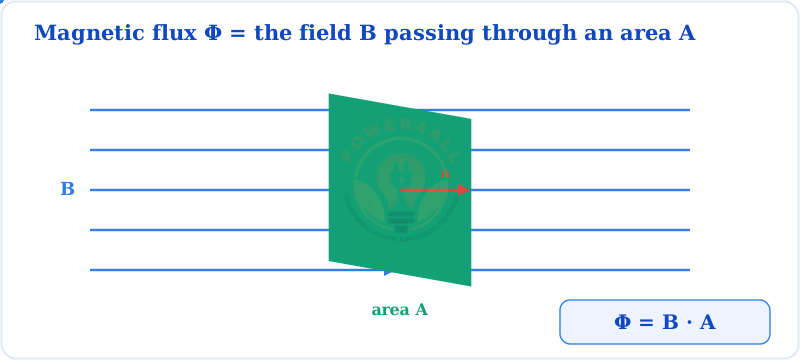
Flux is a "how much field, through here" quantity
Flux density B (tesla) tells you how strong the field is at a point; magnetic flux Φ (weber) tells you how much of that field is threading through a whole area.
The Magnetic Flux Formula: Φ = B·A·cosθ
Flux depends not just on the field and area, but on their angle. Only the part of the field that passes through the surface counts — so the full formula includes cosθ.
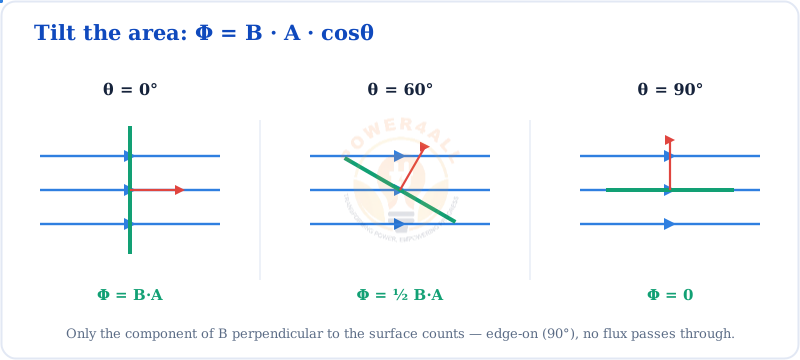
Φ = B · A · cosθ
General magnetic flux — θ is the angle between B and the area's normal (perpendicular)
Worked example — flux through a coil
A field of B = 0.4 T passes through a coil of area A = 0.05 m², tilted so θ = 30°:
Φ = 0.4 × 0.05 × cos30° = 0.4 × 0.05 × 0.866 ≈ 0.0173 Wb
Straighten the coil to face the field (θ = 0) and the flux rises to its maximum, 0.4 × 0.05 = 0.02 Wb.
The general case
For a non-uniform field, flux is the integral Φ = ∫ B · dA over the surface. For most problems the simple Φ = B·A·cosθ is all you need.
Flux Density B and the Weber
People often mix up flux and flux density. Flux density B is the flux packed into each unit of area — B = Φ/A — measured in tesla (T).
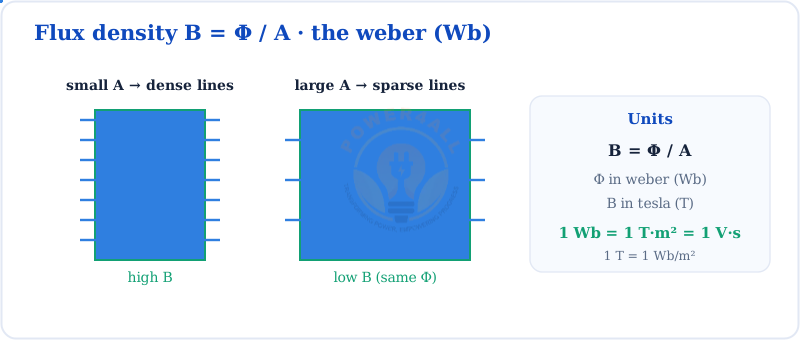
B = Φ / A • 1 Wb = 1 T·m² = 1 V·s
Flux density in tesla; the weber ties flux to both field-area and induced voltage
| Quantity | Symbol | SI Unit | Relationship |
|---|---|---|---|
| Magnetic flux | Φ | weber (Wb) | Φ = B·A·cosθ |
| Flux density | B | tesla (T) | B = Φ/A |
| Flux linkage | λ = NΦ | weber-turn | λ = N·Φ |
| Area | A | m² | A = Φ/B |
Flux Linkage & Faraday's Law
Wind a coil of N turns and each turn links the same flux, so the total flux linkage is NΦ. When that flux changes, it induces a voltage — this is Faraday's law.
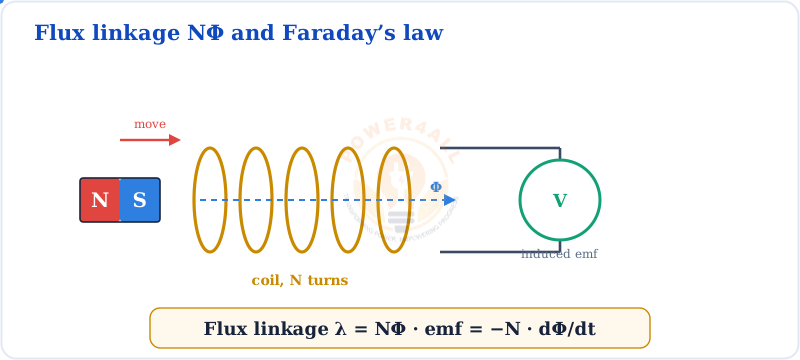
λ = NΦ • emf = −N · dΦ/dt
Flux linkage and Faraday's law of electromagnetic induction (the minus sign is Lenz's law)
Why flux matters so much
Almost all electrical power depends on changing flux: transformers couple flux between windings, inductors store energy in flux, and generators turn mechanical motion into a changing flux that drives current.
Flux Lines Form Closed Loops
Unlike electric field lines that start and end on charges, magnetic field lines always form closed loops. There are no magnetic monopoles, so flux is continuous.
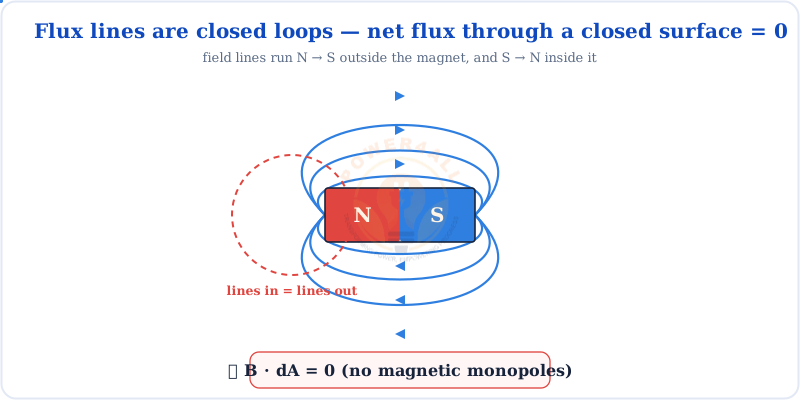
∮ B · dA = 0
Gauss's law for magnetism — the net magnetic flux through any closed surface is always zero
No magnetic monopoles
You can never isolate a single north or south pole. Cut a magnet in half and you get two smaller magnets, each with its own N and S — the field lines stay unbroken loops.
The Magnetic Circuit Analogy
Flux behaves in a magnetic core just like current in a wire. This magnetic circuit view makes designing transformers and inductors far easier.
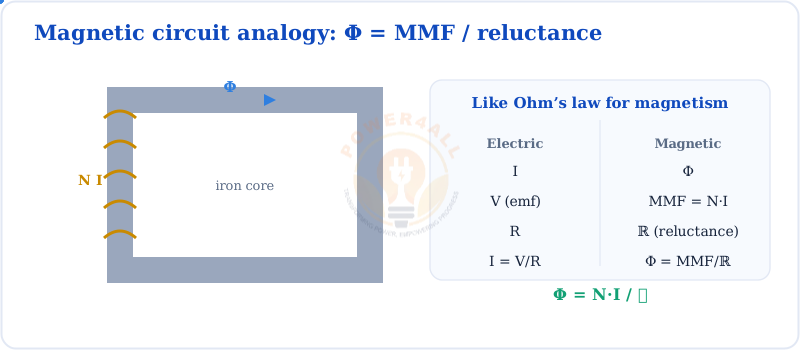
Φ = MMF / ℝ = N·I / ℝ
Hopkinson's law — flux = magnetomotive force ÷ reluctance (the magnetic Ohm's law)
| Electric circuit | Magnetic circuit |
|---|---|
| Current I | Flux Φ |
| EMF / Voltage V | Magnetomotive force MMF = N·I |
| Resistance R | Reluctance ℝ |
| I = V / R | Φ = MMF / ℝ |
Where Magnetic Flux is Used
Magnetic flux is not just theory — changing flux is how nearly all electrical energy is generated, converted and stored.
Transformers
Shared flux in a core couples the primary and secondary transformer windings to step voltage up or down.
Generators & motors
Rotating machines rely on a changing flux to induce emf (generators) or produce torque (motors).
Inductors & chokes
An inductor stores energy in the magnetic flux set up by its current.
Sensors & relays
Flux sensing underlies Hall sensors, reed switches and the relay that pulls in when flux builds.
Flux is the link between electricity and magnetism
Current makes flux (Ampère's law); changing flux makes voltage (Faraday's law). That two-way link is the whole of electromagnetism.
Key Terms at a Glance
The essential magnetic-flux vocabulary students and engineers search for.
Magnetic flux (Φ)
Total field through an area; Φ = B·A·cosθ.
Weber (Wb)
SI unit; 1 Wb = 1 T·m² = 1 V·s.
Flux density (B)
Flux per area; B = Φ/A, in tesla.
Flux linkage (λ)
λ = NΦ, in weber-turns.
MMF
Magnetomotive force = N·I, drives flux.
Reluctance (ℝ)
Magnetic resistance; Φ = MMF/ℝ.
Frequently Asked Questions
Quick, expert answers to the questions people ask most about magnetic flux.
What is magnetic flux in simple words?
Magnetic flux (Φ) is the total amount of magnetic field passing through an area — think of it as the number of field lines crossing that area. For a uniform field perpendicular to the area, Φ = B × A, measured in webers (Wb).
What is the formula for magnetic flux?
Φ = B × A × cosθ, where B is the flux density, A the area, and θ the angle between the field and the area's normal. When the field is perpendicular to the area (θ = 0), it simplifies to Φ = B × A.
What is the SI unit of magnetic flux?
The weber (Wb). One weber equals one tesla times one square metre (T·m²) and also one volt second (V·s), because flux changing by one weber per second induces one volt.
What is the difference between magnetic flux and flux density?
Magnetic flux (Φ, in webers) is the total field through an area. Flux density (B, in tesla) is flux per unit area, B = Φ/A. The same flux in a smaller area gives a higher flux density.
Why is flux maximum when the area faces the field?
Because flux depends on cosθ. Facing the field (θ = 0) gives cosθ = 1 and the most lines through; edge-on (θ = 90°) gives cosθ = 0 and no flux at all.
What is flux linkage?
Flux linkage is the total flux linked with a coil: λ = N × Φ, where N is the number of turns. Measured in weber-turns, it is central to Faraday's law.
How is magnetic flux related to Faraday's law?
A changing flux induces an emf: emf = −N × dΦ/dt. The faster the flux through a coil changes, the larger the induced voltage — the basis of generators, transformers and inductors.
Why do magnetic field lines form closed loops?
Because there are no magnetic monopoles. Every line leaving a north pole returns to a south pole and back through the magnet, so the net flux through any closed surface is zero — Gauss's law for magnetism, ∮ B·dA = 0.
Conclusion & Key Takeaways
Magnetic flux Φ is the total field through an area, Φ = B·A·cosθ, measured in webers. Its rate of change drives every generator, transformer and inductor through Faraday's law.
Φ = B·A·cosθ
Field through an area.
Unit: weber
1 Wb = 1 T·m² = 1 V·s.
B = Φ/A
Flux density in tesla.
emf = −N dΦ/dt
Changing flux makes voltage.
Closed loops
Net flux through a surface = 0.
Φ = MMF/ℝ
The magnetic Ohm's law.