Sine Wave
The complete guide to the sine wave — the pure, fundamental waveform of alternating current. From v(t) = Vmsin(2πft + φ) to amplitude, period, frequency, phase, and its peak, RMS and average values.
Complete Learning Path — Sine Wave
From the anatomy of a sinusoid and its equation, through the unit circle, its values, frequency, period and phase, to why sine waves rule AC
What is a Sine Wave?
A sine wave (or sinusoid) is the smooth, repeating S-shaped curve that is the purest form of alternating current. It contains a single frequency — nothing else — which is why it is called the fundamental waveform.
Every sine wave is fully described by three numbers: its amplitude (how tall), its frequency (how fast), and its phase (where it starts). The diagram below names the parts you will meet on every waveform.
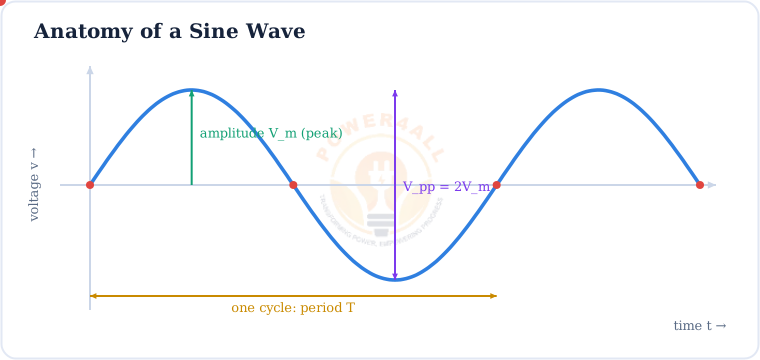
Why an “S” shape?
The sine curve is exactly the shape you get when something rotates steadily — like a generator coil spinning in a magnetic field. That deep link to rotation is why sinusoids appear everywhere in nature and engineering.
The Sine Wave Equation
A sine wave is captured by one compact formula. Learn it once and every AC problem becomes readable.
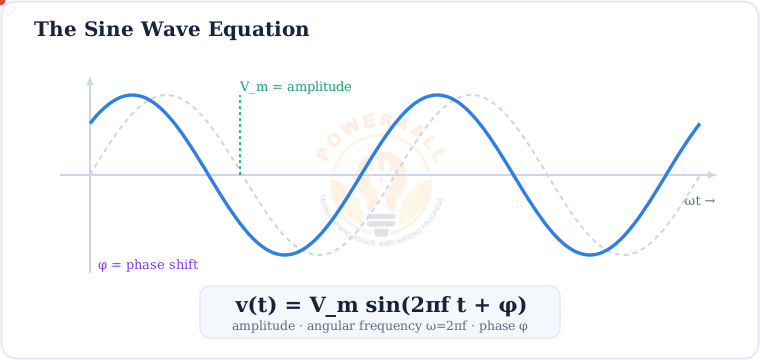
v(t) = Vm sin(2πft + φ) = Vm sin(ωt + φ)
Instantaneous value — amplitude Vm, angular frequency ω = 2πf, phase φ
Worked example — Indian mains
Household mains is 230 V RMS at 50 Hz. The peak is Vm = 230√2 ≈ 325 V, so:
v(t) = 325 sin(2π × 50 × t) = 325 sin(314 t) volts, with period T = 1/50 = 20 ms.
Sine & the Unit Circle
Where does the shape come from? A sine wave is literally the height of a point moving around a circle at constant speed.
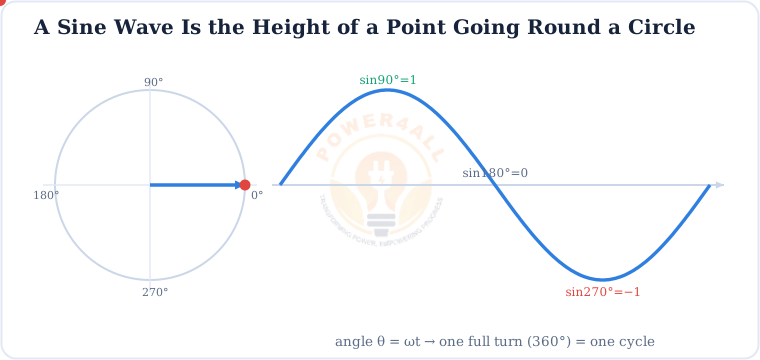
This is the phasor idea
That rotating arrow is exactly a phasor. Because the height is sin(ωt), angle and time are linked by θ = ωt — the bridge between waveforms and phasor analysis.
Peak, RMS & Average Values
A sine wave’s value changes every instant, so we describe it with a few standard measures.
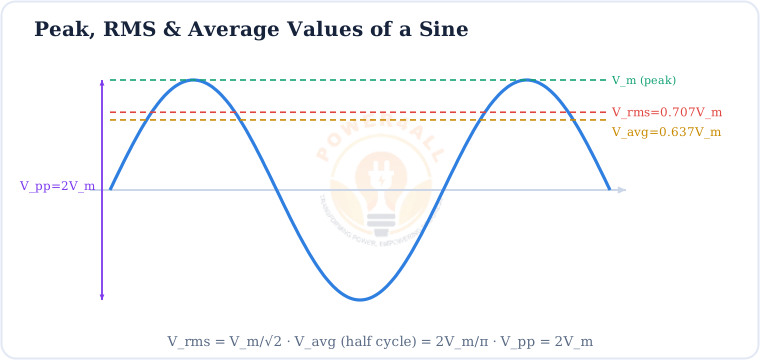
Vrms = Vm/√2 ≈ 0.707 Vm · Vavg = 2Vm/π ≈ 0.637 Vm
RMS (effective) value and half-cycle average of a sinusoid
| Quantity | Value (for a sine) | Meaning |
|---|---|---|
| Peak Vm | — | Maximum height from centre |
| Peak-to-peak | 2Vm | Crest to trough |
| RMS | 0.707 Vm | Effective / heating value |
| Average (half cycle) | 0.637 Vm | Mean of one half cycle |
| Form factor | 1.11 | RMS / average |
| Crest factor | 1.414 | Peak / RMS |
The full-cycle average is zero
Over a complete cycle the positive and negative halves cancel, so the average is 0. That is why we use the RMS value — it never cancels and gives the true power.
Frequency & Period
How fast the sine repeats is its frequency; how long one cycle takes is its period. They are reciprocals.
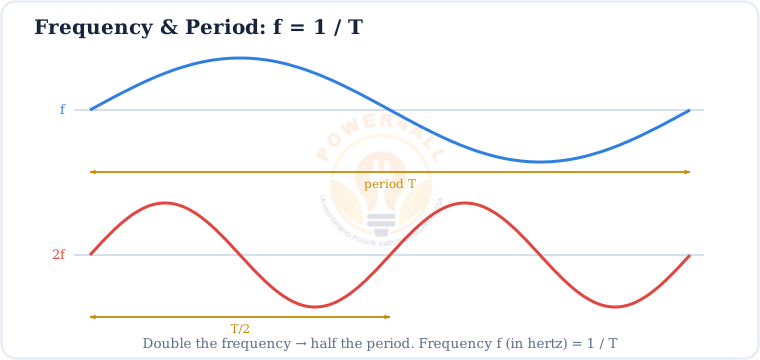
f = 1 / T · ω = 2πf = 2π/T
Frequency (Hz), period (s) and angular frequency (rad/s)
Worked example
Mains at 50 Hz: T = 1/50 = 20 ms and ω = 2π × 50 ≈ 314 rad/s. US mains at 60 Hz has T ≈ 16.7 ms.
Phase & Phase Difference
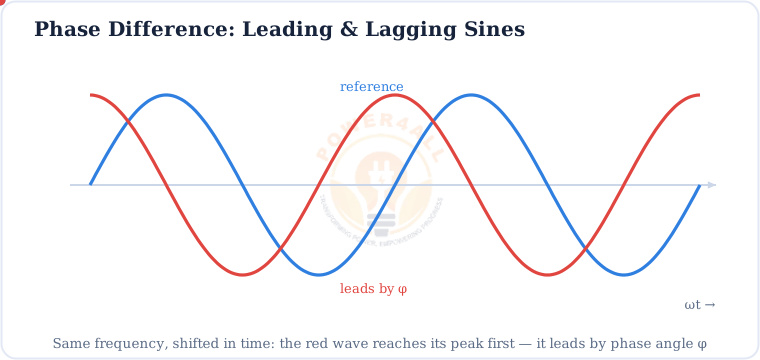
The phase tells you where in its cycle a sine starts. When two sines of the same frequency start at different points, one leads or lags the other.
Phase is the heart of AC power
In circuits with inductors and capacitors, current and voltage are sines shifted in phase. That phase angle sets the power factor and how much real power a load actually uses.
Why Sine Waves Rule AC
Of all possible shapes, why is the sine the one used for power and signals? Three deep reasons.
Natural from rotation
A coil spinning in a magnetic field generates a voltage that is exactly sinusoidal.
Building block of everything
By Fourier analysis, any repeating signal is a sum of sine waves — the fundamental plus harmonics.
Efficient transmission
Sinusoidal AC transforms cleanly between voltages, making the whole power grid possible.
Easy maths
Sinusoids turn calculus into phasor algebra, the basis of all AC analysis.
Carrier of signals
Radio, audio and communications all ride on sinusoidal carriers.
Compare it with other shapes on the way — and try the RMS, peak and average value guides.
Key Terms at a Glance
The essential sine-wave vocabulary students and engineers search for.
Sine wave
Pure single-frequency sinusoid.
Amplitude (Vm)
Peak height from the centre.
Period (T)
Time for one cycle.
Frequency (f)
f = 1/T, in hertz.
Angular frequency
ω = 2πf, in rad/s.
Phase (φ)
Starting point of the cycle.
RMS value
0.707 Vm; effective value.
Peak-to-peak
2 Vm.
Frequently Asked Questions
Quick, expert answers to the questions people ask most about sine waves.
What is a sine wave in simple words?
It is the smooth, repeating up-and-down curve of pure AC. It has one frequency and a rounded S-shape, and it is the wave you get when something spins steadily, like a generator. Its formula is v(t) = Vm sin(2πft + φ).
What is the equation of a sine wave?
v(t) = Vm sin(2πft + φ), where Vm is the amplitude, f the frequency, t the time and φ the phase. The term 2πf is the angular frequency ω.
What is the RMS value of a sine wave?
Vrms = Vm/√2 ≈ 0.707 Vm. It is the effective value that heats a resistor the same as an equal DC voltage. So 230 V RMS mains has a peak of about 325 V.
What is the average value of a sine wave?
Over a full cycle it is zero (the halves cancel). Over a half cycle it is 2Vm/π ≈ 0.637 Vm.
How are frequency and period related?
They are reciprocals: f = 1/T. The period is the time for one cycle; the frequency is cycles per second (hertz). 50 Hz means a 20 ms period.
What is the phase of a sine wave?
The phase φ sets where the wave is in its cycle at t = 0. Two sines of the same frequency with different phases are shifted in time; one leads or lags the other.
Why is the sine wave so important?
Generators produce it naturally, it keeps its shape through R, L and C, and every other signal can be built from sine waves (Fourier analysis). That makes it the fundamental building block of AC power and signals.
How is a sine wave different from a square or triangle wave?
A sine has a single pure frequency and is perfectly smooth. Square, triangle and sawtooth waves are a fundamental sine plus many harmonics, which gives them their sharp corners.
Conclusion & Key Takeaways
The sine wave is the pure, fundamental waveform of AC — simple to describe, and the foundation of everything that follows.
Pure single frequency
The fundamental waveform.
v = Vmsin(ωt+φ)
Amplitude, frequency, phase.
From rotation
Height of a point on a circle.
Vrms = 0.707Vm
The effective value.
f = 1/T
Frequency and period.
Building block
All signals are sums of sines.