What is an Electric Field?
The complete guide to the electric field — the region of influence around an electric charge where another charge feels a force. From the definition E = F/q (force per unit charge) and field lines, to field strength E = kQ/r² and the uniform field between capacitor plates E = V/d.
Complete Learning Path — Electric Field
From what an electric field is, to its formula, direction, field lines, strength and the uniform field
What is an Electric Field?
An electric field is the invisible region of influence around an electric charge in which any other charge feels a force — without the two ever touching. Every charge is surrounded by its own field, and that field is how one charge "reaches out" to push or pull another.
The electric field is a vector: at every point in space it has both a strength and a direction. We picture it with field lines that show which way a small positive charge would be pushed.

Field vs force
The field exists in space whether or not another charge is there. Put a charge in it and the field turns into a real force, F = qE. The field is the "readiness" to push; the force is the push itself.
Definition & Formula: E = F/q
The electric field strength at a point is the force per unit charge that a tiny positive test charge would feel there. Divide the force by the charge and you get a property of the point in space, independent of the test charge you used.
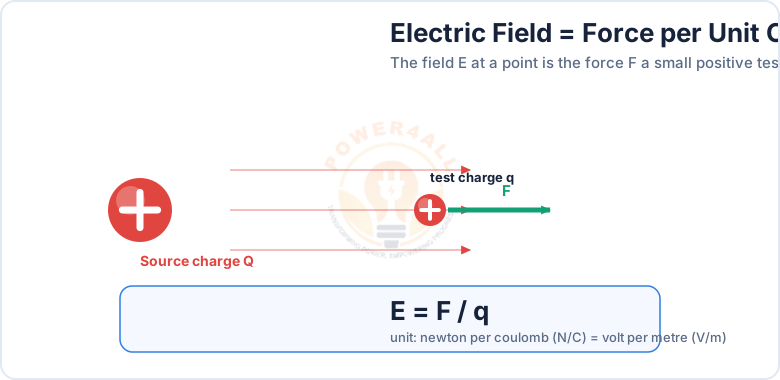
E = F / q · F = qE
Electric field in newtons per coulomb (N/C) = volts per metre (V/m)
Worked example
A charge of 2 µC placed at a point feels a force of 0.1 N:
E = F/q = 0.1 / (2×10⁻⁶) = 50,000 N/C. A 5 µC charge at the same point would feel F = qE = 0.25 N.
Field Direction: Positive vs Negative
By convention, the electric field points the way a positive test charge would be pushed. So field lines leave positive charges and enter negative charges.
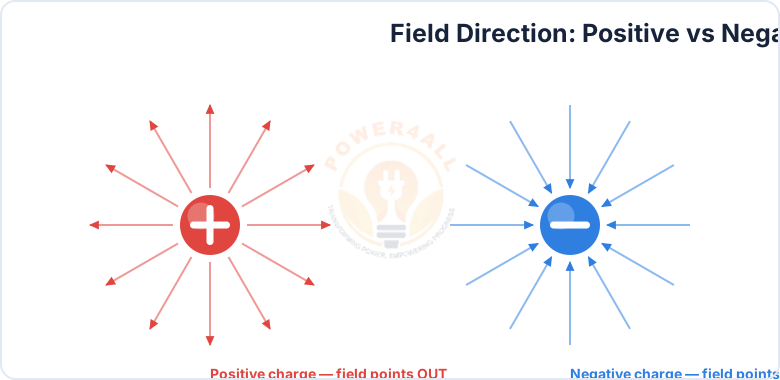
Rules for field lines
Field lines start on + and end on −; they never cross; they are denser where the field is stronger; and they meet a conductor's surface at right angles.
Field Lines & the Electric Dipole
When two opposite charges sit near each other they form an electric dipole. The field lines leave the positive charge and curve gracefully around into the negative charge — the most recognisable pattern in electrostatics.
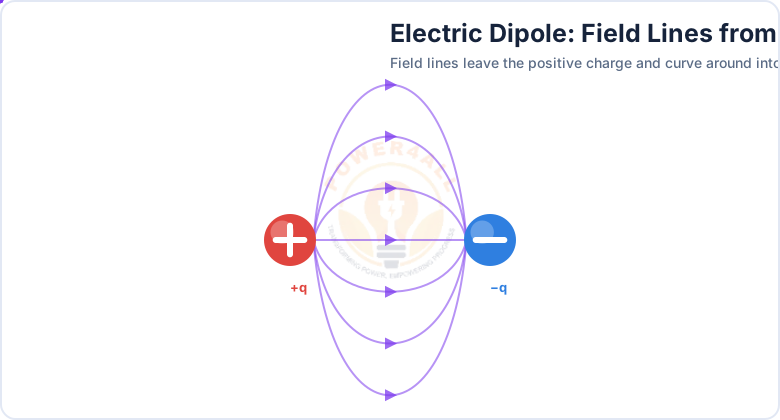
Dipoles matter far beyond the textbook: water molecules are dipoles, antennas radiate as oscillating dipoles, and dielectric materials in capacitors are full of tiny dipoles that line up with the field.
Field Strength of a Point Charge: E = kQ/r²
How strong is the field a distance r from a point charge Q? It follows an inverse-square law — the same shape as gravity. Move twice as far away and the field drops to a quarter.
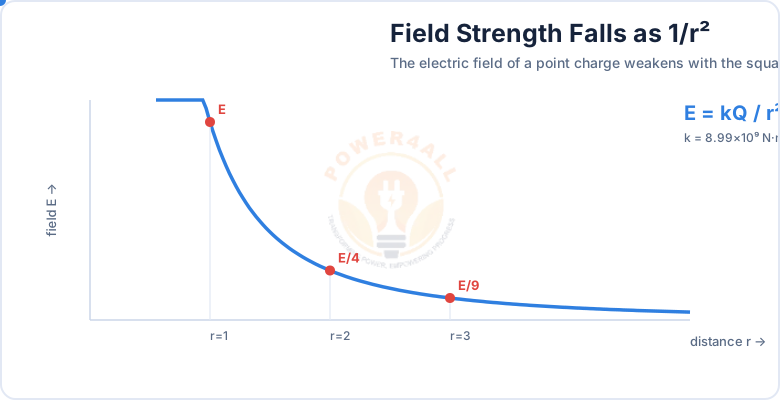
E = kQ / r² · k = 8.99×10⁹ N·m²/C²
Field of a point charge (Coulomb's constant k); r is the distance from the charge
Worked example
The field 0.1 m from a 1 µC charge:
E = kQ/r² = (8.99×10⁹ × 1×10⁻⁶) / (0.1)² ≈ 8.99×10⁵ N/C. At 0.2 m it would be a quarter of that.
Uniform Field & Capacitors: E = V/d
Between two parallel charged plates the field is uniform — the same strength and direction everywhere, drawn as straight, equally spaced lines. This is the field inside a parallel-plate capacitor.
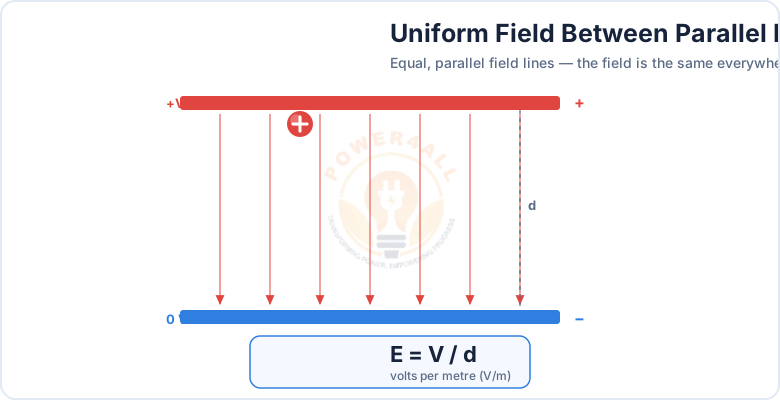
E = V / d
Uniform field between plates (V/m) — voltage V across a gap d
Worked example
Two plates 2 mm apart with 100 V across them:
E = V/d = 100 / 0.002 = 50,000 V/m — a strong, uniform field pointing from the + plate to the − plate.
Field vs Potential & Where It Matters
The electric field is closely tied to voltage (electric potential), and it is behind a huge range of technology.
| Property | Electric field (E) | Electric potential (V) |
|---|---|---|
| Quantity | Vector (has direction) | Scalar (just a number) |
| Measures | Force per charge | Energy per charge |
| Unit | N/C or V/m | Volt (V) |
| Link | Field points from high to low potential; in a uniform field E = V/d | |
Capacitors
Store energy in the electric field between their plates.
Shielding
A conductor (Faraday cage) has zero field inside, protecting electronics.
Xerography & inkjet
Photocopiers and printers steer charged toner and ink with fields.
Antennas
Oscillating charges radiate electromagnetic waves — travelling fields.
Key Terms at a Glance
The essential electric-field vocabulary students and engineers search for.
Electric field (E)
Force per unit charge; a vector in N/C.
Field lines
Show field direction; + to −.
Point charge field
E = kQ/r²; inverse square.
Uniform field
E = V/d; between plates.
Dipole
Equal + and − charges nearby.
Force on charge
F = qE.
Frequently Asked Questions
Quick, expert answers to the questions people ask most about the electric field.
What is an electric field in simple words?
It is the invisible zone around a charge where another charge feels a push or pull. Anywhere in that zone, a charge experiences a force — even though nothing is touching it. The field carries the influence of the charge out into space.
What is the formula for electric field?
The definition is E = F/q (force per unit charge). For a point charge, E = kQ/r²; for a uniform field between plates, E = V/d. The force on a charge is F = qE.
What is the unit of electric field?
Newtons per coulomb (N/C), which is identical to volts per metre (V/m). Both say how hard the field pushes on each coulomb of charge.
Which way does the electric field point?
In the direction a positive charge would be pushed. So field lines point away from positive charges and toward negative charges. They never cross and are denser where the field is stronger.
How does the electric field change with distance?
For a point charge it obeys an inverse-square law, E = kQ/r². Double the distance and the field falls to one quarter; triple it and the field falls to one ninth.
What is a uniform electric field?
One that is the same everywhere in magnitude and direction, shown by straight, evenly spaced lines. It exists between the parallel plates of a capacitor, where E = V/d.
What is the difference between electric field and voltage?
The field E is a vector (force per charge, V/m); voltage V is a scalar (energy per charge, volts). The field points from high to low potential, and in a uniform field they are linked by E = V/d.
Is there an electric field inside a conductor?
In static conditions, no — charges rearrange until the field inside a conductor is zero. That is why a metal box (a Faraday cage) shields whatever is inside it from external fields.
Conclusion & Key Takeaways
The electric field is the bridge between charges — it turns the presence of one charge into a force on another, and it is the foundation of voltage, capacitors and every electric circuit.
Region of force
Around every charge.
E = F/q
Force per unit charge (N/C).
+ out, − in
Field-line direction.
E = kQ/r²
Inverse-square for a point charge.
E = V/d
Uniform field in a capacitor.
F = qE
Force on a charge.