Q Factor & Bandwidth
The complete guide to the quality factor and bandwidth of a resonant circuit — how sharp resonance is, the half-power (−3 dB) points, and the one relationship that ties them together: Q = f₀/BW. From series and parallel RLC formulas to the energy definition and selectivity.
Complete Learning Path — Q Factor & Bandwidth
From what Q factor and bandwidth mean, to the half-power points, Q = f₀/BW, the RLC formulas, the energy definition and selectivity
What is the Q Factor?
The quality factor, or Q factor, is a dimensionless number that measures how sharp or selective the resonance of a tuned circuit is. A high Q means a tall, narrow resonance peak with very little energy loss; a low Q means a broad, flat peak.
In short, Q tells you how “good” a resonator is. A high-Q circuit rings for a long time and picks out one frequency very precisely — exactly what a radio tuner or a resonant circuit needs.
Q is a ratio — it has no unit
Because Q compares two like quantities (two frequencies, or two energies), it is a pure number. A Q of 100 is sharp; a Q of 5 is broad. Typical LC tuned circuits reach Q values of 50–200, while quartz crystals reach tens of thousands.
What is Bandwidth?
Bandwidth (BW) is the range of frequencies over which a resonant circuit responds strongly. It is the width between the two half-power frequencies f₁ and f₂, where the response falls to 0.707 of its peak — a drop of 3 dB.
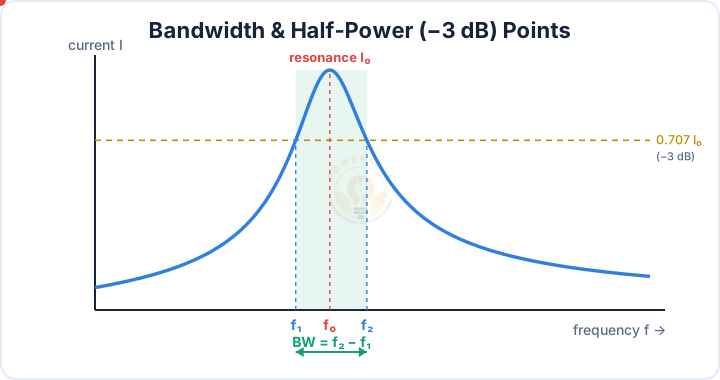
BW = f₂ − f₁
Bandwidth = upper half-power frequency − lower half-power frequency
Why 0.707 and not 0.5?
The points are “half-power”, not half-current. Since power is proportional to the square of current or voltage, half power happens where the current is 1/√2 = 0.707 of its peak. In decibels that is 10 log(½) ≈ −3 dB.
The Key Relationship: Q = f₀ / BW
This is the equation that links the two ideas. The quality factor equals the resonant frequency divided by the bandwidth.
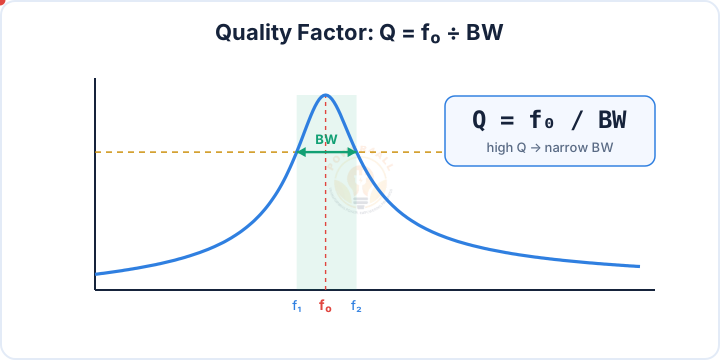
Q = f₀ / BW ↔ BW = f₀ / Q
Quality factor and bandwidth are inversely related through the resonant frequency f₀
Worked example
A tuned circuit resonates at f₀ = 1 MHz with a bandwidth of BW = 10 kHz. Its quality factor is:
Q = f₀/BW = 1 000 000 / 10 000 = 100. Raise Q to 200 and the bandwidth halves to 5 kHz — a sharper tuner.
Q Factor Formulas (Series & Parallel RLC)
Q can also be found straight from the component values. It depends on how much reactance there is compared with the resistance that wastes energy.
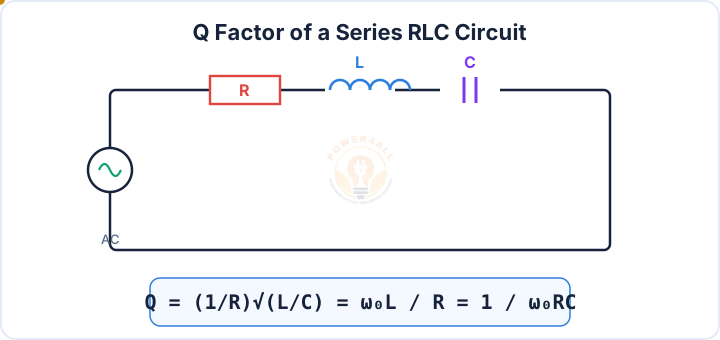
Series RLC
Q = (1/R)√(L/C)
Also Q = ω₀L/R = 1/ω₀RC. Lower R → higher Q.
Parallel RLC
Q = R√(C/L)
Also Q = R/ω₀L = ω₀RC. Here a higher R gives a higher Q.
From frequency
Q = f₀/BW
Measured straight from the resonance curve — no component values needed.
Series vs parallel — R flips
In a series circuit resistance is in the current path, so less R means a higher Q. In a parallel (tank) circuit the resistance is across the tank, so more R means a higher Q. Both share Q = f₀/BW.
Q as an Energy Ratio
The most fundamental definition of Q has nothing to do with frequency — it compares energy stored with energy lost.
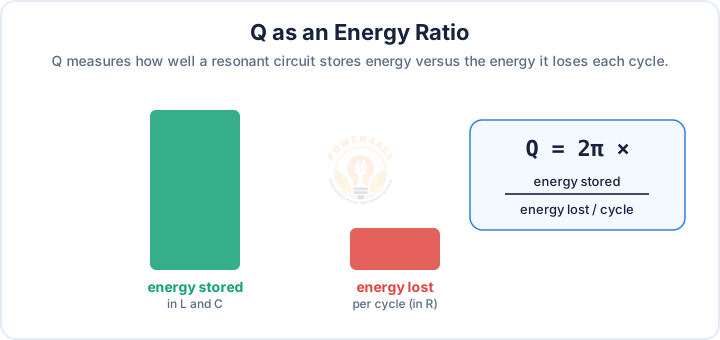
Q = 2π × (energy stored) / (energy lost per cycle)
The universal definition — works for any resonant system, electrical or mechanical
This is why a low-loss (low-resistance) circuit has a high Q: it barely leaks energy, so it rings for many cycles and responds sharply. A bell with a high mechanical Q rings for a long time; one with a low Q gives a dull thud.
High Q vs Low Q — Selectivity
Selectivity is the ability to single out one frequency and reject its neighbours. A high Q gives high selectivity because the bandwidth is narrow.
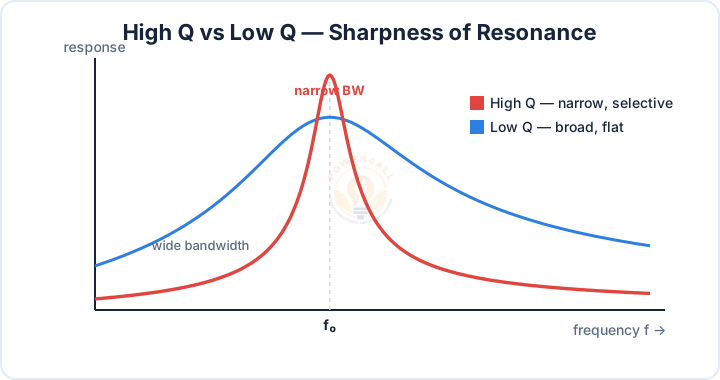
High Q
Narrow bandwidth, sharp peak, low loss, long ring-down. Great for tuning and precise filters — but too narrow can cut wanted signal.
Low Q
Wide bandwidth, broad peak, higher loss. Good where you need to pass a band of frequencies rather than a single one.
Where Q & Bandwidth Matter
Q factor and bandwidth decide the performance of almost every tuned or filtered system.
Radio & TV tuning
A high-Q tuned circuit selects one station and rejects the rest — narrow bandwidth = clean reception.
Filters
Band-pass and band-stop filters are specified by their centre frequency and bandwidth, i.e. their Q.
Oscillators
A high-Q resonator (e.g. a quartz crystal) gives a stable, low-noise, precise oscillation frequency.
Power & wireless
Resonant converters and wireless-charging coils rely on Q for efficient energy transfer.
Key Terms at a Glance
The essential Q-factor and bandwidth vocabulary students and engineers search for.
Q factor
Sharpness of resonance; Q = f₀/BW, dimensionless.
Bandwidth (BW)
f₂ − f₁, width between half-power points.
Half-power points
f₁, f₂ at 0.707 of peak (−3 dB).
Resonant freq. f₀
Peak of the response curve.
Selectivity
Ability to pick one frequency; rises with Q.
Energy definition
Q = 2π × stored / lost-per-cycle.
Frequently Asked Questions
Quick, expert answers to the questions people ask most about Q factor and bandwidth.
What is the Q factor in simple words?
The Q factor (quality factor) tells you how sharp a circuit’s resonance is. High Q = a tall, narrow peak that picks out one frequency very precisely and loses little energy; low Q = a broad, flat peak. It is a pure number, Q = f₀/BW.
What is bandwidth in a resonant circuit?
Bandwidth is the band of frequencies where the circuit responds strongly — the width between the half-power points f₁ and f₂, where the response drops to 0.707 of the peak. So BW = f₂ − f₁.
How are Q factor and bandwidth related?
They are inversely related through the resonant frequency: Q = f₀/BW, i.e. BW = f₀/Q. Higher Q means narrower bandwidth and a sharper response.
Why are the cutoff points at 0.707 (−3 dB)?
They mark half power. Power depends on the square of current or voltage, so half power occurs where the current is 1/√2 = 0.707 of its peak. In decibels that is about −3 dB.
What is the Q factor formula for a series RLC circuit?
Q = (1/R)√(L/C), which also equals ω₀L/R and 1/ω₀RC. A smaller series resistance gives a higher Q. For a parallel tank it is Q = R√(C/L).
Why does higher Q give a narrower bandwidth?
A high-Q circuit stores far more energy than it loses each cycle, so it responds strongly only very close to resonance and drops off fast on either side. That tall, narrow peak is a small bandwidth, exactly as BW = f₀/Q.
Is Q factor the same as selectivity?
They go hand in hand. Selectivity is how well a circuit picks one frequency and rejects nearby ones; a high Q gives a narrow bandwidth and therefore high selectivity. Radio tuners and filters aim for high Q.
What is the energy definition of Q?
Q = 2π × (energy stored) / (energy dissipated per cycle). This works for any resonant system — a bell, a pendulum or an LC circuit — and shows Q as a measure of how lossless the resonance is.
Conclusion & Key Takeaways
Q factor and bandwidth are two sides of one coin: how sharp a resonance is, and how wide. One equation ties them: Q = f₀/BW.
Q = sharpness
Dimensionless quality factor.
BW = f₂ − f₁
Between the half-power points.
Q = f₀/BW
High Q → narrow BW.
0.707 = −3 dB
Half-power cutoff level.
Q = (1/R)√(L/C)
From the components (series).
Energy ratio
Q = 2π stored / lost-per-cycle.