What is Potential Difference?
The complete guide to potential difference (PD) — the difference in electric potential between two points and the driving force behind every current. From the definition V = W/Q and the volt, to electric potential, PD vs EMF and terminal voltage, and how a voltmeter measures it.
Complete Learning Path — Potential Difference
From two-point potentials and V = W/Q, to the reference point, PD vs EMF, measurement and the water analogy
What is Potential Difference?
Potential difference (PD) is the difference in electric potential between two points. It measures the energy given to (or taken from) each unit of charge as it moves from one point to the other — and it is the driving force that pushes current around a circuit.
The key word is difference: PD always involves two points. Point A might sit at 12 volts and point B at 4 volts; the potential difference between them is 12 − 4 = 8 V. That 8 V is what a voltmeter placed across them would read.
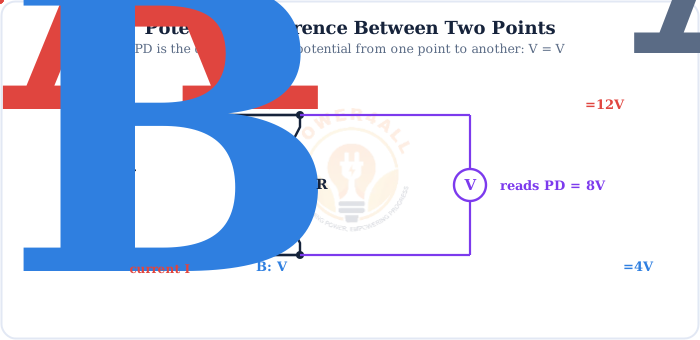
The one-line idea
Potential difference is the energy per coulomb transferred between two points — the electrical “push” that makes charge move.
Potential Difference = Work per Charge
Formally, the potential difference between two points is the work done per unit charge in moving charge between them. This is the definition that fixes the size of the volt.
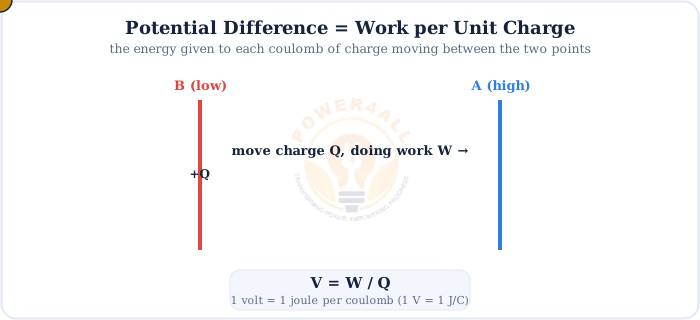
V = W / Q
Potential difference = work (energy) transferred ÷ charge moved — the volt is 1 joule per coulomb
Worked example
Moving Q = 2 C of charge between two points transfers W = 24 J of energy.
The potential difference is V = W/Q = 24/2 = 12 V.
Why "1 volt = 1 joule per coulomb"
A 12 V battery gives 12 joules of energy to every coulomb of charge it pushes out. Bigger PD means more energy delivered per charge — and more power for a given current.
Electric Potential & the Reference Point
To give a single point a potential, you first pick a reference and call it 0 V (usually ground, or the battery's − terminal). Every other point's potential is then measured from that zero.
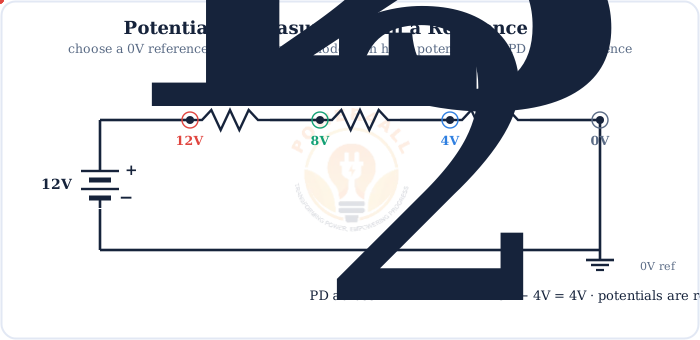
Potentials are relative — differences are real
Change the reference and every node potential shifts, but the differences stay the same. That is why circuits are driven by potential differences, not by absolute potentials.
Potential Difference Drives the Current
A potential difference is to charge what a height difference is to water. No difference, no flow. The classic water analogy makes it intuitive.
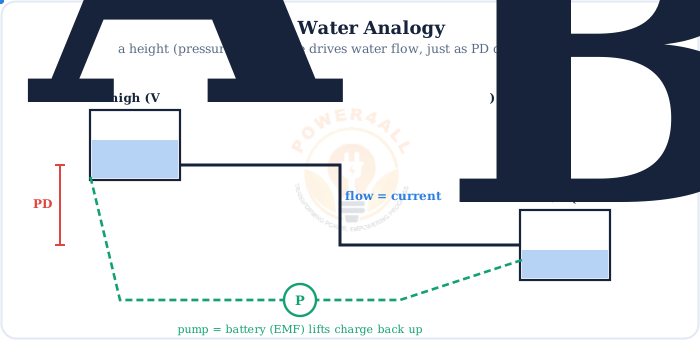
In a resistor, that driving PD and the resulting current are tied together by Ohm's law: the bigger the potential difference across a resistor, the bigger the current through it.
V = I × R
The PD across a resistor equals current × resistance
Potential Difference vs EMF
A source's EMF is the total energy it gives each coulomb; the terminal potential difference is what actually appears across its terminals once current flows. They differ because of the source's internal resistance.
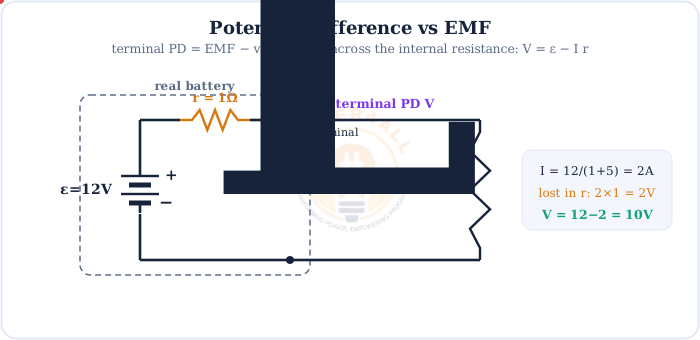
Vterminal = ε − I × r
Terminal PD = EMF (ε) minus the drop across the internal resistance r
EMF is a "no-current" measurement
With no load (no current), I = 0 so the terminal PD equals the EMF. The more current you draw, the more the internal drop Ir pulls the terminal voltage down. A weak, old battery has a high internal resistance and its terminal PD sags badly under load.
Measuring Potential Difference
Because PD is between two points, you measure it with a voltmeter connected across those points — in parallel with the component, never in series.
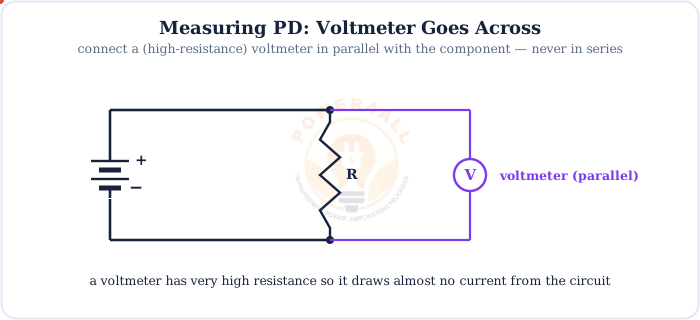
Voltmeter across, ammeter in line
A voltmeter goes in parallel (it measures a difference between two points). An ammeter goes in series (the current must pass through it). Swapping them is a classic lab mistake.
Is Potential Difference the Same as Voltage?
In everyday use, yes — both are measured in volts and people use the words interchangeably. There is just a subtle emphasis worth knowing.
| Term | Emphasis | Needs |
|---|---|---|
| Electric potential | Energy per charge at one point (vs a reference) | One point + a 0 V reference |
| Potential difference | The difference between two points' potentials | Two points |
| Voltage | General everyday word for either | — |
| EMF (ε) | Energy per charge supplied by a source (no load) | A source |
Rule of thumb
Say “potential difference” when you mean the voltage across something between two points, and “potential” when you mean the value at a single node relative to ground.
Key Formulas at a Glance
Everything you need to work with potential difference in one place.
| Quantity | Formula | Notes |
|---|---|---|
| Definition | V = W / Q | Work per unit charge (1 V = 1 J/C) |
| Ohm's law | V = I × R | PD across a resistor |
| Terminal PD | V = ε − I r | EMF minus internal drop |
| From potentials | V = VA − VB | Difference of two node potentials |
| Power | P = V × I | Energy per second delivered |
Key Terms at a Glance
The essential potential-difference vocabulary students and engineers search for.
Potential difference
Voltage between two points.
Electric potential
Energy per charge at one point.
Volt (V)
1 joule per coulomb.
EMF (ε)
Energy per charge from a source.
Terminal voltage
ε − I r under load.
Reference (ground)
The chosen 0 V point.
Frequently Asked Questions
Quick, expert answers to the questions people ask most about potential difference.
What is potential difference?
Potential difference is the difference in electric potential between two points in a circuit. It equals the work done, or energy transferred, per unit charge moving between those points, and it is what drives current through a component. It is measured in volts.
What is the formula for potential difference?
The defining formula is V = W/Q, the work done per unit charge. In a resistive circuit it is also given by Ohm's law, V = I × R, the current multiplied by the resistance.
What is the unit of potential difference?
The unit is the volt (V). One volt is one joule per coulomb, meaning one joule of energy is transferred for every coulomb of charge that moves through the potential difference.
Is potential difference the same as voltage?
In everyday use they are treated as the same thing, and both are measured in volts. Strictly, potential difference is the voltage between two specific points, while voltage is the general term. A single point can have a potential, but a potential difference always needs two points.
What is the difference between potential difference and EMF?
EMF is the total energy a source gives each coulomb of charge, measured with no current flowing. Potential difference is the voltage actually available across the terminals when current flows. Because some voltage is lost across the source's internal resistance, the terminal PD is V = ε − I r, which is less than the EMF.
What is electric potential?
Electric potential is the potential energy per unit charge at a single point, measured relative to a chosen zero reference (often the ground or the battery's negative terminal). Potential difference is simply the difference between the potentials at two points.
How is potential difference measured?
With a voltmeter connected in parallel, across the two points or the component you want to measure. A voltmeter has a very high resistance so it draws almost no current and does not disturb the circuit.
Can current flow without a potential difference?
No. A potential difference is the driving force for current. With no potential difference across a component there is nothing to push the charge, so no current flows through it — just as water will not flow between two points at the same height.
Why is a voltmeter connected in parallel?
Because potential difference is measured between two points, the meter must connect to both points at once, which means across the component — in parallel. Its high resistance ensures it samples the voltage without drawing significant current.
What is the potential difference across a battery's terminals?
It is the terminal voltage, V = ε − I r. With no load it equals the EMF, but as current is drawn, the drop across the internal resistance r lowers it. For example, a 12 V EMF battery with 1 Ω internal resistance supplying 2 A gives a terminal potential difference of 10 V.
Conclusion & Key Takeaways
Potential difference is the electrical "push" between two points — the energy per charge that makes current flow.
Two points
PD is always a difference.
V = W/Q
Work per unit charge.
1 V = 1 J/C
The volt defined.
Drives current
No PD, no flow.
PD < EMF
V = ε − Ir under load.
Voltmeter across
Measured in parallel.