What is Ripple & Ripple Factor?
The complete guide to ripple — the leftover AC riding on a rectifier’s DC output — and the ripple factor γ = Vr(rms)/Vdc = √(FF² − 1) that measures it: why half-wave gives 1.21 and full-wave 0.48, how a smoothing capacitor tames it, and how to reduce and measure it.
Complete Learning Path — Ripple & Ripple Factor
From what ripple is and the ripple factor formula, to half-wave vs full-wave values, capacitor smoothing, reducing ripple, why it matters and how to measure it
What is Ripple?
Ripple is the small, leftover AC variation that rides on the DC output of a rectifier or power supply. Real DC is never perfectly flat — a periodic wobble sits on top of the steady level.
When AC is rectified, the output is a train of humps, not a flat line. Even after a smoothing filter, some of that variation survives. That residual AC is the ripple voltage Vr, and the steady part it rides on is the DC value Vdc — the average value of the output.
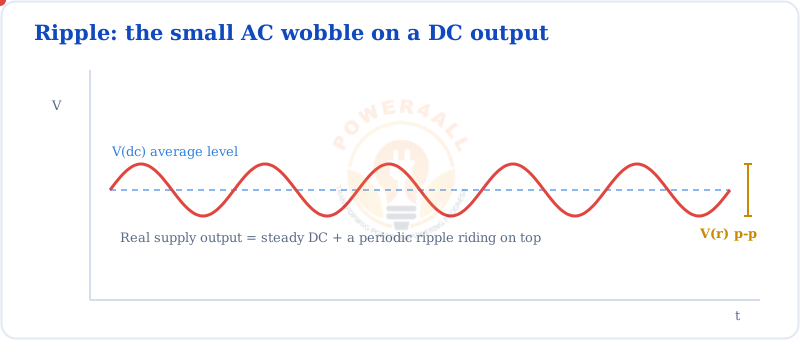
Ripple = the AC that survived rectifying & filtering
A perfect DC supply would have zero ripple. In practice we design the filter so the ripple is small enough for the load — the goal is a low ripple factor, not zero.
Ripple Factor & Its Formula
The ripple factor γ is the ratio of the rms value of the AC ripple to the DC value. Split the output into a DC part plus a pure ripple part, and γ compares the two.
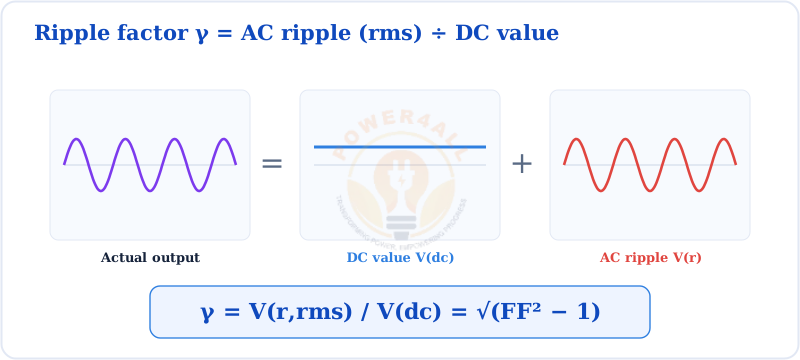
γ = Vr(rms) / Vdc = √(FF² − 1)
Ripple factor — rms ripple over DC value; also from the form factor FF = Vrms/Vdc
The second form drops out of the fact that the total rms squared equals the DC squared plus the ripple rms squared: Vrms² = Vdc² + Vr(rms)². Divide through by Vdc² and you get γ = √(FF² − 1). Percentage ripple is just γ × 100%.
Worked example — ripple factor from measurements
A supply reads Vdc = 12 V on a DC meter and Vr(rms) = 0.30 V of AC ripple on an AC meter. The ripple factor is:
γ = 0.30 / 12 = 0.025 = 2.5% ripple
That is a fairly clean supply — well below the 48% of an unfiltered full-wave rectifier.
Rule of thumb
Smaller γ → smoother DC. An ideal battery has γ = 0; a raw rectifier can be over 1; a good regulated supply is a tiny fraction of a percent.
Half-wave vs Full-wave Ripple
The type of rectifier sets the starting ripple. A half-wave rectifier throws away half of every cycle, so it ripples badly; a full-wave or bridge rectifier fills both halves and doubles the ripple frequency.
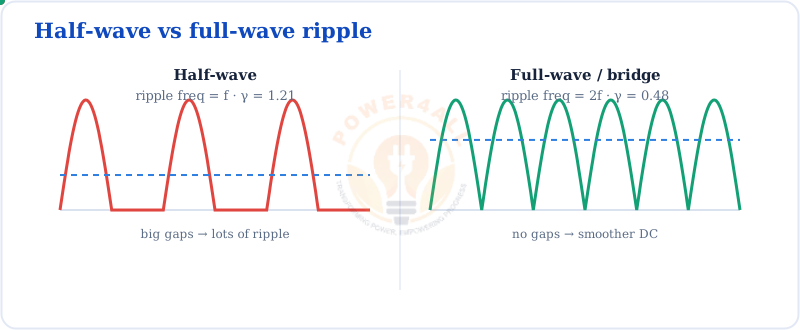
| Rectifier (no filter) | Ripple factor γ | % Ripple | Ripple frequency | Vdc |
|---|---|---|---|---|
| Half-wave | 1.21 | 121% | f (50 / 60 Hz) | 0.318 Vm |
| Full-wave (centre-tap) | 0.48 | 48% | 2f (100 / 120 Hz) | 0.637 Vm |
| Bridge | 0.48 | 48% | 2f (100 / 120 Hz) | 0.637 Vm |
Why full-wave wins twice
Full-wave rectification cuts the ripple factor from 1.21 to 0.48 and doubles the ripple frequency. Both help the filter: a higher frequency and smaller gaps mean a given capacitor smooths the output much better.
Smoothing with a Capacitor
A reservoir capacitor across the output is the classic ripple-buster. It charges to each rectified peak, then feeds the load while the rectifier voltage falls — turning the humps into a small sawtooth ripple.
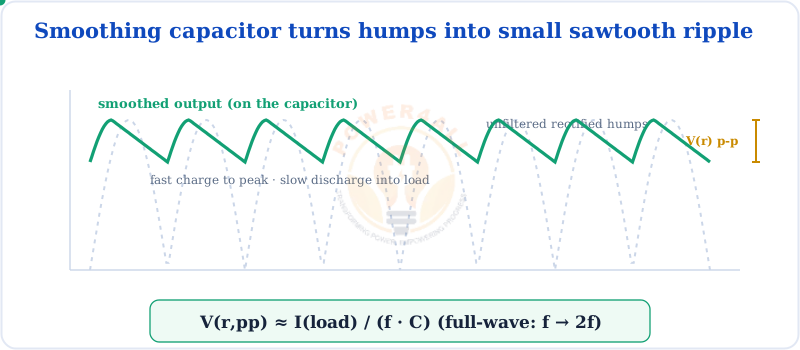
Vr(pp) ≈ Iload / (f · C)
Peak-to-peak ripple from a reservoir capacitor — use f = 2 × line frequency for full-wave
Because a sawtooth has an rms of about Vr(pp)/(2√3), the ripple factor of a capacitor-filtered full-wave supply works out to γ = 1 / (2√3 · f · Rload · C). Bigger C, bigger load resistance (lighter load), or higher f all shrink it.
Worked example — sizing a reservoir capacitor
A full-wave supply on 50 Hz mains (ripple at f = 100 Hz) delivers Iload = 0.5 A and we want Vr(pp) = 1 V:
C = I / (f · Vr(pp)) = 0.5 / (100 × 1) = 5000 µF
Try the Output Capacitor Ripple Calculator to size one for your own load.
Reducing the Ripple Factor
Once a capacitor has done the coarse work, several techniques push the ripple factor lower still — from a bigger reservoir to a full regulator.
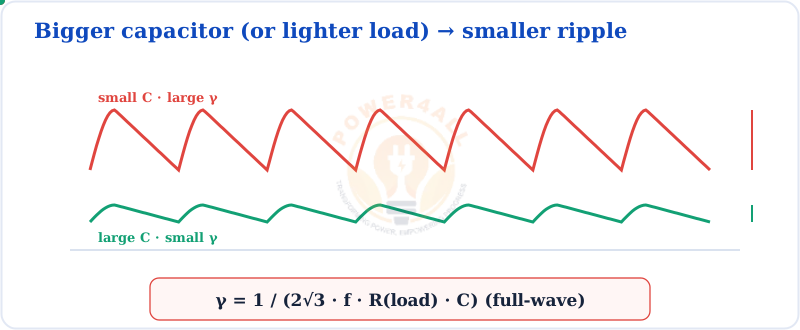
Bigger capacitor
Ripple is inversely proportional to C. Doubling the reservoir roughly halves the ripple — the cheapest first step.
Full-wave instead of half
Switching to a bridge cuts γ from 1.21 to 0.48 and doubles the ripple frequency, so the same capacitor works twice as hard.
LC or π filter
Adding an inductor (choke) or a second capacitor forms an LC or π-filter that attenuates the ripple much further.
Voltage regulator
A linear or switching regulator has a high ripple rejection and can cut the remaining ripple by hundreds or thousands of times.
Ripple rejection ratio
A regulator’s ripple rejection (often 60–80 dB) says how much it suppresses input ripple. That is why almost every clean DC supply ends with a regulator stage.
Why Ripple Matters
Ripple is not just cosmetic — it shows up as real noise, flicker and heat, and every sensitive circuit sets a limit on how much it can tolerate.
Hum in audio
Ripple at 50/100 Hz leaks into amplifiers as an audible mains hum — a classic sign of a tired reservoir capacitor.
Noise on signals
Ripple on the rail adds noise to sensor, ADC and radio circuits, degrading accuracy and dynamic range.
Capacitor heating
The ripple current flowing in and out of the reservoir capacitor heats it up; exceeding its rating shortens its life.
Ripple current is a real rating
Electrolytic capacitors are rated for a maximum ripple current, not just voltage. In switching supplies this often decides the capacitor choice — see the Inductor Ripple Current Calculator.
Measuring Ripple
Ripple is measured as the AC riding on the DC, so you separate the two: read the DC level and the AC ripple, then take the ratio.
Oscilloscope (AC coupled)
AC-couple the scope to block the DC and magnify the ripple, then read its peak-to-peak or rms directly.
DMM: DC then AC
Read Vdc in DC mode and Vr(rms) in AC mode; γ = Vr(rms) / Vdc.
Ripple calculator
Predict it from the design with the Ripple & Form Factor Calculator.
Watch the coupling & bandwidth
Measure ripple AC-coupled and note the bandwidth — high-frequency switching spikes can dwarf the low-frequency sawtooth, and a wide-band reading looks worse than a filtered one.
Key Terms at a Glance
The essential ripple vocabulary students and engineers search for.
Ripple voltage (Vr)
The residual AC on the DC output.
Ripple factor (γ)
Vr(rms) / Vdc = √(FF² − 1).
Percentage ripple
γ × 100%.
Ripple frequency
f for half-wave, 2f for full-wave.
Reservoir capacitor
Charges to the peak, feeds the load between peaks.
Ripple current
The AC current heating the smoothing capacitor.
Frequently Asked Questions
Quick, expert answers to the questions people ask most about ripple and ripple factor.
What is ripple in a power supply?
Ripple is the small residual AC variation that remains on the DC output of a rectifier or power supply after filtering. Instead of a perfectly flat line, the output has a periodic wobble made of the rectifier’s output frequency and its harmonics.
What is ripple factor?
The ripple factor is the ratio of the rms of the AC ripple to the DC value of the output: γ = Vr(rms) / Vdc. It tells you how much AC is left on the DC — a smaller ripple factor means smoother, cleaner DC.
What is the formula for ripple factor?
It is γ = Vr(rms) / Vdc, which can also be written γ = √(FF² − 1) using the form factor FF = Vrms/Vdc, because the total rms squared equals the DC squared plus the ripple rms squared.
What is the ripple factor of a half-wave and full-wave rectifier?
Without a filter, a half-wave rectifier has a ripple factor of about 1.21 (121%) and a full-wave or bridge rectifier about 0.48 (48%). Full-wave is far lower because there are no gaps and the ripple frequency is doubled.
What is the ripple frequency?
For a half-wave rectifier it equals the line frequency (50 or 60 Hz). For a full-wave or bridge rectifier it is twice the line frequency (100 or 120 Hz), because both halves of every cycle produce an output hump.
How does a capacitor reduce ripple?
A reservoir capacitor charges to each rectified peak, then supplies the load as the rectifier voltage falls, so the output only sags a little before the next peak recharges it. This gives a small sawtooth ripple of roughly Vr(pp) = Iload / (f × C).
How do you reduce ripple further?
Use a larger capacitor, a full-wave instead of a half-wave rectifier, an LC or π filter, or a voltage regulator. A regulator has a high ripple rejection and can cut the remaining ripple by a factor of hundreds or thousands.
What is percentage ripple?
Percentage ripple is the ripple factor as a percentage: %ripple = γ × 100. An unfiltered full-wave rectifier at γ = 0.48 has 48% ripple; a well-filtered, regulated supply can be well under 1%.
Conclusion & Key Takeaways
Ripple is the AC that survives rectifying and filtering; the ripple factor γ = Vr(rms)/Vdc measures it. Full-wave rectification and a good smoothing capacitor bring it down, and a regulator finishes the job.
Ripple = leftover AC
A wobble on the DC output.
γ = Vr(rms)/Vdc
Also √(FF²−1).
Half 1.21, full 0.48
Full-wave also doubles f.
Capacitor smooths
Vr(pp) = I/(fC).
Lower = better
Bigger C, LC/π, regulator.
It matters
Hum, noise, capacitor heat.